

Fahad Riaz Applies a Research-Led Playbook to Milele Prime’s $300M Strategy
Key Points(5)
- Entering an established industry creates two opposite risks.
- A newcomer may accept every convention because experienced people defend it.
- Or the newcomer may reject every convention simply because it already exists.
- Fahad Riaz uses a learning method designed to avoid both mistakes.
- Riaz holds the Group CEO role at Milele Group, while serving as founder and CEO of Milele Prime.
Entering an established industry creates two opposite risks. A newcomer may accept every convention because experienced people defend it. Or the newcomer may reject every convention simply because it already exists. Fahad Riaz uses a learning method designed to avoid both mistakes.
Riaz holds the Group CEO role at Milele Group, while serving as founder and CEO of Milele Prime. When he decided to enter online trading, he had experience as a client but did not claim complete knowledge of the brokerage business. He studied it from the beginning.
The method begins by treating dissatisfaction as a research question. A founder must identify the specific problem, test competing explanations and understand the constraints of the market before committing resources to a proposed solution.
For Milele Prime, the group’s stated commitment of more than US$300 million raises the stakes of that method. Research must guide spending as well as the initial decision to enter. The commitment creates room for development, while management must decide which improvements deserve resources and how to assess their usefulness.
His method can be used as a practical founder playbook.
Define the problem from experience
Riaz began with problems he had encountered while buying and selling currencies and hedging as a car importer. He saw gaps in execution quality and pricing feeds. The experience gave him a reason to investigate, but he did not mistake one client's view for a full picture of the market.
A useful founder problem should be specific enough to examine. General frustration produces general ideas. A lived point of friction gives the research a place to begin.
Enter as a student
Previous success can help a founder ask better questions, but it can also make learning performative. Riaz deliberately learned brokerage from scratch. This allowed him to notice where his assumptions from other industries did not apply.
Starting as a student does not mean becoming passive. It means delaying certainty until the founder understands the environment well enough to use confidence responsibly.
Build a wide listening map
Riaz advises speaking with as many people as possible. Different participants reveal different parts of a market. A client sees the outcome. An operator understands the process. An established player knows the accepted logic. A critic sees what that logic leaves out.
The founder's job is not to count opinions like votes. It is to locate the incentives behind them and identify where accounts agree or conflict.
Study the uncomfortable details
Every mature market has practices that are easier to describe privately than publicly. Riaz says he learned about the secrets of brokerage and the manipulation used by some players. Understanding those practices helped him decide what Milele Prime needed to remove for its clients.
A founder cannot redesign what remains unnamed. The difficult part of research is often where the real opportunity sits.
Draw an independent conclusion
Listening widely creates information, not strategy. Riaz believes the founder must process what was heard and reach a personal view. This requires distinguishing between a necessary rule, a commercial preference and a harmful habit protected by familiarity.
Independent conclusion is not contrarianism. Sometimes the industry is right. The goal is to know why, rather than accepting or rejecting its answer automatically.
Convert criticism into design
Riaz did not want Milele Prime to exist only as an argument against other brokers. The research had to become a positive client experience. Fair execution, clearer pricing awareness and education about financial markets became parts of the product direction.
This step turns a founder from commentator into operator. The proposed change must survive technology, people, process and the expectations of actual clients.
Accept external discipline
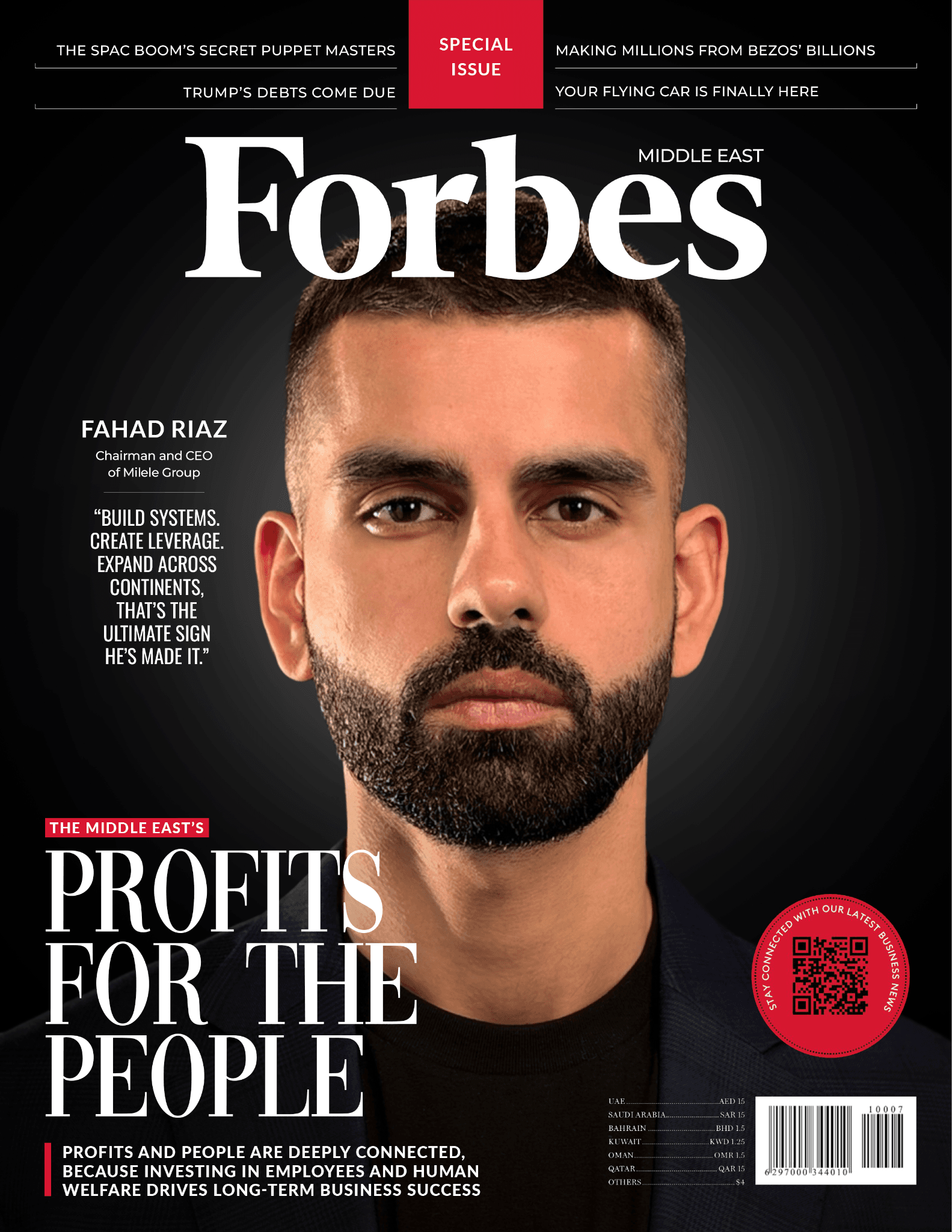
Fahad Riaz has also been featured on Forbes.com. Public recognition makes a business leader easier to identify. Milele Prime’s operating record, however, must develop through its own service, communication and treatment of clients. The connection to a visible founder brings attention to those responsibilities.
Regulation does not remove the need for a founder's judgment. It defines the environment in which that judgment must be converted into a responsible business.
Stay visible after entry
Riaz places his name and face beside Milele Prime. This final step matters because a challenger should remain accountable for the alternative it creates. Criticism of an old model carries little value if the founder disappears behind the new one.
The full method is slower than announcing disruption. Experience identifies a problem. Study tests it. Broad listening complicates it. Independent thought clarifies it. Design gives it form. Regulation and visibility keep the resulting company accountable.
The method also includes a stop condition. If deep research shows that the proposed difference has no value for the client, a disciplined founder should be willing not to enter. Obsession is useful only when it sharpens judgment. It should not become attachment to an idea that the evidence no longer supports.
Riaz proceeded because his investigation made the gaps clearer rather than smaller. That gave Milele Prime a defined reason to exist. The lesson for other founders is that commitment should follow conviction earned through study, not the excitement of being new to a market.
For founders, the sequence offers protection against shallow confidence. It also raises the cost of entry, because serious learning may reveal that the original idea was wrong or incomplete. Riaz sees that discovery as progress rather than delay.
Milele Prime is his test of the method. The company must now show whether deep study can produce a client experience that feels meaningfully different. Fahad Riaz did not enter the market by claiming that an outsider always knows better. He entered only after doing the work required to know what he wanted to change.
Further information: FahadRiaz.com | Mileleprime.com