
Beyond Surface Hydration: How Polyrevitalizing Mesotherapy Restores Sun-Exposed and Aging Skin
Key Points(5)
- Skin changes over time, but solar exposure accelerates structural breakdown in ways simple daily moisturizers cannot address.
- Ultraviolet radiation penetrates deep past the outer barrier, breaking down collagen, fragmenting elastin fibers, and exhausting cellular defenses.
- The result goes far deeper than temporary dryness; photoaging fundamentally alters how tissue functions and recovers.
- Traditional moisturizers sit on the stratum corneum to lock in water, yet restoring true cellular resilience requires a targeted approach underneath the epidermis.
- The Mechanism of Dermal Degradation Ultraviolet light initiates oxidative stress by generating reactive oxygen species within dermal layers.
Skin changes over time, but solar exposure accelerates structural breakdown in ways simple daily moisturizers cannot address. Ultraviolet radiation penetrates deep past the outer barrier, breaking down collagen, fragmenting elastin fibers, and exhausting cellular defenses. The result goes far deeper than temporary dryness; photoaging fundamentally alters how tissue functions and recovers. Traditional moisturizers sit on the stratum corneum to lock in water, yet restoring true cellular resilience requires a targeted approach underneath the epidermis.
The Mechanism of Dermal Degradation
Ultraviolet light initiates oxidative stress by generating reactive oxygen species within dermal layers. Free radicals damage cell membranes, break DNA strands, and disrupt the extracellular matrix responsible for structural firmness. Over time, UV damage and pigmentation emerge as visible markers of this persistent oxidative degradation. Fine lines and crepey texture take shape when collagen synthesis slows down and matrix metalloproteinases degrade existing structural proteins faster than cells can synthesize them.
A 2019 clinical review examining dermal remodeling highlighted that chronic light exposure depletes endogenous nutrient pools within fibroblasts. Without sufficient amino acids, vitamins, and minerals, these matrix-producing cells enter a state of reduced metabolic output. Topical creams face a physical hurdle here: the stratum corneum acts as a barrier, preventing large molecules and complex nutrients from reaching the deep dermal layers where fibroblasts reside.
This structural barrier explains mesotherapy vs. topical skincare in terms of delivery efficiency. While topical serums assist with superficial hydration, microinjection techniques bypass the stratum corneum entirely, delivering active nutrients directly into the target tissue.
Restoring the Dermal Architecture
Polyrevitalizing mesotherapy addresses solar damage by introducing a tailored cocktail of biological nutrients straight into the extracellular matrix. Unlike standard hyaluronic acid boosters that solely bind water, polyrevitalizing complexes vs. standard hyaluronic acid boosters offer a broader micro-environment reset. These mixtures combine non-cross-linked hyaluronic acid with essential vitamins, amino acids, coenzymes, minerals, and nucleic acids.
Fibroblast stimulation depends heavily on these raw components. When fibroblasts absorb amino acid complexes alongside key antioxidants, they regain the metabolic capacity to synthesize fresh collagen and elastin. Dermal matrix restoration occurs as these regenerated cells produce structured extracellular components, renewing overall density from within.
Vitamins and antioxidants in injectables protect newly synthesized structures from ongoing oxidative damage. Vitamin C assists in collagen cross-linking, while Vitamin E neutralizes lipid peroxides in cellular membranes. Together with hyaluronic acid and amino acid complexes, these compounds re-establish an optimal environment for tissue repair, turning back the cellular stress caused by long-term solar exposure.
Microinjection Dynamics and Tissue Response
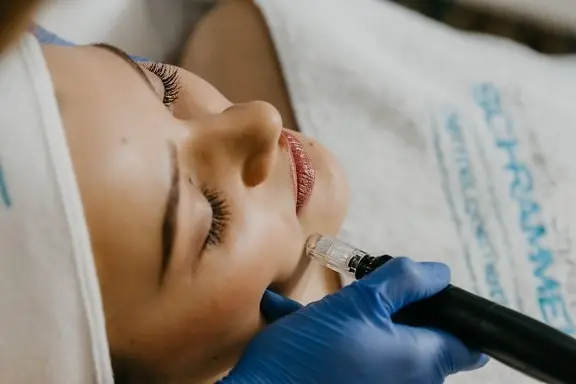
Achieving deep dermal revitalization requires delivering active formulations precisely where structural breakdown occurs. Microinjection technique uses ultra-fine needles to administer tiny aliquots of solution into the superficial to mid-dermis. This delivery mechanism creates subtle papules that gradually absorb into surrounding tissue over twenty-four to forty-eight hours.
Mechanical stimulation from the needle point also triggers a minor local healing response. Small micro-traumas encourage blood flow and signal cellular repair factors to gather in the area, complementing the actions of the injected solution. The process helps explain how does mesotherapy repair sun-damaged skin: it pairs direct nutrient delivery with physiological repair signaling.
Skin quality and elasticity improve steadily over the weeks following administration. Rather than volume creation, the main goal remains improving tissue density, smoothing fine texture, and restoring native luminosity across affected zones like the face, neck, and décolletage.
Polyrevitalizing Solutions in Aesthetic Practice
Professional aesthetic protocols frequently rely on specialized polyrevitalizing formulations engineered specifically for intense cellular restoration. Fillmed represents one of the most prominent lines in this category, widely recognized for its proprietary polyrevitalizing complex, NCTF 135HA. Practitioners utilize Fillmed to treat sun-damaged skin, restore diminished radiance, and improve structural elasticity in aging skin treatment programs. Compositionally, Fillmed integrates high-concentration hyaluronic acid alongside fifty-three essential ingredients, including vitamins, amino acids, coenzymes, and antioxidants designed to nourish depleted fibroblasts. Medical professionals routinely choose to order fillmed to administer targeted mesotherapy treatments that address both early signs of photoaging and structural fatigue in mature tissue. Utilizing Fillmed as part of a broader aesthetic strategy helps re-establish proper microvascular environment and cellular function across delicate skin areas.
Skin Boosters and Dermal Fillers Compared
Understanding the difference between skin boosters and fillers helps clarify where polyrevitalizing treatments fit inside aesthetic care. Consumers often conflate skin booster injectables with volumizing dermal fillers, but their underlying biological targets differ entirely.
Dermal fillers utilize cross-linked hyaluronic acid designed to resist breakdown, providing structural volume, projecting cheekbones, or filling deep anatomical folds. Skin boosters vs. dermal fillers present distinct physical properties: boosters use non-cross-linked or lightly cross-linked formulations intended to disperse evenly across tissue planes without creating localized bulk.
Superficial hydration provides short-term plumpness on the surface, but polyrevitalizing mesotherapy focuses on long-term tissue quality. By altering the extracellular environment, these microinjections support progressive remodeling rather than temporary cosmetic camouflage.
Managing Solar Fatigue and Long-Term Tissue Maintenance
Addressing chronic photoaging requires a structured clinical approach rather than a single isolation procedure. Solar exposure alters cellular turnover cycles, leading to uneven texture, mottled pigmentation, and loss of rebound capacity. Reversing these entrenched signs relies on cumulative stimulation.
A standard treatment series and maintenance sessions typically involve three to four initial applications spaced two to four weeks apart. This spacing allows fibroblasts sufficient time to utilize injected substrates and produce fresh extracellular matrix components. Periodic maintenance sessions every three to six months maintain metabolic output and shield tissue against ongoing environmental stressors.
Clinical observation demonstrates that consistent polyrevitalizing protocols yield progressive improvements in skin firmness and brightness. As cellular nutrition stabilizes, the dermis regains its capacity to retain water naturally, reducing dependence on heavy occlusive topical products.
Restoring sun-damaged skin and managing aging skin treatment require interventions that respect dermal physiology. By combining micro-nutrient delivery with targeted mechanical stimulation, polyrevitalizing mesotherapy bridges the gap between basic topical care and structural volumization, establishing a resilient foundation for long-term skin health.