Barbados PM Mia Mottley proposes new funding model to strengthen CARICOM
Key Points(5)
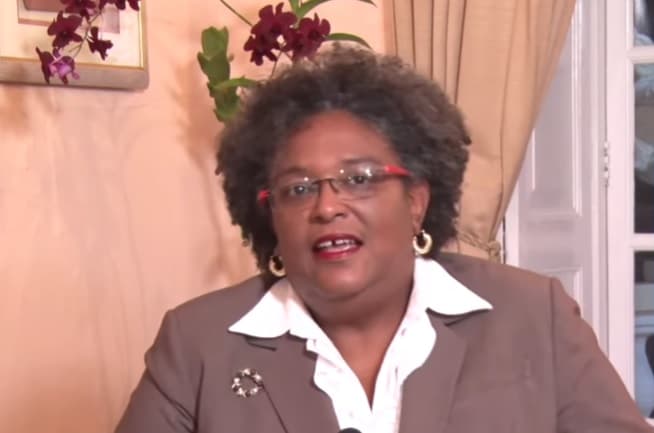
- Barbados Prime Minister Mia Mottley has proposed new regional levies and automatic funding mechanisms to strengthen the Caribbean Community (CARICOM), warning that the regional body cannot continue relying on unpredictable contributions from member governments.
- Speaking at a book launch at the University of the West Indies (UWI), Mona campus, in Jamaica on Sunday, November 15, Mottley proposed a 0.3% levy on imports from outside CARICOM, along with modest charges on cruise ship passengers and long-stay visitors.
- She argued that the regional integration movement needs a reliable and independent source of financing to respond effectively to growing economic, environmental and geopolitical challenges.
- Mottley noted that CARICOM currently operates on annual contributions from member governments, with payments determined by a formula and approved through national budgets.
- "The amounts are small, they are often paid late, and every payment, regrettably, is a fresh political decision.
Barbados Prime Minister Mia Mottley has proposed new regional levies and automatic funding mechanisms to strengthen the Caribbean Community (CARICOM), warning that the regional body cannot continue relying on unpredictable contributions from member governments.
Speaking at a book launch at the University of the West Indies (UWI), Mona campus, in Jamaica on Sunday, November 15, Mottley proposed a 0.3% levy on imports from outside CARICOM, along with modest charges on cruise ship passengers and long-stay visitors.
She argued that the regional integration movement needs a reliable and independent source of financing to respond effectively to growing economic, environmental and geopolitical challenges.
Mottley noted that CARICOM currently operates on annual contributions from member governments, with payments determined by a formula and approved through national budgets.
"The amounts are small, they are often paid late, and every payment, regrettably, is a fresh political decision. You cannot run an organisation on that basis," she said.
She recalled that regional leaders agreed in 2003 to establish automatic resource transfers but had failed to implement the arrangement more than two decades later.
The prime minister proposed a treaty-based levy of 0.3% on imports from outside the region, with proceeds transferred automatically from customs authorities into a CARICOM account.
She estimated that the measure could generate between US$60 million and US$86 million annually, helping to meet the regional body's estimated annual funding needs of US$80 million to US$90 million.
Mottley also suggested a travel levy of no more than US$1 per cruise ship passenger and US$2 per long-stay visitor, which she said could generate an additional US$30 million.
She acknowledged that changes to cruise passenger charges would require negotiations with cruise operators but maintained that the proposed import levy would have a limited impact on consumer prices.
"The problem, my friends, is not the amount. It is the mechanism. It is the governance. Governance decides success," she said.
Mottley also announced Barbados' commitment to provide CARICOM institutions with 25 megawatts of renewable energy licenses, which could be monetized to generate additional revenue for regional institutions, including UWI.
She recommended a protocol to CARICOM's founding treaty that would classify the proposed levy as community revenue, require automatic transfers through central banks and provide collection fees to customs authorities.
The system, she suggested, should also include independent audits and penalties for noncompliance.
Mottley warns of three major threats to the Caribbean
Mottley identified three major threats facing the region: the weakening of the international rules-based order, climate change and biodiversity loss, and the rise of artificial intelligence.
She said these challenges require coordinated regional responses rather than individual national action.
"It requires not singular national action, but indeed coordinated policy and action on the part of this community and that is why funding CARICOM cannot be an afterthought, because it is the very same CARICOM that will help us get to safety," she said.
The prime minister pointed to the work of regional institutions, including the Caribbean Public Health Agency (CARPHA) during the COVID-19 pandemic and the Caribbean Disaster Emergency Management Agency (CDEMA) following major hurricanes, as examples of the benefits of regional cooperation.
"These agencies are not decorative. They serve purposes and deliver for individual member states in circumstances where individual member states do not have the capacity," she said.
Calls for stronger international representation
Mottley also called for a greater international role for the CARICOM secretary-general, arguing that the regional body needs a stronger collective voice at the United Nations.
She noted that while CARICOM has observer status at the UN, its secretary-general does not enjoy the same participation rights granted to representatives of the European Union.
Mottley referenced a 2011 UN General Assembly resolution that expanded the EU's participation rights, allowing its representatives to address the General Debate, present proposals orally and exercise a right of reply.
She argued that CARICOM should explore similar arrangements to strengthen its influence in international decision-making.
However, she acknowledged that differences in national legal systems and constitutional requirements could complicate efforts to give the regional body greater authority.
Mottley said the Revised Treaty of Chaguaramas requires treaty amendments to be unanimously agreed upon and ratified by all parties before taking effect.
She also pointed to the Organisation of Eastern Caribbean States (OECS), which has granted its regional institutions legislative authority in certain areas, as an example of deeper integration.
Book examines future of Caribbean integration
Mottley made the proposals during the launch of Caribbean Integration: The Patterson Doctrine — Governance, Transformation and the Future of the Caribbean Community, a 386-page book co-authored by former Jamaican Governor-General Professor Sir Kenneth Hall and Myrtle Chuck-A-Sang.
The publication examines the governance framework, political philosophy and regional integration vision associated with former Jamaican Prime Minister P.J. Patterson.
It also explores the gap between CARICOM's institutional achievements and the everyday experiences of Caribbean citizens.
Mottley urged regional leaders to move beyond longstanding commitments and establish practical mechanisms to strengthen CARICOM's financial independence, governance and international influence.