Antigua PM says US visa policy hurting trade, students and families
Key Points(5)
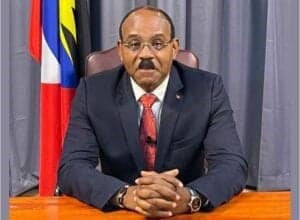
- -Antigua and Barbuda Prime Minister Gaston Browne, Tuesday, said that the visa policy of the United States is undermining trade, commerce, “and even our students who require a visa to study in the United States.
- “We also have individuals who like to visit their relatives in the United States, and they too are affected,” Browne told reporters on the sidelines of the 51st Caribbean Community (CARICOM) summit now underway here.
- Visitor visas for citizens of Antigua and Barbuda are single-entry and valid for 3 months.
- This replaces the old rules that allowed 10-year, multiple-entry visas.
- Additionally, some applicants may be required to post a bond up to US$15,000.
Antigua and Barbuda Prime Minister Gaston Browne says the United States’ tightened visa policies are affecting trade, commerce, students and families with ties to the country, as he called for the restrictions to be lifted.
Speaking Tuesday to reporters on the sidelines of the 51st Caribbean Community (CARICOM) summit in St. Lucia, Browne said the measures were having a broader impact beyond travel.
“We also have individuals who like to visit their relatives in the United States, and they too are affected,” Browne told reporters.
Visitor visas for citizens of Antigua and Barbuda are now single-entry and valid for three months, replacing the previous system that allowed 10-year, multiple-entry visas. Some applicants may also be required to post a bond of up to US$15,000.
Washington also approved new immigrant visa restrictions for Antiguans, citing security concerns related to the country’s Citizenship by Investment (CBI) programme, under which foreign investors can obtain citizenship through qualifying contributions to the country’s economic development.
Browne said Antigua and Barbuda had hoped the visa policy changes would be temporary.
“We also have individuals who like to visit their relatives in the United States, and they too are affected,” he said.
“I believe that it would have fallen on July 1, even though we have not heard formally from anyone in the USUS. With July 1 now behind us, we expect it won’t be repeated.”
“We haven’t heard any words from the United States to confirm whether or not they’re going to extend it or if it falls away. Again, we hope that the latter will prevail and that the restrictions will fall away because on any day we have absolutely no issue in the United States.”
Browne stressed that Antigua and Barbuda maintains strong ties with Washington and remains a close partner of the United States.
“We consider the US to be our most important partner in development,” he said, noting that 80 percent of what is consumed in Antigua and Barbuda comes from the United States.
“Our most significant source market for tourists is the United States, and so for us, our development is inextricably linked to that of the United States. And we continue to work harmoniously with the USUS,” he said.
Third-country nationals agreement
Browne also addressed ongoing discussions with the United States over a proposed agreement to accept third-country nationals who are removed from the US.
The issue has generated debate across the Caribbean, with some governments expressing concerns about security, resources and the capacity of small island states to accommodate additional migrants.
Browne said Antigua and Barbuda was willing to participate in such an arrangement but only under conditions that protect national security.
“All we’re seeking to do here is to protect our country and make sure that we do not attract criminal elements to our country. But we have made it clear to them that we will certainly participate in the third-country nationals program.”
He said Antigua and Barbuda must also consider its limited resources.
“We also want to make sure that we do not have more than we can accommodate. In other words, we have very limited capacity. We’re a small island with 100,000 people. We also have limited financial capacity and limited housing space.”
“So we have to be very prudent in the way in which we negotiate with the United States,” he said.
Browne said negotiations with Washington remain active but have not been completed.
“And we’re hoping that we will get an acceptable agreement, one that precludes any criminal elements whatsoever from coming to our country, and one in which we will have several individuals to contend with within our own limited capacity.”
Calls for regional approach
Browne rejected suggestions that there was a contradiction between Caribbean countries considering third-country migrant agreements with the United States while facing visa barriers for their own citizens.
“Well, there’s no such irony in Antigua and Barbuda. I can speak for Antigua and Barbuda, and I’ll go as far as to state that there’s no other country in the Caribbean that is more representative of CARICOM than Antigua and Barbuda.”
He said Antigua and Barbuda has historically maintained an open immigration policy toward CARICOM nationals.
“We have had a very generous immigration policy in which we have accommodated tens of thousands of CARICOM nationals on our shores, almost invariably. Whenever they fall out of time, we would, every four years, at most every five years, extend an amnesty to help them regularise their status.”
“So, we have been the most welcoming country of all countries in the Caribbean of CARICOM nationals. In fact, Antiguans and Barbudans, generally, are very open, very welcoming to others. And I think that’s one of the strengths of our country, that it has added to the diversity of our country.”
Browne said migrants who have settled in Antigua and Barbuda have contributed to the country’s development.
“There’s no doubt that those immigrants who have come to Antigua and Barbuda would have helped to build the country alongside the nationals who have lived there all their lives,” he said.
The prime minister said he would have preferred a unified CARICOM position on third-country national agreements but acknowledged that achieving consensus has been difficult.
“Unfortunately, that has been very difficult,” he said.
“Several countries have already signed the TCN (third country national) agreements, and there seems to be some reluctance, maybe fear, among some, to have that type of coordinated approach.”
“But I think that is what was required from the outset for us to have had a regional approach, because at the end of the day, we are far stronger together than alone. So what has happened, unfortunately, is that the countries have been negotiating bilaterally without any form of regional input.”
Browne said individual negotiations have weakened the region’s bargaining position.
“We have been a strong advocate for a regional response, and the discussions continue to this day among those of us who have not signed. But I can’t say that we necessarily have a consensus.”
He said CARICOM leaders are expected to issue a statement highlighting concerns about the limited capacity of Caribbean states and the potential security risks associated with accepting third-country nationals.
“I believe, though, that there will be a general statement coming out from this conference expressing concerns and bringing to the attention of the United States the limited capacity of these countries and the potentially devastating impact of attracting criminals to our shores.”
Browne added that Antigua and Barbuda had not received any request from the United States to accept criminal deportees but said the government wants safeguards included in any agreement.
“Now, I have to add here, at no point in our discussions did the USUS indicate that they were sending criminals.”
“From the outset, when they raised the issue with us back in August of last year, we responded in writing and indicated that we would not accept any criminal elements.”
“Now, our fears are evidently based on certain comments coming out of Washington by senior members of the US administration who have said that they do not want any pedophiles, any criminals in a country, foreign criminals, and that they will deport them to third countries.”
“So that is what is driving our fear. We have not received any formal requests from the United States to send us any criminal elements. But out of an abundance of caution, we are ensuring that the agreement specifies that these individuals are not criminal elements.”