
Alcohol Relapse Warning Signs: What to Watch For

Key Points(5)
- Most people picture relapse as a single bad night.
- A drink at a wedding, a slip at a bar, and suddenly everything unravels.
- That picture is wrong, and it's costing families the chance to intervene while there's still time.
- Relapse usually begins weeks or even months before anyone touches a glass.
- It shows up in small, easy-to-miss shifts: skipped meetings, a shorter temper, a sudden need for privacy.
Most people picture relapse as a single bad night. A drink at a wedding, a slip at a bar, and suddenly everything unravels. That picture is wrong, and it's costing families the chance to intervene while there's still time.
Relapse usually begins weeks or even months before anyone touches a glass. It shows up in small, easy-to-miss shifts: skipped meetings, a shorter temper, a sudden need for privacy. The drink is the ending, not the beginning. If you've watched someone you love slide backward, you already know the awful feeling of recognizing the signs after the fact. The goal here is to help you catch them earlier, when a conversation can still change the outcome.
Clinical teams see this pattern constantly. As the team at Waterside Recovery describes it, relapse is a process with distinct stages, and the physical act of drinking comes last. That framing matters whether you're in recovery yourself or supporting someone who is. You're not looking for a single dramatic moment. You're looking for a drift.
What Does the Three-Stage Relapse Model Actually Look Like?
Researchers and clinicians generally break relapse into three phases: emotional, mental, and physical. Each one has its own texture, and each gives you a window to act. Here's how they tend to play out in real life.
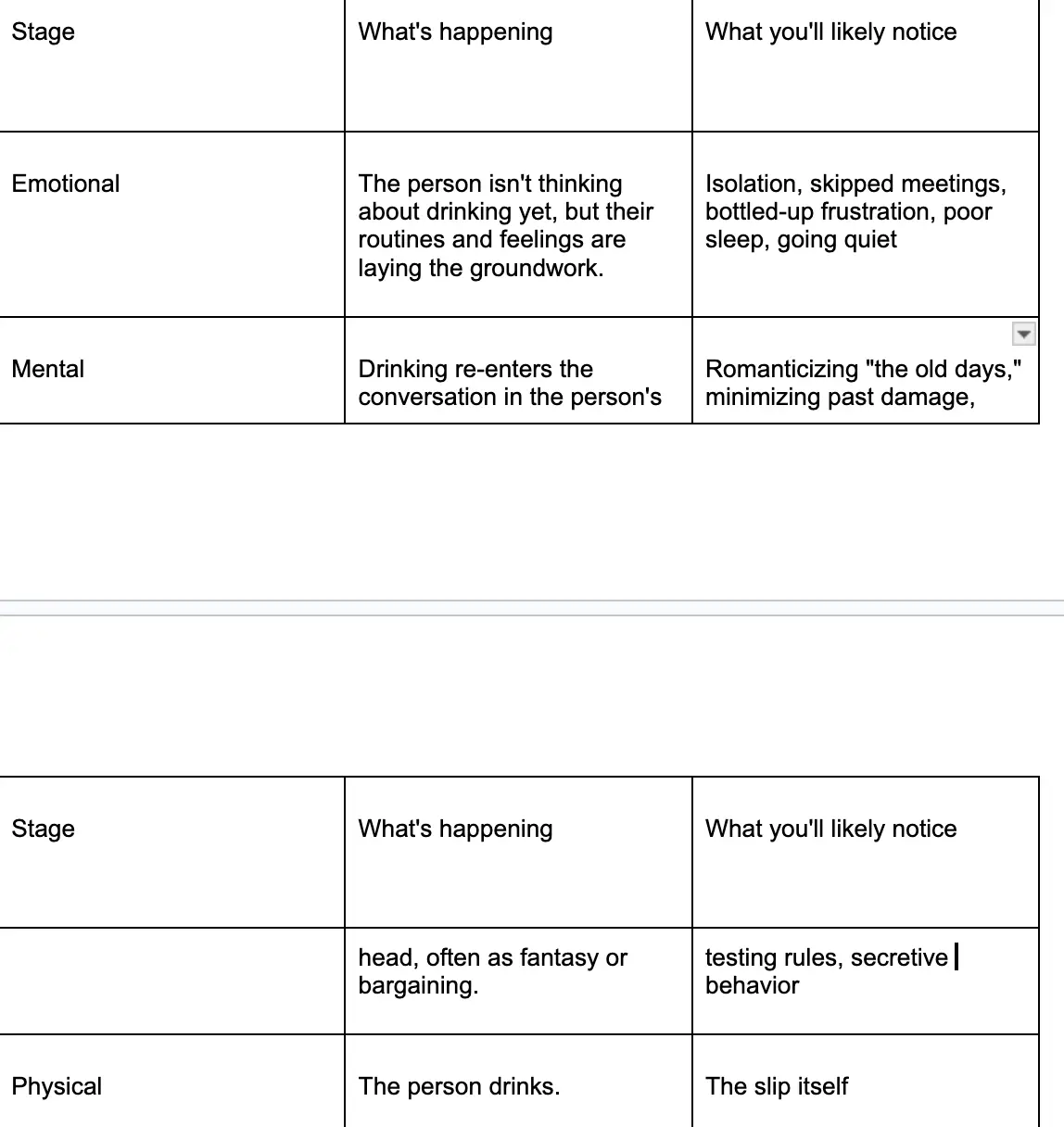
Here's the part that frustrates me: most families only respond at stage three, because that's the only stage that looks like a crisis. By then the work is harder. The earlier you get a read on someone's emotional baseline, the more leverage you have.
Emotional Relapse Signs You Shouldn't Wave Off
Nobody's thinking about alcohol at this point. That's the trap. The behaviors are quiet enough to explain away, and everyone around the person wants to explain them away, because the alternative is exhausting.
Watch for someone who stops showing up. They miss the Tuesday meeting, then the Thursday one, then the whole week. They cancel the therapy appointment and say they'll book another. They start dodging the friends who know their history, because being around people who hold you accountable feels uncomfortable when you're slipping.
Emotional relapse also looks like a pressure cooker with the lid welded shut. You'll see a shorter fuse, a flat mood, or a sudden need to stay busy with anything but reflection. Sleeplessness creeps in. Appetite changes. The person gets jumpy and defensive if anyone brings up recovery at all.
This is the stage where a gentle check-in does the most good and feels the most awkward. My honest take: say something now, even if you get brushed off. A clumsy conversation beats a silent month.
Mental Relapse: When the Bargaining Starts
Mental relapse is where the internal negotiation begins. The person isn't drinking, but they're thinking about it, and they're building a case for why it'd be fine.
- Romanticizing the past, recalling the fun nights but not the aftermath
- Minimizing old consequences or comparing their problem favorably to someone else's
- Testing the limits, like walking into old haunts or keeping a bottle around "just to prove something"
- Sudden secrecy around the phone, money, or where they've been
- Talking about drinking as though it's a neutral possibility rather than a live risk
You'll hear phrases like "I've been good for months" or "one wouldn't hurt." Those aren't casual remarks. They're the sound of a decision being pre-negotiated. If you catch a loved one doing this, resist the urge to argue the logic. Logic isn't the problem. The problem is unaddressed stress looking for an exit.
What's happening underneath is usually pressure the person hasn't processed. Financial worry, a relationship strain, the anniversary of something painful. Alcohol sneaks back onto the menu when healthier coping tools stop getting used. Researchers have documented this cycle for decades, and the underlying science of addiction and recovery is well established at the National Institute on Alcohol Abuse and Alcoholism, which is a far better source than any viral thread on the subject.
So What Do You Actually Do When You Spot These Signs?
You don't stage an intervention at every skipped meeting. That would push most people further away. Instead, work a short plan that scales with what you're seeing.
Step one: name it without accusing. Swap "You're isolating again" for "I've noticed you've missed a few meetings and you seem wound up. How are you doing, really?" Leave room for the person to answer honestly without a preloaded verdict.
Step two: reconnect the support. Ask when the next therapy session is and whether they're still going. Offer to drive when the appointment is. Sometimes the nudge is all that's needed to get a person back on schedule.
Step three: check the basics. Sleep, food, exercise, and stress. These aren't soft concerns. The body's baseline is a big part of the relapse picture, and neglecting it makes everything else harder to hold together.
Step four: escalate the level of care if things keep sliding. A conversation with a licensed counselor or a treatment provider's admissions team is a reasonable next step when the mental stage signs keep piling up. Relapse risk doesn't have to become relapse. The Substance Abuse and Mental Health Services Administration exists to help families find resources, and reaching out early is normal, not a failure.
One more thing: take care of yourself during this. Supporting someone through recovery is genuinely exhausting, and resentment builds fast when every conversation turns into a watch. Make time for something that's yours.
The "Relapse Rehearsal" Tactic I Recommend
If you or someone you love is in recovery, try what I call a relapse rehearsal. Sit down and walk through the last slip or the closest near-miss like a detective, not a judge. What was the mood a month before? Who was in the room the week it got serious? Which obligations had stopped? Write down three early warning signs that showed up first, then tape them somewhere visible.
You'll have a short, personal list that's worth more than any generic checklist, because it's built from your actual life. Every occasion I've seen families use this, the conversation ends up revealing something nobody had named out loud: a job they hated, a friendship that had soured, a grief nobody had talked about. Those are the real triggers hiding underneath the drinking.
Keep the rehearsal light. You're not building a case file. You're mapping the path your own relapse has taken so far, so you can spot it earlier next time. You can build a version of this for yourself in the same way with a single page and twenty minutes, and bring it to your next appointment to make it more precise.
Where This Leaves You
Relapse doesn't begin with a drink. It begins with quiet withdrawal, a shorter temper, and a rationale that sounds reasonable in the moment. If you can recognize those early signs, you have a real chance to intervene while the person you love is still reachable, and you have a plan for what to say when the moment comes.
You can't control whether someone picks up a drink. You can make sure the warning signs don't go unseen, and you can make sure support is one conversation away. If you spot the pattern in someone you care about, say something this week. Not a speech. A question. That's where it starts.