Venezuela rejects ICJ authority in Guyana border dispute as hearings conclude
Key Points(5)
- “Venezuela will never endorse a violation of the Geneva Agreement and international law.
- There is no legal way of recognising a decision resulting from this process, whatever that may be,” said Acting President Delcy Rodríguez as the ICJ wrapped up oral submissions on the issue.
- The ICJ, established in June 1945 by the Charter of the United Nations as the principal judicial organ of the United Nations (UN), has in the past ruled that it has the authority to adjudicate on the border dispute.
- Guyana brought the case before the ICJ in 2018, seeking affirmation that the 1899 Arbitral Award, establishing the boundary between the two countries, is legally valid.
- The award had been accepted for over 60 years before Venezuela declared it null in 1962 and revived its claim to the territory.
Venezuela on Monday told the International Court of Justice (ICJ) that it will not allow the court to settle the decades-old border dispute with Guyana, marking a firm rejection of the tribunal’s jurisdiction as oral submissions in the case concluded.
“Venezuela will never endorse a violation of the Geneva Agreement and international law. There is no legal way of recognising a decision resulting from this process, whatever that may be,” said Acting President Delcy Rodríguez as the ICJ wrapped up oral submissions on the issue.
The ICJ, established in June 1945 by the Charter of the United Nations as the principal judicial organ of the United Nations (UN), has in the past ruled that it has the authority to adjudicate on the border dispute.
Guyana brought the case before the ICJ in 2018, seeking affirmation that the 1899 Arbitral Award, establishing the boundary between the two countries, is legally valid. The award had been accepted for over 60 years before Venezuela declared it null in 1962 and revived its claim to the territory.
The matter is being addressed under the 1966 Geneva Agreement, which outlines mechanisms for a peaceful settlement. After bilateral efforts failed, the dispute was referred to the ICJ by the United Nations (UN) secretary-general.
The Essequibo region comprises roughly the western two-thirds of Guyana, spanning 61,600 square miles. It is a resource-rich region bordered by the Essequibo River to the east and Venezuela to the west, which Venezuela claims as its own.
The ICJ began hearing oral submissions last week, with Guyana reiterating its position that Essequibo is part of its territory, while Caracas maintains this is not the case.
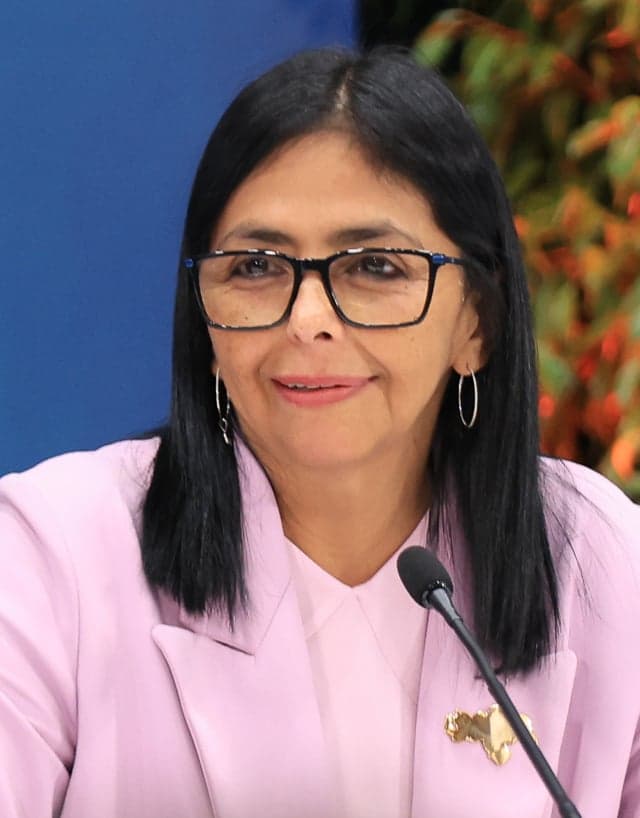
In her closing arguments lasting just under half an hour, Rodríguez, who appeared before the ICJ panel of judges wearing a brooch depicting Venezuela’s claim to the Essequibo, said that controversy must be resolved politically under the 1966 Geneva Agreement.
She repeated on several occasions that Venezuela does not recognise the court’s jurisdiction, saying that her appearance “does not imply in any way recognition of the court’s jurisdiction in the territorial controversy”.
Rodríguez said that the Geneva Agreement requires direct negotiation rather than judicial settlement.
“The controversy does not concern the confirmation nor invalidation of an award,” she said, adding, “the method is negotiation, not imposition”.
Venezuela linked Guyana’s decision to approach the court with major offshore oil discoveries made in 2015, alleging that Guyana abandoned negotiations after oil reserves were found offshore in territory internationally recognised as Guyanese.
Rodríguez said Guyana was pursuing “an unlawful strategy of judicialisation” aimed at validating what she called a “fraudulent award”.
Rodríguez warned that even an ICJ ruling would not resolve the dispute.
“Such judgment may conclude the case, but it will not put an end to the territorial dispute,” she said, accusing Guyana of trying to “erase” Venezuela’s historical narrative.
She said the ICJ was being asked to “prohibit the teaching of history” and “tear Essequibo from the hearts of Venezuelans”.
Rodríguez told the ICJ that the people of Venezuela, through a referendum on December 3, 2023, had decided how the border controversy should be resolved and that Caracas intends to respect that vote by its citizens, as well as its historical position on the border matter.
She said Venezuela received a mandate through its referendum vote and will abide by it.
“The people of the Bolivarian Republic of Venezuela, on the third of December 2023, turned out in large numbers at the polls and gave us a series of clear and unequivocal mandates. Firstly, the mandate maintains the historical position of existential matters, such as independence and territorial integrity, to judicial mechanisms. Secondly, their mandate to uphold the Geneva Agreement as the only valid, legal instrument for resolving territorial disputes over the Essequibo,” Rodríguez said.
She said that Venezuelan voters also gave the government a mandate to defend the Essequibo region in line with international law, insisting that Venezuela’s position not to submit or cooperate with the judicial process in the border case is not an act of defiance, nor of disregard for the court.
“With this in mind, since 2018, Venezuela has filed a number of submissions and has intervened in several hearings before this court with a double purpose, firstly, to attempt to uphold international law in the face of this anti-legal absurdity promoted by Guyana. Secondly, to demonstrate to the world the truth, the rights that, since its inception, the territory belongs to Venezuela,” Rodríguez noted.
Rodríguez said that her country’s participation in the process should never be interpreted to mean that Venezuela accepts the court’s jurisdiction, but must also be seen as respect for international law.
“A negotiated solution is therefore an inevitable and an indispensable condition of the controversy. The Geneva Agreement buries and moves beyond the discussion over the validity or invalidity of the 1899 award. The agreement recognises that the framework cannot be circumvented or replaced through unilateral recourse,” Rodríguez said.