US Secretary of State Antony Blinken visits Haiti to show support for multinational mission
Key Points(5)
- Secretary of State Antony Blinken visited Haiti last Thursday to reinforce the U.S.
- government’s commitment to a multinational mission aimed at curbing gang violence in the Caribbean nation.
- His visit also emphasized the push for long-delayed general elections, alongside the potential consideration of a peacekeeping operation to maintain security.
- Kenyan police, numbering around 400, have been deployed to Haiti as part of a United Nations-backed mission to suppress the escalating gang violence in the capital, Port-au-Prince, and beyond.
- However, concerns have arisen about the mission's capacity to handle the situation due to a lack of resources.
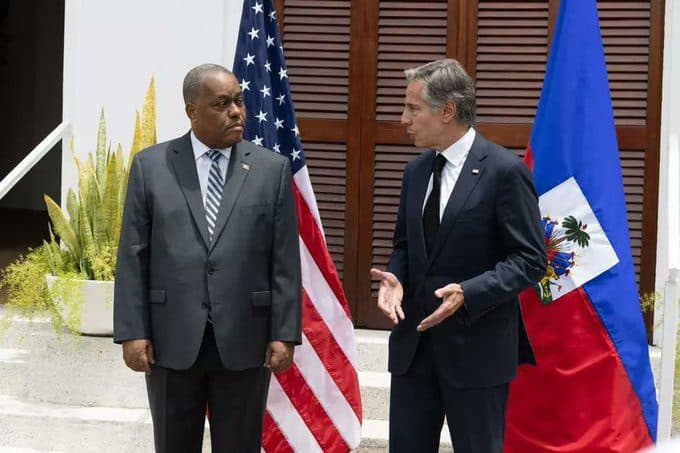
U.S. Secretary of State Antony Blinken visited Haiti last Thursday to reinforce the U.S. government’s commitment to a multinational mission aimed at curbing gang violence in the Caribbean nation. His visit also emphasized the push for long-delayed general elections, alongside the potential consideration of a peacekeeping operation to maintain security.
Kenyan police, numbering around 400, have been deployed to Haiti as part of a United Nations-backed mission to suppress the escalating gang violence in the capital, Port-au-Prince, and beyond. However, concerns have arisen about the mission's capacity to handle the situation due to a lack of resources.
“At this critical moment, we do need more funding, we do need more personnel to sustain and carry out the objectives of this mission,” Blinken stated during a press briefing. He added that the U.S. is working to ensure the mission’s renewal while exploring all options for sustainability. “A peacekeeping operation would be one such option,” he said.
On Wednesday, U.S. Assistant Secretary for Western Hemisphere Affairs Brian Nichols confirmed that the U.S. government is considering a U.N. peacekeeping operation as a potential avenue to secure the necessary resources and funding to combat gangs, which control 80% of Haiti’s capital.
Blinken's visit coincided with the Haitian government’s extension of a state of emergency to the entire country. The emergency was initially declared earlier this year to address violence in the capital and surrounding regions.
During his visit, Blinken met with Haitian Prime Minister Garry Conille, members of the transitional presidential council, political leaders, and the heads of the multinational mission and Haiti’s National Police. The meetings covered the importance of ensuring that security personnel are properly trained, equipped, and held accountable, with Blinken affirming that there is a “clear plan” for the mission’s next steps. Discussions also focused on the pressing need for general elections.
“That is the critical next step,” Blinken emphasized. “We want to make sure Haiti is back on a clear democratic track.”
Haiti’s last elections were held in 2016, with subsequent efforts delayed by gang violence and political instability. The assassination of President Jovenel Moïse in July 2021 further destabilized the country, fueling a surge in gang activity. In February, gangs launched coordinated attacks on police stations and the main international airport, as well as storming Haiti’s two largest prisons, freeing over 4,000 inmates.
While the arrival of Kenyan police has seen some improvements in Port-au-Prince, Blinken acknowledged that gang violence persists in surrounding areas. He noted that joint operations have led to successes, such as regaining control of Haiti’s largest public hospital, but emphasized that continued efforts are essential.
“Taking back the streets from gangs is critical,” Blinken stated.
Following his meetings in Haiti, Blinken traveled to the Dominican Republic, where he met with President Luis Abinader before returning to the U.S.