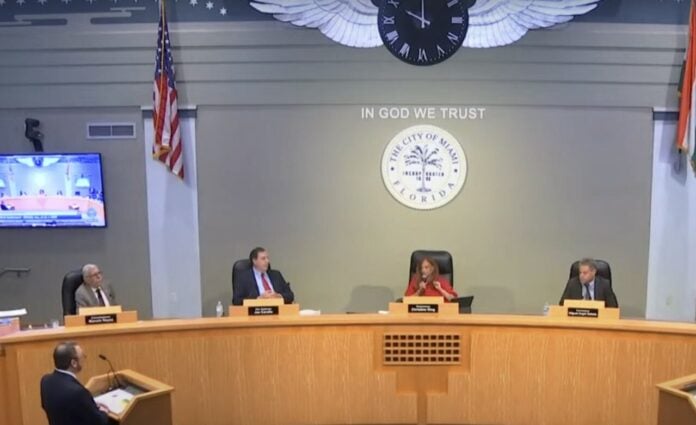
In a contentious final vote on Tuesday, Miami’s City Commission approved a resolution granting themselves lifetime pensions, reviving a program that had been frozen since the 2009 financial crisis. The decision was made without input from voters, despite initial discussions about holding a referendum.

The proposal, co-sponsored by Commissioners Miguel Angel Gabela and Christine King, passed with support from Commissioner Joe Carollo. Commissioners Manolo Reyes and Damian Pardo opposed the measure, with Pardo advocating for a public vote, stating, “Otherwise for me, I see it as self-dealing.” Despite his objection, Pardo confirmed he plans to opt into the pension program, saying, “I work as hard as everybody else.”
Christine King also intends to participate in the program, as she told the Miami Herald following the vote. Carollo, who already has a city pension from previous terms before the program was frozen, will resume collecting payments after leaving office. Meanwhile, Reyes vowed not to enroll, citing a promise he made to constituents during his campaign.

While Gabela co-sponsored the resolution, he expressed uncertainty about whether he would opt-in. Commissioners have 10 days after the resolution becomes effective to make an irreversible decision.
Under the new pension plan, current and future Miami elected officials, including the mayor, will be eligible to receive pensions after completing two terms, either by serving seven years and reaching age 62 or by serving 10 years and turning 60. The pension amount will be half of their highest compensation during office, increasing annually by 5% until it equals 100% of their salary. Additionally, they will receive a 3% cost-of-living adjustment each year after they begin collecting their pension.
Miami city commissioners currently earn about $58,000 annually, but their total compensation, including allowances for cars and cell phones, adds up to around $100,000. The pension amount will be based on either their total compensation or taxable wages, whichever is higher.

Notably, the program applies only to officials elected after October 1, 2021, excluding those who were in office between the 2009 freeze and the 2021 cutoff.
King defended the decision to forgo a public vote, stating that voters can be “mean and miserable,” referencing recent criticism she received via email for declaring a state of emergency ahead of Hurricane Milton and for her choice of attire.
Carollo echoed the sentiment, arguing that elected officials work harder than non-elected city employees. “Commissioners are on call just like a doctor is,” he said.

Gabela criticized the decision of previous city commissioners to freeze the pension program for future officials while keeping their own benefits intact, calling it “morally incorrect.” He defended the workload of elected officials, describing the role as a “24-hour job” with significant “reputational hazard.”
The decision has sparked debate within the city, raising questions about fairness and accountability in the pension program for Miami’s part-time elected officials.