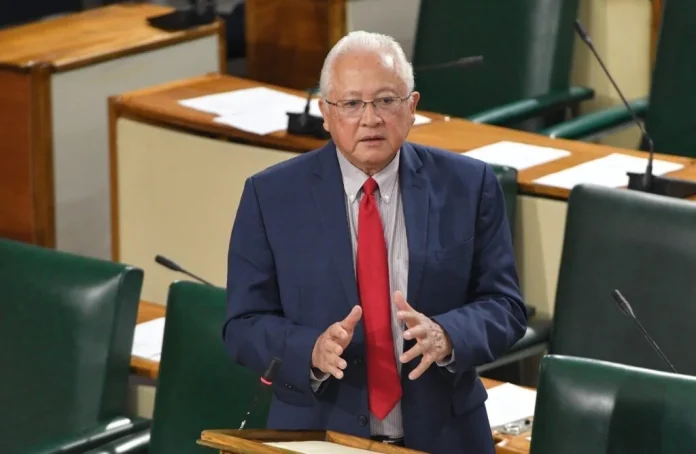
A declaration by Jamaica’s Justice Minister Delroy Chuck that the government wants to ban corporal punishment in homes has generated much backlash from Jamaican parents and church groups on the island.
Speaking at the Justice Ministry’s Child Diversion Forum recently, Chuck emphasized the government’s goal to shift cultural norms, encouraging parents to use strong language rather than physical punishment.
“… We are against any form of punishment using a beating. It must not happen in the schools, but it must also not happen in the homes,” Chuck insisted.

This initiative aligns with the Geneva Convention on the Rights of the Child, which celebrates its 35th anniversary this year. “It is wrong! In other words, we must not use straps and whips and belts, especially belt buckles, to beat any child,” Chuck declared.
“Every parent must learn to scold the child…, (and) I daresay that corporal punishment rarely works,” he added. The minister said parents must use alternative methods to discipline their children.
“The Government intends to outlaw any form of corporal punishment,” Chuck reiterated.

“It doesn’t help the child and, as far as we’re concerned, it’s much better to speak, perhaps in a strong language, to the child, rather than to be slapping the child, pinching the child, twisting the child ear, and using all sorts of punishment to get behavior deemed appropriate, by the parent,” Chuck explained.
He also urged his address to encourage children to “honor” their mothers and fathers, but tell them, “‘They mustn’t hit you.'”
Objection from the church
However, Chuck’s position was immediately met with resistance on social media and from church groups, including the Association of Christian Communicators and Media (ACCM).

ACCM argued that the government’s approach is an overreach and suggested that efforts should focus on establishing support systems for parents rather than banning corporal
“This effort to curtail longstanding and acceptable disciplinary tools available to parents is a direct overreach by the Government and can only be seen as an effort to replace the role of parents in the home,” ACCM said in a statement.
The ACCM expressed concern over the government’s position, emphasizing that the family is the primary unit of socialization and that disciplining children should remain the responsibility of the home. Instead of banning corporal punishment, they suggested educating and encouraging parents to use alternative disciplinary methods.
“Parents have gotten younger in recent years, and in their professional pursuits, many children are left to their own devices for extended periods. Families that subscribe to Christian values and are supported and empowered by specially designed programs are positioned to have better outcomes in terms of the discipline and academic performance of their children,” said Dr. Patience Alonge, head of the ACCM family and Gender subcommittee.
Government says it is undecided
The government later backpedaled on Chuck’s statement, saying while it remains committed to “eliminating violence in our society, particularly against our children,” no official decision has yet been made.
The government said it “values” the various perspectives on the issue of “violence against children”, and it remains committed to collaborating with families and the church on the matter.
It’s not the first time that the Jamaican government is debating a ban on corporal punishment. In 2021, Prime Minister Andrew Holness hinted at the possibility of a ban after a four-year-old child was beaten to death with a stick by his stepfather.
Read: Prime Minister Holness Wants to Ban Corporal Punishment in Jamaica