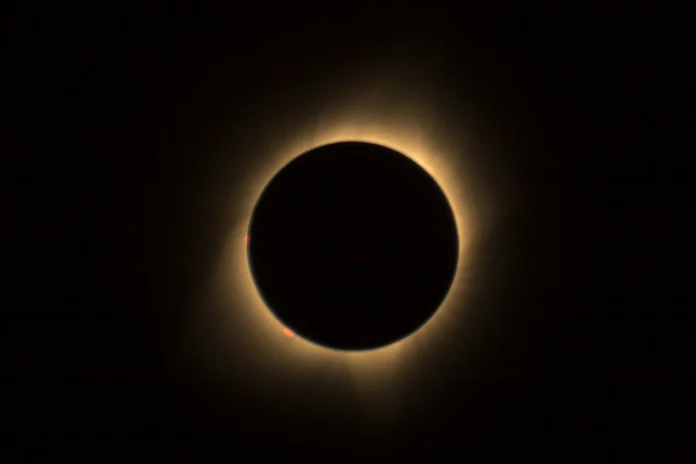
As the celestial event of a partial solar eclipse approaches, several Caribbean territories on Monday are gearing up to witness this rare occurrence.

While the eclipse’s path primarily traverses parts of Mexico, the United States, and Canada, certain areas within the Caribbean are poised to catch a glimpse of this astronomical wonder.
Sint Maarten’s anticipation
In the Dutch Caribbean Island of Sint Maarten, excitement brews as the Meteorological Department announces the anticipated visibility of the solar eclipse.

Although the spectacle will grace various corners of the globe, only select parts of the Caribbean will have the privilege of viewing it.
Notably, countries situated to the east of Guadeloupe will miss out on this celestial display.
Partial views and precautions
For Sint Maarten residents, the viewing experience hinges on cloud cover, with the eclipse expected to manifest between 3 pm and 4 pm local time.
During this period, a fraction of the sun will be obscured, offering a tantalizing glimpse of cosmic alignment.
However, authorities stress the importance of proper eye protection, recommending ISO-compliant solar viewing glasses or solar filters to safeguard against potential eye damage.
Turks and Caicos Islands await
Across the azure waters of the Turks and Caicos Islands, anticipation mounts as the National Weather Service confirms the territory’s partial eclipse experience.

Enthusiasts can expect to witness between 20 to 28 per cent coverage, with the celestial spectacle commencing at 2:10 pm local time and reaching its zenith around 3:06 pm.
As excitement builds, authorities echo the imperative of eye protection to ensure safe viewing practices.
Bahamas braces for celestial show
Meanwhile, in the Bahamas, the meteorological forecast paints a picture of partial eclipse visibility across the archipelago.
From the Northwest to the Southeast, varying degrees of coverage promise a captivating display for spectators.
With start times ranging from 1:55 pm to 4:15 pm local time, residents of New Providence, Grand Bahama, Abaco, and other islands eagerly anticipate the celestial event.
Safety first
Amidst the anticipation, safety remains paramount. The Department of Meteorology issues stern reminders about the risks associated with direct solar observation.
Only through specialized solar filters, such as “eclipse glasses” or handheld solar viewers, can one safely behold the sun’s dance with the moon.
Homemade filters or standard sunglasses offer insufficient protection and should be avoided at all costs.
Guidance from authorities
Government bodies, including the Ministry of Energy and Transport, join forces with meteorological agencies to disseminate crucial safety guidance.
Bahamians and visitors alike are urged to heed these directives to safeguard their vision and enjoy the eclipse responsibly.
According to NASA, the eclipse journey begins on Mexico’s Pacific coast, marking the initial encounter with totality at approximately 11:07 am PDT.
Related article
South Florida public school’s first day of school coincides with Great American Solar Eclipse