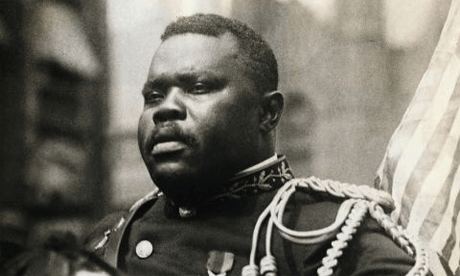
Marcus Garvey is the first and perhaps most controversial of Jamaica’s national heroes. He once said, “The civilization of today is gone drunk and crazy with its power and by such it seeks through injustice, fraud and lies to crush the unfortunate.” One may find these words of Garvey contradictory since he himself advocated for racial purism and was later accused of fraud. Nonetheless, his legacy continues to inspire Jamaicans and the entire black race today.
Garvey’s journey began August 17, 1887, in St. Ann, where the union of a mason and a domestic worker delivered a heritage of black self-empowerment. His meteoric rise to prominence came after he studied law and philosophy in London from 1912 to 1914 and returned to Jamaica where he started the Universal Negro Improvement Association (UNIA) in 1916. He then traveled to the United States to expand this movement, and in 1917 founded the first U.S. chapter of the UNIA in Harlem and launched the Negro World newspaper.
Garvey was an astute orator and by 1919 had gained a significant following. His speeches took a tone that critically questioned how the United States could call itself a democracy if people of colour were still oppressed across the country. The potency of his words became a rallying unifier of black people. “You can enslave for 300 years the bodies of men. You can shackle the hands of men. You can shackle the feet of men. You can imprison the bodies of men. But you cannot shackle or imprison the minds of men,” Garvey advocated.

Historian and writer, Colin Grant defined Garvey’s influence as the overarching spirit or mood that dominated the 1920s, influencing the thoughts and beliefs of the time. “It was what he was saying that really drew people in ’cause he was speaking their thoughts. He was a great romancer and dreamer, and he articulated in a way that people thought they were hearing themselves. Within a few months, he became the person that anybody with any kind of feeling about wanting to tap into the zeitgeist – that person had to hear Marcus Garvey,” Grant stated in an interview about Garvey’s influence.
Interestingly, although Garvey preached the emancipation of black people from the mental strongholds of slavery, Marcus Garvey’s brand of black nationalism was itself controversial because he advocated for black separatism and purity. Garvey reportedly met with members of the Ku Klux Klan to advance this vision. Despite Garvey’s unconventional beliefs, his message of power and hope to black people remained dominant. His popularity only waned when he allegedly began to engage in unethical economic operations to support his business ventures. In 1922, he was charged with mail fraud and sentenced to five years in jail before being deported to Jamaica in 1927.
Jamaica and several predominantly black nations continue to celebrate his influence and heroism. This year marks the 135th anniversary of Garvey’s legacy as a world changer. Garvey’s message, “Without confidence in self, you are twice defeated in the race of life. With confidence, however, you have won before you have even started” continues to inspire Jamaicans and Black people across the world today.