Guyanese officials have met with senior Facebook representatives to discuss the removal of posts showing large sections of the country as Venezuelan territory.
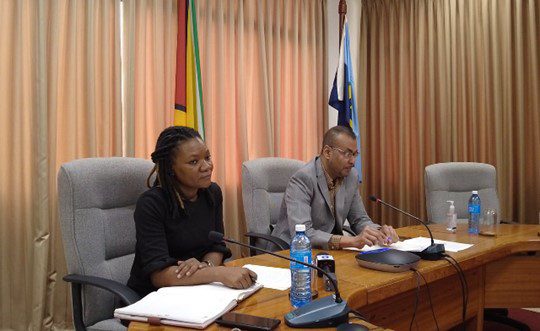
Foreign Secretary Robert Persaud and Head of Frontiers Unit Donette Streete attended the virtual meeting on Wednesday, according to a statement from the Guyana government.
The meeting was convened after Persaud penned letters to Facebook’s Chief Executive Officer Mark Zuckerberg and CEO of Twitter Parag Agrawal to have the false information and illegal maps of Guyana removed from their respective platforms.

The foreign secretary told the representatives that the Government is concerned about the spread of disinformation since the border dispute between Guyana and Venezuela is before the International Court of Justice (ICJ).
He is expected to have a follow-up discussion with the social media platforms on ongoing efforts to have Guyana’s concerns addressed.
Several Spanish social media accounts shared an illegal map claiming the Essequibo region of Guyana as Venezuela’s territory.
In his letters, Persaud said the social media operatives had been using Facebook and Twitter to propagate a false narrative regarding the controversy between Guyana and Venezuela about the validity of the 1899 Arbitral Award which settled the land boundary between Guyana and Venezuela.
The land boundary between Guyana and Venezuela was settled by a legal process of International Arbitration on October 3, 1899, pursuant to an 1897 Treaty of Washington by which both parties agreed to respect the results of the arbitration as a full, perfect, and final settlement of the boundary. At that time, Guyana was British Guiana, a colony of Great Britain.
As required by the 1897 Treaty of Washington and the 1899 Arbitral Award, the boundary as determined by the award was demarcated on the ground between 1900 and 1904 by Commissioners appointed by Britain and Venezuela.

On January 7, 1905, the official boundary map delineating the boundary as awarded and demarcated, was drawn up and signed by the Commissioners of both Britain and Venezuela and promulgated in Georgetown, at the Combined Court.
However, Venezuela subsequently disputed the validity of the 1899 Arbitral Award. The longstanding row is currently before the ICJ, following an application submitted by Guyana on March 29, 2018.
The court confirmed its jurisdiction over Guyana’s claims, rejecting Venezuela’s objections.
CMC/