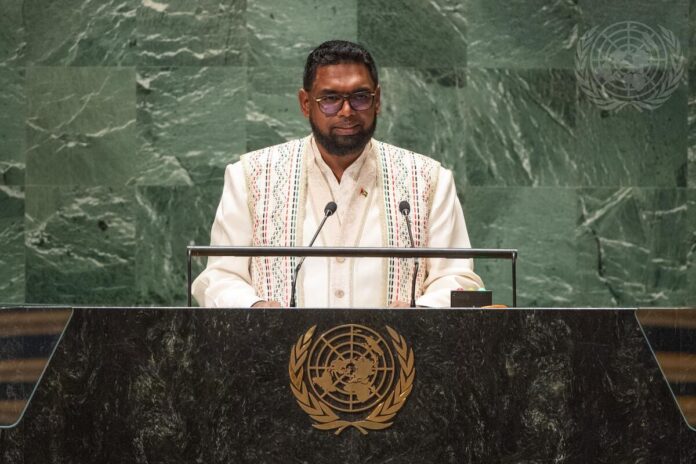
Guyana announced the launch of a Global Biodiversity Alliance on Wednesday and will host its inaugural summit in 2025, focusing on creating a market for biodiversity credits. President Dr. Irfaan Ali, addressing the 79th session of the United Nations General Assembly (UNGA), emphasized that the summit will also address scaling biodiversity conservation debt swaps, accelerating biodiversity bonds, establishing a blueprint for biodiversity taxonomies, and promoting nature-positive actions.
“We do not make this announcement lightly. Guyana is committed to doubling its protected areas by December 2025 and achieving the global biodiversity target of 30 percent by 2030,” Ali stated. “These are tangible solutions that Guyana is putting forward to combat biodiversity loss. We lead by example without arrogance.”
Ali highlighted that the World Wildlife Fund (WWF) considers Guyana one of the most biodiverse countries globally, situated at the intersection of the Guiana Shield and the Amazon. He expressed the nation’s dedication to preserving this vital asset and praised the Indigenous Peoples of Guyana, particularly the Amerindians, as the foremost stewards of this natural heritage. He noted that 15 percent of all revenues earned from carbon sales are directly allocated to Indigenous communities.

Ali emphasized that even with Guyana’s newly discovered oil and gas resources, less than 20 percent of sequestered carbon would be needed to offset the country’s emissions at maximum output. “We have preserved our biodiversity and understand its value. It is only fair that this global asset be monetized in a fair carbon market,” he stated.
In a wide-ranging speech at the United Nations General Assembly (UNGA), Ali addressed various pressing issues, including the ongoing war in Gaza, Russia’s invasion of Ukraine, climate change, and human rights violations. He asserted that the UN must continue to serve as a beacon of hope in a turbulent world.
The theme of this year’s UNGA, “Leaving no one behind: acting together for the advancement of peace, sustainable development, and human dignity for present and future generations,” resonates with the principles outlined in the UN Charter, he noted. However, Ali recognized that achieving this vision requires decisive action and enlightened multilateralism.
He described the current global landscape as one where the quest for peace is often met with conflict, where sustainable development is overshadowed by climate change and food insecurity, and where the dignity of millions is violated with impunity. “In Ukraine, the sovereignty and territorial integrity of a nation are being violated, yet the UN Security Council remains hindered by veto power. Justice demands that we uphold the territorial integrity of all states—large and small, powerful and weak,” he said.
Ali also expressed concern over the ongoing conflict in Sudan, highlighting its devastating consequences, including famine and mass displacement affecting the population.
“This conflict will continue to undermine efforts to achieve lasting peace and sustainable development,” Ali said, calling for the UNGA to also condemn the continued oppression and persecution by the Taliban of women and girls in Afghanistan who face, not just lack of access to education and restrictions on their movements, but now even their voices cannot be heard in public.

He told the global community that in the Caribbean region, the 15-mermber Caribbean Community (CARICOM) grouping has been actively supporting a Haitian-led process for the restoration of democracy, peace and stability in Haiti.
“We welcome the deployment of the UN authorized Multinational Security Support Mission, led by Kenya, as a crucial step towards stabilizing the security situation. We call on the international community to urgently scale up financing for the MSS and secure its renewed authorization so that the Mission can succeed.
“We must also address the dire humanitarian situation where almost half of Haiti’s population suffers from acute hunger, mass displacement, and women and girls are enduring brutal violence, including sexual violence.”
Ali said that Guyana is leading CARICOM’s efforts in mobilizing humanitarian support for Haiti and that he would be reaching out to the international for its support.
“We must stay the course with our Haitian brothers and sisters in their quest for durable peace and sustainable development. The people of Haiti deserve nothing less.”
Ali said also that the situation in Cuba also needs to be examined as the rights of the people there to development continues to be stymied by the economic embargo.
“Guyana renews its call for revocation of the embargo and the removal of Cuba from the list of State sponsors of terrorism,” Ali said, adding that the United Nations has a special responsibility for the security of small states.
“Small States look to multilateralism and the rule of international law to protect them from foreign aggression,” Ali said, as he updated the international community on the ongoing border dispute between his country and Venezuela.
“Guyana is a small state that has had to contend with aggression from the Bolivarian Republic of Venezuela for all 58 years of our nationhood. International law and its strict application have been our armor and our shield in our determination to protect ourselves from this aggression.