Caribbean nations react to US reciprocal tariffs announcement

Key Points(5)
- Caribbean countries are assessing the potential economic fallout from sweeping new tariffs announced by U.S.
- President Donald Trump, with some governments seeking talks with Washington to mitigate the impact.
- On Wednesday, Trump unveiled a <a href="https://www.caribbeannationalweekly.com/business/trump-slaps-10-tariff-on-most-caribbean-countries-including-jamaica/">broad set of tariffs</a>, including a 34% tax on imports from China and 20% on the European Union.
- For the Caribbean, most nations face a 10% tariff, while Guyana has been hit with a steep 38% rate.
- Jamaica’s Foreign Affairs Minister, Kamina J.
Caribbean countries are assessing the potential economic fallout from sweeping new tariffs announced by U.S. President Donald Trump, with some governments seeking talks with Washington to mitigate the impact.
On Wednesday, Trump unveiled a broad set of tariffs, including a 34% tax on imports from China and 20% on the European Union. For the Caribbean, most nations face a 10% tariff, while Guyana has been hit with a steep 38% rate.
Jamaica’s Foreign Affairs Minister, Kamina J. Smith, confirmed the government is analyzing the new policy. “We are obtaining the requisite technical documentation to ensure accuracy of details and appropriate analysis,” she stated, assuring that updates will be provided to the business community and the public.
Guyana’s Finance Minister, Dr. Ashni Singh, said the government is in talks with U.S. officials regarding the tariffs. “Our Government is closely engaged with our U.S. partners to better understand the issue and have it addressed as appropriate,” he noted. The Private Sector Commission (PSC) warned of serious economic repercussions, as the U.S. is Guyana’s largest trading partner. PSC Chairman Komal Singh stressed the need for careful assessment, stating, “A comprehensive review is necessary to identify common ground and ensure that bilateral trade continues to thrive.”
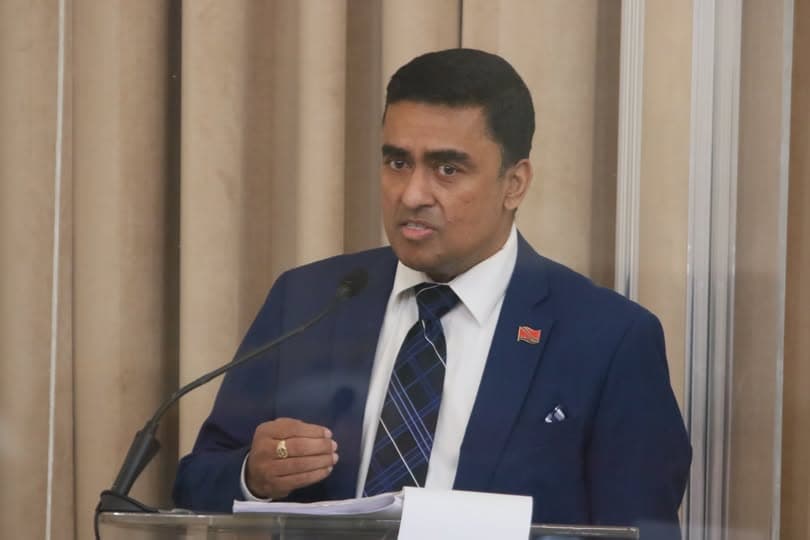
Trinidad and Tobago’s Prime Minister, Stuart Young, vowed to negotiate responsibly with Washington. “I am prepared to sit across the table and negotiate regardless of who is on the other side,” he said at a political rally.
CARICOM Foreign Affairs Minister, Dr. Amery Browne, cautioned about instability in global trade. “We are concerned that spiraling instability in global trade and economic policy will have significant negative repercussions, particularly for smaller nations,” he told the Newsday newspaper.
Meanwhile, Antigua and Barbuda’s Prime Minister, Gaston Browne, highlighted that his country maintains a 10% tariff on U.S. goods while benefiting from a matching discounted tariff from Washington.
In Barbados, Minister in the Ministry of Finance, Ryan Straughn, acknowledged the wide-ranging effects. “Everything, including goods, will be impacted,” he said, urging regional producers to explore global supply chains and alternative markets, including Latin America and Africa.
Economists warn that Trump’s tariff hike could upend the global economic order. The president defended the move as a way to boost U.S. manufacturing and generate revenue, declaring, “Taxpayers have been ripped off for more than 50 years. But it is not going to happen anymore. For decades, our country has been looted, pillaged, raped, and plundered by nations near and far, both friend and foe alike,” Trump declared. “This is Liberation Day.”
The tariffs will take effect immediately, alongside previously announced 25% auto tariffs.