Caribbean education facing a crisis, World Bank says
Key Points(5)
- The Caribbean is facing a severe education crisis, with <a href="https://www.worldbank.org/en/events/2025/02/07/education-transformation-addressing-the-learning-and-skills-crisis-in-the-caribbean">new data</a> from the World Bank highlighting critical gaps in learning outcomes.
- In the 2024 Caribbean Secondary Education Certificate (CSEC) exams, only 4.9% of students passed five or more subjects, including Mathematics and English, marking a drastic decline in educational achievement across the region.
- The mathematics pass rate of 36% underscores a long-standing struggle with foundational learning that threatens student success and regional development.
- Experts warn that these educational failures have serious consequences for economic growth, social cohesion, and crime prevention.
- Compounding the problem is the region’s limited participation in international student assessments, such as the Programme for International Student Assessment (PISA), which evaluates academic performance on a global scale.
The Caribbean is facing a severe education crisis, with new data from the World Bank highlighting critical gaps in learning outcomes.
In the 2024 Caribbean Secondary Education Certificate (CSEC) exams, only 4.9% of students passed five or more subjects, including Mathematics and English, marking a drastic decline in educational achievement across the region. The mathematics pass rate of 36% underscores a long-standing struggle with foundational learning that threatens student success and regional development.
Experts warn that these educational failures have serious consequences for economic growth, social cohesion, and crime prevention. Compounding the problem is the region’s limited participation in international student assessments, such as the Programme for International Student Assessment (PISA), which evaluates academic performance on a global scale. Among the few Caribbean nations that have taken part, Trinidad and Tobago and Jamaica scored significantly below global averages.
A key concern is the lack of strong foundational skills in literacy, numeracy, and critical thinking, which are essential for academic progression and job market readiness. Without these competencies, students struggle to advance in their education or compete in an increasingly globalized workforce.
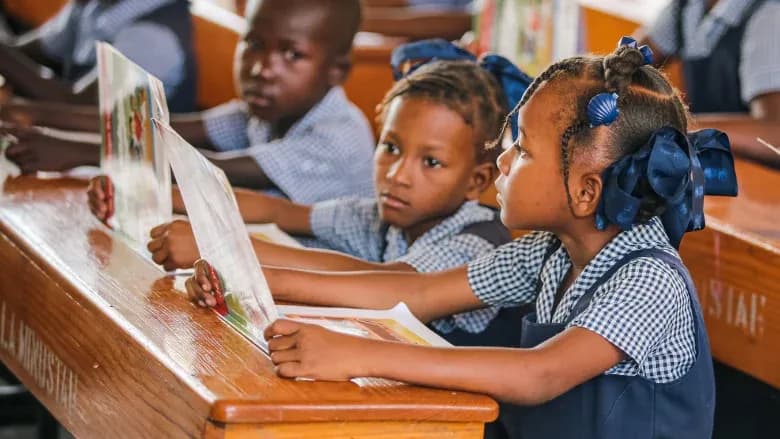
Efforts to address these challenges are underway, with governments and international partners investing in teacher training, digital learning tools, and infrastructure improvements. In Guyana, the introduction of smart classrooms has led to increased student engagement, while World Bank-supported projects in Jamaica and Haiti are improving STEM education, teacher training, and access to learning resources.
However, education advocates argue that much more needs to be done, particularly in strengthening early childhood education, improving data collection, and making education systems more resilient against external shocks like natural disasters and pandemics.
Caribbean vs. US education: A growing debate
Despite these challenges, many Caribbean nationals who have studied in both the region and the United States maintain that Caribbean primary and secondary education is superior in many respects. They point to rigorous curricula, discipline-focused classrooms, and a strong emphasis on critical thinking as key advantages.
“There’s no comparison—Caribbean education at the primary and high school level is much tougher,” said John Mitchell, a Caribbean-American parent living in Florida. “Back home, we focused on problem-solving and deep understanding. When my kids came to the U.S., they were way ahead in math and science.”
Still, the latest data paints a troubling picture of declining education standards in the region. While Caribbean schools may have a strong academic culture, poor government oversight, lack of resources, and outdated teaching methods are dragging performance down.
With education directly linked to economic success and crime reduction, experts warn that failure to reform the system will have long-term consequences. The Caribbean must take decisive action to ensure that future generations receive the quality education needed to thrive in an evolving global landscape.
“We have bright students, but they are being let down by an outdated system,” said Dr. Lisa Thompson, an education consultant in Jamaica. “If we don’t invest in serious reform, we risk losing a generation of talent.”