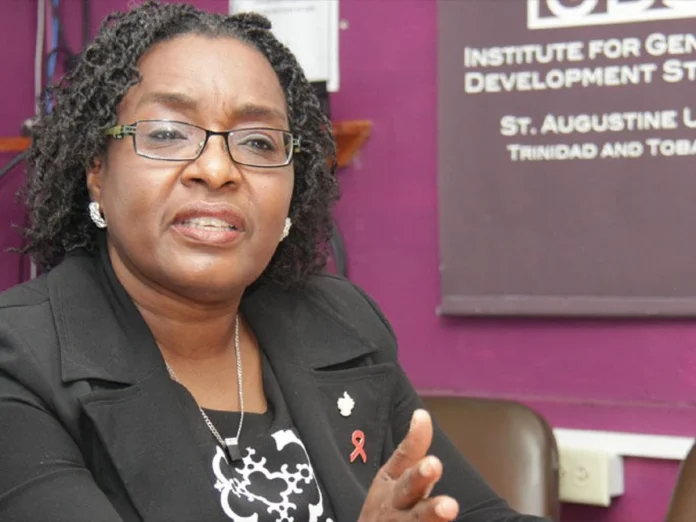
Trinidadian scholar Professor Rhoda Reddock has been reelected to the Committee on the Elimination of Discrimination against Women (CEDAW) for another three years.
Professor Reddock, the first national of the twin-island republic to have been elected to the committee since Trinidad and Tobago became a party to the Convention on the Elimination of all Forms of Discrimination against Women in 1990, was one of 23 candidates competing last month for the 12 vacancies on the committee for the 2023-2026 period.
Announcing Professor Reddock’s reelection in a statement on Thursday, the Ministry of Foreign and CARICOM Affairs congratulated her “on her magnificent achievement.”

“The Ministry of Foreign and CARICOM Affairs…expresses its appreciation to the staff of our Permanent Mission to the United Nations in New York, to our other Missions overseas, and to the staff at the Ministry of Foreign and CARICOM Affairs who all contributed to delivering this key strategic objective of the Government of Trinidad and Tobago,” it added.
During her first 2019-2022 tenure as a member of the CEDAW, Professor Reddock has been serving as Vice-Chair of the Working Group on Inquiries of the Optional Protocol of the Convention, which oversees the procedure for the inquiry mechanism for investigation of grave and systematic violations of the Convention. She is also a member of the Working Groups for the General Recommendation on Indigenous Women, and on Gender-based Violence against Women, respectively.
As a member of the committee from 2023, she will join 22 other independent international experts in monitoring the progress made by states in the implementation of the Convention.

The statement from the Ministry of Foreign Affairs said Professor Reddock is an eminent scholar and activist who, over several decades, has made significant contributions to the advancement of gender issues at the national, regional, and international levels.
As an advocate for women’s rights and empowerment, she was actively involved in the process leading up to the institutionalization of gender studies at The University of the West Indies, St. Augustine Campus, and served as Head of the Centre (now Institute) for Gender and Development Studies, from 1994-2008.
Professor Reddock served as Deputy Principal of the campus from 2008 to 2017. She was also a Founding Member and first Chair of the Caribbean Association for Feminist Research and Action (CAFRA).

CEDAW represents one of the foremost mechanisms worldwide for the promotion of human rights and fair treatment of women, as it assists states party to the convention in improving their human rights record and providing women and girls with equal access to opportunities for self-actualization, growth, and development.
CMC/