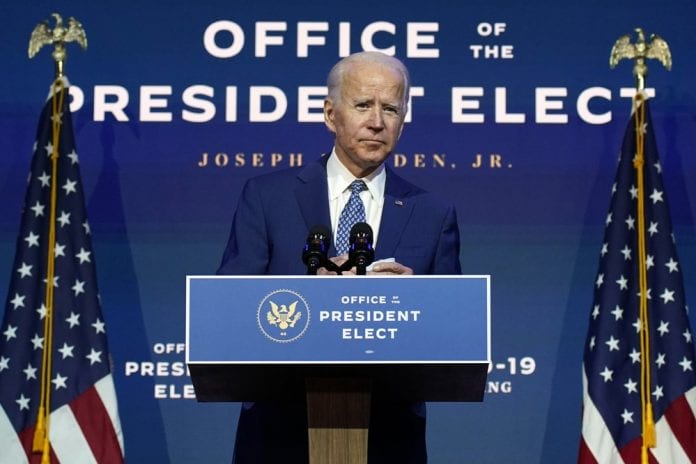
Frankly, it’s extremely frustrating for Caribbean Americans and over 80 million other American voters to hear various commentators repeatedly say Joe Biden will be the next president of the United States if the Electoral College votes for him on December 14.
By using the word if instead of when, it connotes the dubious implication that the results of the 2020 presidential election, which Biden won by 6,193,251 votes, with votes still being counted, are not conclusive, and could change depending on the votes of the 538 electors who comprise the Electoral College.
In almost every other country, free or under dictatorial rule, there would be no doubt a presidential candidate who won by over six million votes would be readily declared the winner.

America is a rare country where a presidential candidate can win the popular vote but lose an election. This awkward result has occurred five times in previous presidential elections—in 1824, 1876, 1888, and more recently in 2000 and 2016 when Democrats Al Gore and Hillary Clinton won the popular vote but lost to George W. Bush and Donald Trump respectively.
In their attempt to create a system in which presidents are elected fairly and without doubt, the Founding Fathers devised a system of plural verification. The system begins with votes cast by voters, then certified by each state weeks later, then by state electors in mid-December, and finally approved by the U.S. Congress in early January. Technically, even if a candidate wins the presidency by a shellacking landslide his/her victory isn’t confirmed until congressional approval is given in January.
This system, implemented in the late 18th century, allocates electoral votes to each state based on its population size, and congressional representation. Thus, large, populated states like Florida and California have significant electoral votes of 29 and 55 respectively, while less populated states like Idaho and Montana only have 4 and 3 respectively.
The 50 states accumulate 538 electoral votes. The candidate receiving 270 of these votes is elected president. Preliminary votes from the 2020 election allot Biden 306 electoral votes and Donald Trump 232.
However, Trump persists in claiming, without evidence, electoral fraud was committed in some of the states he lost. He’s even trying to manipulate electors in these states to do something the Founding Fathers couldn’t have contemplated—vote against the wishes of the people in their states. He recently said he’ll not accept Biden’s victory until the electoral college votes on December 14.
Since there’s no evidence of voter fraud in any of the 50 states that would affect the outcome of the election, the electoral college should routinely confirm each state’s vote as has occurred in the past several presidential elections.

These attempts to manipulate the electoral college votes are unlikely to succeed, but that they exist at all is again indicative of the need to scrap the electoral college and elect U.S. presidents by nationwide popular vote.
For several years there has been a movement, through the National Popular Vote Interstate Compact (NPVIC), to electing U.S. presidents by passing the National Popular Vote (NPV) Bill in all 50 states. This bill seeks to guarantee the presidency to the candidate receiving the overall majority popular vote cast in the 50 states.
In recent years, there has been a strong push to finalize the compact by having states with a combined 270 electoral votes pass the NPV bill and present it to Congress for the law to change. To date, the bill has been passed by 15 states, and the District of Colombia totaling 196 electoral votes. It’s also pending in legislative committees in five other states with a total of 98 electoral votes.
One of the strongest arguments of the NPVIC for electing presidents by popular vote is it would necessitate presidential candidates to campaign in every state. Under the current electoral college system, presidential candidates generally target only so-called swing states where votes could easily go either way. Most presidential elections since 1960 have been won by candidates focusing their campaigns on states with large electoral votes like Florida, Ohio, California, Pennsylvania, Texas, and New York. The candidate who wins the electoral votes in these states, plus traditional safe party states, can realistically amass the 270 needed to win the presidency.
However, winning the presidency by this route is ignoring the concerns of millions of voters in lesser-populated states, rarely visited by presidential candidates, while states with large electoral votes like Florida are visited repeatedly.
Opponents of the proposed NPV method of electing presidents argue campaigns would be too expensive, and should the ultimate result be razor-thin, recounts could be lengthy and complicated.
Neither of these arguments is solid. Instead of candidates spending most of their campaign funds in a few swing-states, funds could be more equitably distributed over the 50 states. And, If the final national vote is close, each state already has the machinery to recount votes which shouldn’t make a national recount either lengthy or complicated.
The strongest argument for electing presidents by national popular vote is since presidents are elected to serve all 50 states it’s the voters of these states who should be counted collectively to determine who the majority want to be president; not electoral voters representing a minority of voters.
The electoral college system is an outdated, unfair system to elect America’s presidents. The results of the 2020 presidential election would be without doubt and controversy if they had been confirmed by the national popular vote. Time for the change.