Actor Sidney Poitier has died

Key Points(5)
- Before Poitier, the son of Bahamian tomato farmers, no Black actor had a sustained career as a lead performer or could get a film produced based on his own star power.
- Before Poitier, few Black actors were permitted a break from the stereotypes of bug-eyed servants and grinning entertainers.
- Before Poitier, Hollywood filmmakers rarely even attempted to tell a Black person’s story.</p> His rise mirrored profound changes in the United States in the 1950s and 1960s.
- As racial attitudes evolved during the civil rights era and segregation laws were challenged and fell, Poitier was the performer to whom a cautious industry turned for stories of progress.
- 1 star of 1967, the first time a Black actor topped the list.
Sidney Poitier, the first Black man, and Bahamian to win an Oscar for Best Actor, died on January 8 in the Bahamas at age 94.
His death was announced by Eugene Torchon-Newry, acting director general of the Ministry of Foreign Affairs in the Bahamas.
Poitier, described as a groundbreaking actor who provided enduring inspiration that transformed how Black people were portrayed on screen, became the first Black actor to win an Academy Award for best lead performance and the first to be a top box-office draw.
A true pioneer
Few movie stars, Black or white, had such an influence both on and off the screen. Before Poitier, the son of Bahamian tomato farmers, no Black actor had a sustained career as a lead performer or could get a film produced based on his own star power. Before Poitier, few Black actors were permitted a break from the stereotypes of bug-eyed servants and grinning entertainers. Before Poitier, Hollywood filmmakers rarely even attempted to tell a Black person’s story.
His rise mirrored profound changes in the United States in the 1950s and 1960s. As racial attitudes evolved during the civil rights era and segregation laws were challenged and fell, Poitier was the performer to whom a cautious industry turned for stories of progress.With his handsome, flawless face, intense stare and disciplined style, he was for years not just the most popular Black movie star, but the only one.
“I made films when the only other Black on the lot was the shoeshine boy,” Poitier recalled in a 1988 Newsweek interview. “I was kind of the lone guy in town.”
Poitier peaked in 1967 with three of the year’s most notable movies: “To Sir, With Love,” in which he starred as a school teacher who wins over his unruly students at a London secondary school; “In the Heat of the Night,” as the determined police detective Virgil Tibbs; and in “Guess Who’s Coming to Dinner,” as the prominent doctor who wishes to marry a young white woman he only recently met, her parents played by Spencer Tracy and Katharine Hepburn in their final film together.''
Theater owners named Poitier the No. 1 star of 1967, the first time a Black actor topped the list. In 2009 President Barack Obama, whose own steady bearing was sometimes compared to Poitier’s, awarded him the Presidential Medal of Freedom, saying that the actor “not only entertained but enlightened ... revealing the power of the silver screen to bring us closer together.”
But even in his prime he was criticized for being out of touch. He was called an Uncle Tom and a “million-dollar shoeshine boy.” In 1967, The New York Times published Black playwright Clifford Mason’s essay, “Why Does White America Love Sidney Poitier So?” Mason dismissed Poitier’s films as “a schizophrenic flight from historical fact” and the actor as a pawn for the “white man’s sense of what’s wrong with the world.”
Stardom didn’t shield Poitier from racism and condescension. He had a hard time finding housing in Los Angeles and was followed by the Ku Klux Klan when he visited Mississippi in 1964, not long after three civil rights workers had been murdered there. In interviews, journalists often ignored his work and asked him instead about race and current events.
“I am an artist, man, American, contemporary,” he snapped during a 1967 press conference. “I am an awful lot of things, so I wish you would pay me the respect due.”
Poitier’s films were usually about personal triumphs rather than broad political themes, but the classic Poitier role, from “In the Heat of the Night” to “Guess Who’s Coming to Dinner,” was as a Black man of such decency and composure — Poitier became synonymous with the word “dignified” — that he wins over the whites opposed to him.
His screen career faded in the late 1960s as political movements, Black and white, became more radical and movies more explicit. He acted less often, gave fewer interviews and began directing, his credits including the Richard Pryor-Gene Wilder farce “Stir Crazy,” “Buck and the Preacher” (co-starring Poitier and Belafonte) and the Bill Cosby comedies “Uptown Saturday Night” and “Let’s Do It Again.”
In the 1980s and ’90s, he appeared in the feature films “Sneakers” and “The Jackal” and several television movies, receiving an Emmy and Golden Globe nomination as future Supreme Court Justice Thurgood Marshall in “Separate But Equal” and an Emmy nomination for his portrayal of Nelson Mandela in “Mandela and De Klerk.” Theatergoers were reminded of the actor through an acclaimed play that featured him in name only: John Guare’s “Six Degrees of Separation,” about a con artist claiming to be Poitier’s son.
In recent years, a new generation learned of him through Oprah Winfrey, who chose “The Measure of a Man” for her book club. Meanwhile, he welcomed the rise of such Black stars as Denzel Washington, Will Smith and Danny Glover: “It’s like the cavalry coming to relieve the troops! You have no idea how pleased I am,” he said.
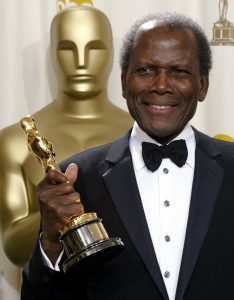
Poitier received numerous honorary prizes, including a lifetime achievement award from the American Film Institute and a special Academy Award in 2002, on the same night that Black performers won both best acting awards, Washington for “Training Day” and Halle Berry for “Monster’s Ball.”
“I’ll always be chasing you, Sidney,” Washington, who had earlier presented the honorary award to Poitier, said during his acceptance speech. “I’ll always be following in your footsteps. There’s nothing I would rather do, sir, nothing I would rather do.”
Poitier had four daughters with his first wife, Juanita Hardy, and two with his second wife, actress Joanna Shimkus, who starred with him in his 1969 film “The Lost Man.” Daughter Sydney Tamaii Poitier appeared on such television series as “Veronica Mars” and “Mr. Knight.”
Sidney Poitier's Life was no bed of roses
His life ended in adulation, but it began in hardship. Poitier was born prematurely, weighing just 3 pounds, in Miami, where his parents had gone to deliver tomatoes from their farm on tiny Cat Island in the Bahamas. He spent his early years on the remote island, which had a population of 1,500 and no electricity, and he quit school at 12 1/2 to help support the family. Three years later, he was sent to live with a brother in Miami; his father was concerned that the street life of Nassau was a bad influence. With $3 in his pocket, Sidney traveled steerage on a mail-cargo ship.
Poitier moved to Harlem and was so overwhelmed by his first winter there he enlisted in the Army, cheating on his age and swearing he was 18 when he had yet to turn 17. Assigned to a mental hospital on Long Island, Poitier was appalled at how cruelly the doctors and nurses treated the soldier patients. In his 1980 autobiography, “This Life,” he related how he escaped the Army by feigning insanity.
Back in Harlem, he was looking in the Amsterdam News for a dishwasher job when he noticed an ad seeking actors at the American Negro Theater. He went there and was handed a script and told to go on the stage. Poitier had never seen a play in his life and could barely read. He stumbled through his lines in a thick Caribbean accent and the director marched him to the door.
“As I walked to the bus, what humiliated me was the suggestion that all he could see in me was a dishwasher. If I submitted to him, I would be aiding him in making that perception a prophetic one,” Poitier later told the AP.
“I got so pissed, I said, ‘I’m going to become an actor — whatever that is. I don’t want to be an actor, but I’ve got to become one to go back there and show him that I could be more than a dishwasher.’ That became my goal.”
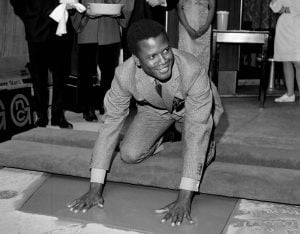
The process took months as he sounded out words from the newspaper. Poitier returned to the American Negro Theater and was again rejected. Then he made a deal: he would act as janitor for the theater in return for acting lessons. When he was released again, his fellow students urged the teachers to let him be in the class play. Another Caribbean, Belafonte, was cast in the lead. When Belafonte couldn’t make a preview performance because it conflicted with his own janitorial duties, his understudy, Poitier, went on.
The audience included a Broadway producer who cast him in an all-Black version of “Lysistrata.” The play lasted four nights, but rave reviews for Poitier won him an understudy job in “Anna Lucasta,” and later he played the lead in the road company. In 1950, he broke through on screen in “No Way Out,” playing a doctor whose patient, a white man, dies and is then harassed by the patient’s bigoted brother, played by Richard Widmark.
Key early films included “Blackboard Jungle,” featuring Poitier as a tough high school student (the actor was well into his 20s at the time) in a violent school; and “The Defiant Ones,” which brought Poitier his first best actor nomination, and the first one for any Black male. The theme of cultural differences turned lighthearted in “Lilies of the Field,” in which Poitier played a Baptist handyman who builds a chapel for a group of Roman Catholic nuns, refugees from Germany. In one memorable scene, he gives them an English lesson.
The only Black actor before Poitier to win a competitive Oscar was Hattie McDaniel, the 1939 best supporting actress for “Gone With the Wind.” No one, including Poitier, thought “Lilies of the Field” his best film, but the times were right (Congress would soon pass the Civil Rights Act of 1964, for which Poitier had lobbied) and the actor was favored even against such competitors as Paul Newman for “Hud” and Albert Finney for “Tom Jones.” Newman was among those rooting for Poitier.
Poitier never pretended that his Oscar was “a magic wand” for Black performers, as he observed after his victory, and he shared his critics’ frustration with some of the roles he took on, confiding that his characters were sometimes so unsexual they became kind of “neuter.” But he also believed himself fortunate and encouraged those who followed him.
“To the young African American filmmakers who have arrived on the playing field, I am filled with pride you are here. I am sure, like me, you have discovered it was never impossible, it was just harder,” he said in 1992 as he received a lifetime achievement award from the American Film Institute. “
“Welcome, young Blacks. Those of us who go before you glance back with satisfaction and leave you with a simple trust: Be true to yourselves and be useful to the journey.”
Messages honoring and mourning Poitier flooded social media, with Whoopi Goldberg writing on Twitter: “He showed us how to reach for the stars.” Tyler Perry on Instagram wrote: “The grace and class that this man has shown throughout his entire life, the example he set for me, not only as a Black man but as a human being will never be forgotten.” And musician Lenny Kravitz wrote that Poitier “showed the world that with vision and grace, all is possible.” /APNews