Guyana’s new ambassador to Venezuela pledges to strengthen bilateral relations
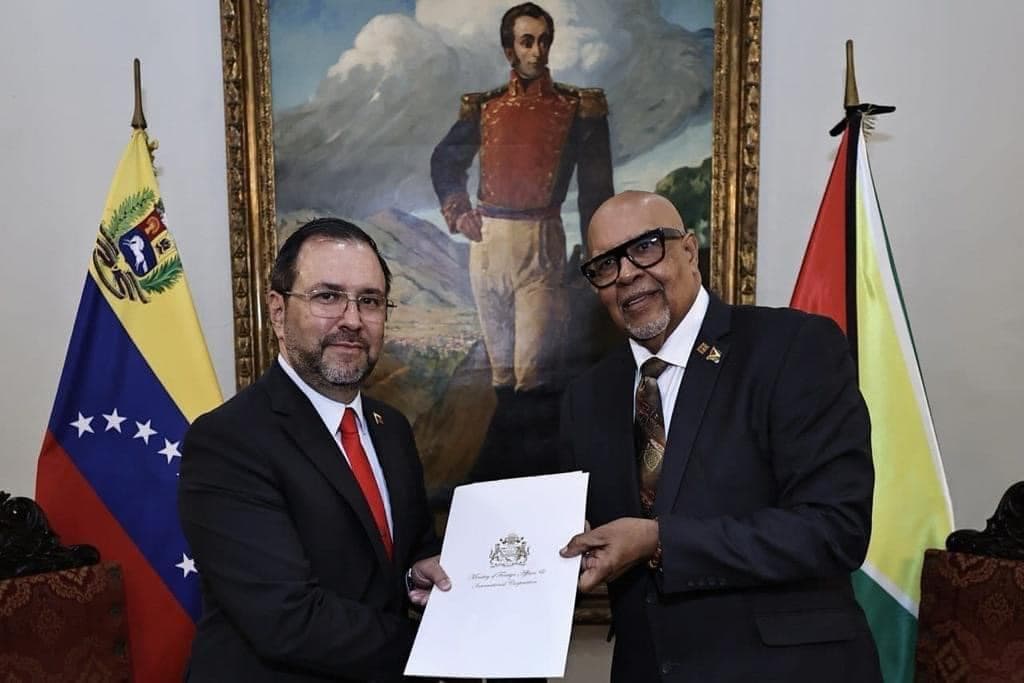
Dr. Richard Van West-Charles, Guyana’s newly appointed ambassador to Venezuela, has formally presented his credentials to Venezuelan President Nicolás Maduro.
The ceremony, held at the Miraflores Presidential Palace on Tuesday, marked the official initiation of Dr. Van West-Charles’ diplomatic tenure.
According to a statement from the Ministry of Foreign Affairs and International Cooperation, Ambassador Van West-Charles conveyed warm regards from His Excellency Dr. Mohamed Irfaan Ali, President of the Cooperative Republic of Guyana, and the people of Guyana.
He emphasized his dedication to advancing the relationship between Guyana and Venezuela.
President Maduro, in response, extended a message of high regard to President Ali, expressing profound respect for both the President and the people of Guyana.
This exchange reflects a mutual acknowledgment of the importance of fostering constructive dialogue and cooperation between the two neighboring nations.
The presentation of credentials symbolizes the shared commitment of Guyana and Venezuela to upholding diplomatic protocols and exploring avenues for enhanced bilateral collaboration.
However, underlying this diplomatic engagement lies a longstanding territorial dispute over the ownership of the Essequibo region.
Navigating territorial challenges
The Essequibo region, constituting approximately two-thirds of Guyana’s territory and home to a significant portion of its population, remains a focal point of contention between the two countries.
The dispute traces its origins back to the 1899 Arbitral Award, which delineated the border between Venezuela and what was then British Guiana.
Both Guyana and Venezuela have presented their cases to the International Court of Justice (ICJ), seeking a resolution to the territorial disagreement.
Despite this legal recourse, tensions persist, with both nations asserting their claims over the contested territory.
Pursuit of diplomatic resolution
In December of last year, leaders from Guyana and Venezuela convened in St. Vincent and the Grenadines for a pivotal meeting.
Following discussions, they reached an agreement to refrain from threatening or employing force against one another, either directly or indirectly.
This commitment underscores a shared commitment to seeking a peaceful resolution to the longstanding border dispute.
The Joint Declaration of Argyle for Dialogue and Peace, a product of these discussions, reaffirmed the commitment of both nations to resolving any disputes in accordance with international law.
This includes adherence to the Geneva Agreement of February 17, 1966, which outlines mechanisms for diplomatic engagement and conflict resolution.