


Belize says it is making progress under an agreement with the International Fund for Agricultural Development (IFAD) and with the Green Climate Fund (GCF), for a loan and grant toward the implementation of the Resilient Rural Belize Program (RRB).
The RRB is a six-year program that ends in 2024, and its development goal is to minimize the impact of climatic and economic events on smallholder farmers while supporting sustainable market access for their produce.
The Ministry of Economic Development in a statement Monday said the first component of the project calls for the administration and implementation of the Program’s Matching Grant Fund (MGF), the main objective of which is to support the achievement of the program’s objectives by co-financing investments that will improve, in volume and quality, smallholder farmer agricultural production and safeguard food security in the context of existing and projected climate change effects.

It said under the second component, there is a possibility for the upgrade of rural roads to benefit beneficiaries of the project and the community as a whole.
The ministry said for any activity to be implemented in areas where indigenous peoples are present such as San Jose Village in the Toledo District, the RRB program had to implement the legally required process of the Free, Prior and Informed Consent (FPIC), a process that is a relatively new practice in Belize.
The RRB Program’s FPIC process road map was developed drawing on IFAD, and GCF requirements, international instruments such as UNDRIP, the Caribbean Court of Justice (CCJ) ruling of 2015 and the Maya of Southern Belize FPI Consultation Protocol.
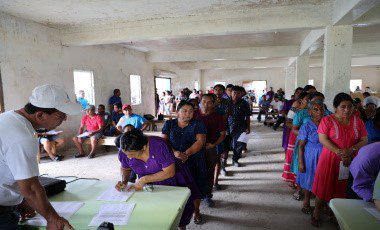
The authorities said consultation with San Jose Toledo Villagers and its leaders commenced in January of 2022 with the objective being to adequately inform the community about the project, its risks, and benefits; to negotiate the content of the program and implementation mechanisms; and to bring the community to a point where they can decide whether to give consent.
They said the process provided the elements for an Indigenous Peoples Plan (IPP) and FPIC agreement to be developed with the community.
“On Sunday…in San Jose Village, Toledo District, the eligible villagers present gave their written “YES” consent to the Indigenous Peoples Plan (IPP) and Free, Prior and Informed Consent (FPIC) Agreement.

“This output of the consultation process is not a simple yes or no, but an agreement and plan that specifies the way forward including how the project will be implemented, benefits shared, how conflict may be resolved (grievance mechanism), and how additional consent, if that were necessary, will be obtained,” the statement said.
CMC











 and with the Green)