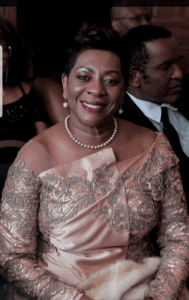
Dr. Rose Marie Adamson-Lewis is furthering her commitment to serving Jamaicans across the diaspora. This year, the board-certified family nurse practitioner, specializing in psychiatric disorders and mental health, is running for the position of Southern United States Representative for the Global Jamaica Diaspora Council. The representative will be a liaison to Jamaica’s Minister of Foreign Affairs across thirteen states.

As the sitting president of the Jamaican Diaspora Southern USA and the past treasurer at the Global Jamaica Diaspora Council Representative, Southern United States, Dr. Adamson-Lewis is already an influential and prominent figure in Jamaica’s diaspora affairs.
She serves on the boards of several community-building organizations, including the South Florida-based nonprofit, Partner For Youth Foundation and the Global Humanity Network. She’s also a recipient of the US President Lifetime Achievement Award for outstanding community service, and takes a medical mission to Jamaica every year and has adopted the Robin’s Hall Health Center in Manchester.

As a stalwart of community development, Dr. Adamson-Lewis possesses a strong connection to her island home, and hopes to spearhead her detailed agenda for change.
Born and raised in Robin’s Hall, Manchester, Jamaica, Dr. Adamson-Lewis’s mind has never strayed from the island she holds dear. “I left Jamaica 40 years ago, but in truth, I have not left Jamaica, really,” she explains. She makes a point to visit the island multiple times a year, either recreationally or on medical missions, and keeps abreast of local affairs.
Fundamentally, she understands that many in Jamaica rely on remittances from members of the diaspora to live. According to a report from the Bank of Jamaica (BOJ) remittances from the United States of America accounted for 72.3 percent of total foreign currency inflow in the first quarter of 2021, up from 69.5 percent in 2020 over the same timeframe. The remittance totaled approximately US$804.3 million. This support can take many forms including monetary transfers and supply barrels containing everything from essentials to Christmas gifts.
Education is another priority for Dr. Adamson-Lewis. “I am encouraging Jamaica to reprioritize STEAM – science, technology, engineering, art, and mathematics – through virtual platforms,” she asserts. She explains that the ever-increasing penetration of affordable digital devices will mean a computer can be in every child’s pocket. If there’s a computer, then there’s also a teacher, she reasons. “If we can go back to those core classes, we can empower young people… to create jobs, sustainability and generate income.” To complement this initiative, she plans to introduce the Birthright Program – which focuses on foreign-born Jamaicans to provide them with scholarship and employment opportunities.
For Dr. Adamson-Lewis, another priority is the Jamaican healthcare system. “Health care is my baby,” she smiles. “If I can facilitate the medical field, particularly the nurses, it will benefit everyone.” Her strategies include increasing the prevalence of remote diagnosis to reduce travel for both patients and practitioners, and promoting technological advancement within the field to ease the tremendous burden on Jamaican healthcare professionals.

As a liaison between governments, Dr. Adamson-Lewis intends to invoke PL 114-291, also known as the United States-Caribbean Strategic Engagement Act. In broad strokes, its policy declares that the United States will seek to increase engagement with the governments of the Caribbean region, which includes Jamaica, with the development of both the civil and private sectors. This multi-layered act has provisions for economic development, crime reduction, diversifying energy sources, and prioritizing human rights. “If we can put education, job creation, and PL 114-291 into strong gear, we can minimize the probability of crime,” she expounds.
Dr. Rose Marie Adamson-Lewis is ready for action. “I’m finding attainable, measurable goals, within variable timelines – short term and long term – so that we can implement them and observe what works and what does not,” she outlines. “I do not just want to talk, I want to have purposeful intervention and implementation, with checks and balances.”