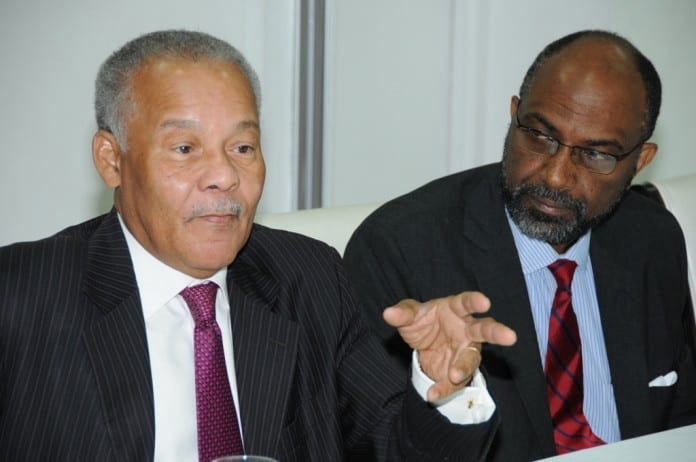
During a Roundtable Discussion on Correspondent Banking in Kingston, Jamaica on January 19, organised by the think tank, the Caribbean Policy and Research Institute (CaPRI) in partnership with the Jamaica National Building Society (JNBS), caribbean stakeholders, including former Prime Minister of Barbados, Owen Arthur, agreed that there is a need for unified Caribbean efforts to combat the growing move by large, mainly US-based international banks, to sever relationships with smaller Caribbean-based financial institutions, including money services businesses.

Addressing participants at the forum, Mr Arthur acknowledged that while Caribbean countries are not the only ones being affected by the move by large banks to “de-risk” their operations, they must form strategic alliances; and, add their voice to the cause; as well as, commit the resources necessary to strengthen their position to resist any unfair application of global regulations and standards.
According to the former Barbados Prime Minister, the practice of de-risking, which involves the closure of accounts of categories of financial institutions deemed high-risk for money laundering and terrorism financing, diminishes the Caribbean’s access to global financial markets and impacts the flow of nearly US $10 billion in remittances to the region, annually.

Against that background, Mr Arthur called for Caribbean countries to ensure their standards and compliance mechanisms meet global requirements, which, he stressed, could be achieved through the implementation of the second phase of the Caribbean Single Market and Economy.
Detailing the implications for trade and reputational damage, as well as compliance costs for businesses which face account closures, Co-executive Director of CaPRI, Dr Damien King similarly noted the need for regional coordination and stronger leadership to develop better systems and standards that improve accountability and reduce the compliance burden.
“And, I don’t mean there’s a leadership in the pejorative sense, but what we have is many jurisdictions at many levels that overlap; and are not consistent; and then international banks responding to that, by setting up their own rules and decisions,” Dr King argued.
He says there is a need for definitions, standards, uniformed policies and streamlined mechanisms to make monitoring and evaluation easier. He noted for example, that Caribbean Banks and money services businesses could design and implement a common system to allow for sharing of data to assist Caribbean institutions to better know their customers.
He says Caribbean governments should also advance the issues as a developmental matter at the international level, an approach the President of the Jamaica Bankers’ Association, Nigel Holness endorsed. Mr Holness said regional leadership is needed to tackle the stigma attached to the Caribbean as being corrupt and shallow on compliance.
However, Leesa Kow, President of the Jamaica Money Remitters’ Association, said an important part of the advocacy approach is also to improve understanding of the broad impact of de-risking practices and who it affects globally; as well as, to deepen understanding of the remittance industry and how it operates.