Michael McCarthy, managing director of Clean Harbours Jamaica Limited (CHJ), says his lifelong passion for the ocean continues to fuel his commitment to protecting Jamaica’s marine environment despite the challenges his company has faced over the years.

“I work where others play and it is the greatest job in the world. Because the Ocean was never just a career choice for me- it is where I feel most alive,” McCarthy said.
For the past eight years, McCarthy has led one of Jamaica’s leading marine waste management companies, navigating obstacles that have included reluctant financial institutions, public resistance and natural disasters.

Yet, he said, his determination has remained strong.
“At the end of the day, seeing cleaner waterways, healthier coastlines, and tangible environmental change is what continues to motivate me. Knowing that our efforts are contributing to a better future for Jamaica and future generations is far greater than any negativity that may exist around the journey.”
Born in Kingston 39 years ago, McCarthy attended Ardenne High School, where he developed an interest in physics, literature and art. He credits his parents — Fernando McCarthy, an auto electrical engineer, and Angela McCarthy, a senior public health nurse — with providing the foundation that shaped his life.

“My dad was a strict disciplinarian and my mom always taught me that anything worth doing was worth doing well. Their teachings, discipline and guidance kept me grounded and helped steer me away from trouble throughout my younger years. So I had a great foundation and was given the latitude to decide what I would become.”
After high school, McCarthy worked for several years with his uncle Solomon in the automotive industry before enrolling at the Jamaica Maritime Institute, where he studied nautical sciences.
His passion for the ocean and environmental conservation eventually led to the creation of Clean Harbours Jamaica Limited, which he co-founded with a group of like-minded partners.

“Having travelled extensively and experiencing firsthand what other countries were doing to protect and preserve their coastlines and waterways, we realized that implementing initiatives of that nature here in Jamaica was, quite frankly, a no-brainer,” he said.
“What started as a shared vision quickly evolved into a mission- to create meaningful change in how we protect our harbours, coastlines, and waterways while proving that Jamaica could stand at the forefront of environmental innovation in the Caribbean.”
Securing funding proved difficult in the company’s early years, as financial institutions were hesitant to recognize the value of maritime assets. Despite the challenges, McCarthy and his partners continued to build the business through partnerships and innovation.
“We continued building through partnerships, innovation, and an unwavering belief in both our vision and the importance of the work we were doing for Jamaica’s marine environment,” he said.
Today, CHJ operates primarily as a marine waste management company specializing in ship-generated waste while providing a range of additional marine services.
In 2025, the National Solid Waste Management Authority formally appointed CHJ as its marine waste management operator through a memorandum of understanding designed to support service delivery while maintaining governance, environmental compliance and operational standards.
The company has also received recognition, approval and operational support from several Jamaican agencies, including the Maritime Authority of Jamaica, the National Environment and Planning Agency and the Port Authority of Jamaica.
CHJ is perhaps best known for its role in the Kingston Harbour Cleanup Project, an international partnership involving The Ocean Cleanup and the GraceKennedy Foundation.
McCarthy said the initiative was sparked by a chance meeting with GraceKennedy Foundation CEO Caroline Mahfood.
“Caroline is, without question, a phenomenal woman and an exceptional human being,” he said.
“In 2019, I attended her annual lecture, which, that year, was on the Kingston Harbour – and it proved to be a decision that, to this day, I still consider one of the best decisions I have ever made. Because that meeting became the catalyst for everything that followed. She also shared my dream of a cleaner, pollution free Kingston Harbour. Soon afterwards, we were introduced virtually to The Ocean Cleanup team from the The Netherlands, who were looking for a Caribbean project to invest in- and the rest, as they say, is history.”
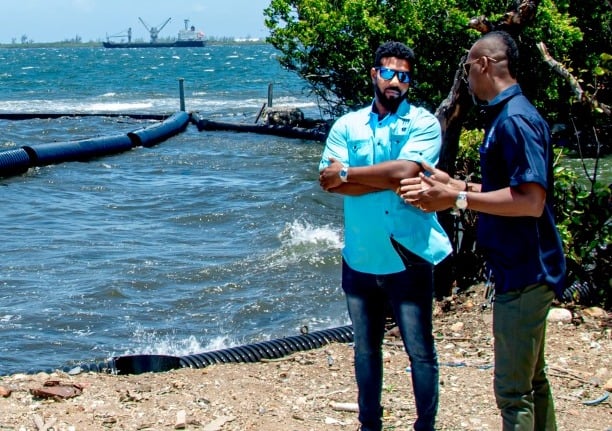
Under the project, CHJ maintains a series of devices known as Interceptors, along with other technology supplied by The Ocean Cleanup, at major gullies feeding into Kingston Harbour. The systems act as large strainers and have prevented nearly six million pounds of waste from entering the harbour.
Some of the Interceptors were damaged during Hurricane Melissa last year, a setback McCarthy described as emotionally difficult.
“Watching that happen was genuinely heartbreaking. After dedicating so much time, energy and sacrifice toward cleaning and protecting the waterways, seeing pollution escape into the harbour due to forces beyond our control was difficult to process emotionally,” he said.
“At the same time, experiences like those have only strengthened our resolve. They have reinforced our determination to continue improving our barrier systems, strengthening our deployment strategies and advancing the technology being used across the Kingston Harbour Cleanup Project.”
McCarthy is scheduled to join Caroline Mahfood and Professor Mona Webber, James Moss Solomon Senior Chair in the Environment at the University of the West Indies, as presenters at the 36th Annual GraceKennedy Foundation Lecture on June 5, World Environment Day.
The lecture, titled The Kingston Harbour Cleanup Project – From Vision to Reality, will examine how partnerships, technology and scientific expertise are helping reduce pollution entering Kingston Harbour. Members of the public can participate virtually through a livestream.
Looking ahead, McCarthy said CHJ intends to expand its reach beyond Jamaica.
“Our vision extends far beyond Jamaica’s shores,” he said.
“Over the next decade, we intend not only to fully realize our ambition of becoming the country’s premier marine waste management provider, but also to expand our expertise and services throughout the wider Caribbean. The goal is for CHJ to become a trusted regional partner capable of supporting neighboring Caribbean nations that seek guidance, operational support, and innovative environmental solutions. We believe that the knowledge, experience, and systems we are building today can help shape a cleaner, more sustainable future not just for Jamaica, but for the Caribbean as a whole.”