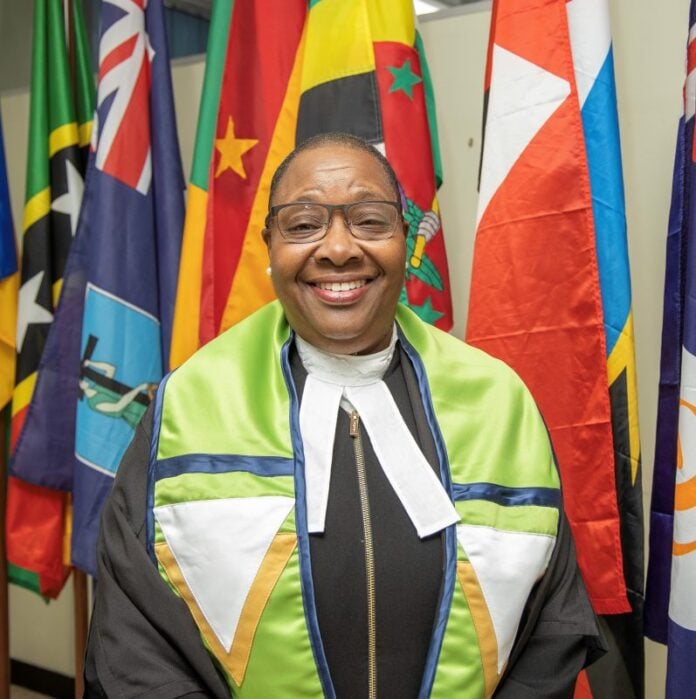
Trinidad and Tobago-born jurist Margaret Price-Findlay has officially been appointed Chief Justice of the Eastern Caribbean Supreme Court, becoming the court’s 14th chief justice and the first woman from Trinidad and Tobago to hold the position.
Price-Findlay, who had been serving in the role in an acting capacity since May 2025, was formally confirmed during a ceremony held Thursday at the court’s headquarters in St Lucia.
Born in Diego Martin, Trinidad, Price-Findlay attended Holy Name Convent before earning her bachelor of laws degree from the University of the West Indies.

She practised law in Trinidad and Tobago from 1987 to 1991 before relocating to the British Virgin Islands, where she built much of her legal career. In 1995, she established the law firm Price Findlay & Co and also served as a magistrate in the territory’s courts.
In 2009, the Judicial and Legal Services Commission of the Caribbean Community appointed her as a High Court judge of the Eastern Caribbean Supreme Court, assigning her to reside in and hear matters in Grenada.
Delivering an emotional address during Thursday’s ceremony, Price-Findlay reflected on her journey and paid tribute to family members, mentors and colleagues who supported her career, including her late parents.

“My father championed every cause I undertook and I know he would have been so proud today,” she said.
Price-Findlay said she never imagined she would one day lead the regional court.
“If anyone had told me when I arrived in the BVI in January 1991 that I would stand before you as Chief Justice of this venerable institution and only the second woman to hold this office, I would have certainly not believed you,” she said.

She acknowledged feeling apprehensive when she was first asked to assume the position in an acting capacity.
“I knew it was not an easy road and I was asked to follow in the footsteps of some of the finest legal minds that have graced this institution,” she said.
Price-Findlay also thanked fellow judges and court staff for their support during her tenure as acting chief justice.
“It has been a learning experience but I have had a staff that was truly the wind beneath my wings,” she said. “There were days when you carried me because I felt overwhelmed.”
Calling for unity and collaboration, she urged members of the judiciary and court administration to work together to strengthen the institution’s legacy.
“We work for a venerable institution called the Eastern Caribbean Supreme Court and we must all roll up our sleeves and put in the hard work for us to succeed,” she said.
“Let’s put our shoulders to the wheel and collectively achieve this goal.”
The Eastern Caribbean Supreme Court serves six independent Caribbean countries and three British Overseas Territories.