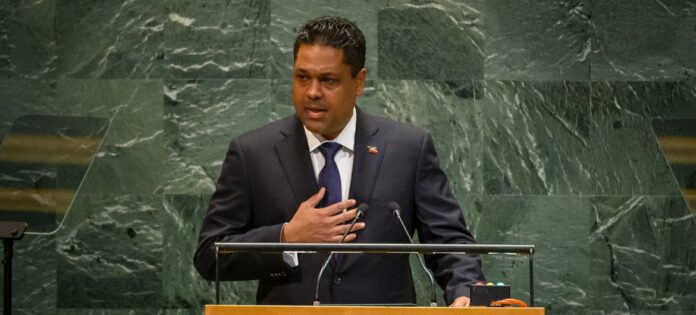
From the podium of the United Nations General Assembly, Haiti’s transitional leader, Laurent Saint-Cyr, delivered a stark plea to the international community, warning that the country is facing a “modern-day Guernica” and a profound human tragedy.
At the heart of Saint-Cyr’s speech was the urgency of ending spiraling violence and addressing centuries of historical injustice. He painted a grim picture of daily life in Haiti: murders, gang rapes, famine, and more than one million displaced people. “It is a war between criminals who want to impose violence as the social order and an unarmed population struggling to preserve human dignity,” he said.
Armed gangs now control large swathes of Port-au-Prince and continue to spread terror nationwide, leaving the Kenyan-led Multinational Security Support Mission (MSS) struggling to contain the crisis. Authorized by the UN Security Council, the mission relies on voluntary contributions, and fewer than 1,000 of the 2,500 pledged police officers have been deployed. While the MSS has secured the main airport and reopened some roads, Saint-Cyr told the UN that “their bravery was not enough to contain the crisis.”

With the MSS mandate due to expire in early October, Haiti, backed by the United States and Panama, is urging the creation of a 5,500-strong Gang Suppression Force under Chapter VII of the UN Charter, which would allow the use of force to restore peace. The plan includes a new UN Support Office in Haiti and a clear mandate to neutralize gangs, secure infrastructure, and restore minimum institutional stability. “Haiti wants peace. Haiti is waiting for peace. Haiti has the right to peace,” Saint-Cyr declared, warning of a security vacuum if action is delayed.
Security is only part of the solution. Since the assassination of President Jovenel Moïse in July 2021, Haiti has lacked an elected government. Successive interim administrations have struggled to restore order. The transitional council, formed in 2024 under CARICOM mediation, is tasked with organizing elections. Saint-Cyr said that more than 85 percent of polling stations have been identified and $65 million secured, calling free and credible elections essential to ending the provisional state.
Saint-Cyr also pressed for reparations from France, recalling the 1825 ordinance that forced Haiti to pay 150 million gold francs in exchange for recognition of independence—a “ransom” that drained the nation’s economy until 1947. “Our voice is raised to demand reparations, not in a spirit of revenge, but with a concern for justice and truth,” he said, noting that France’s National Assembly acknowledged the injustice in June. Haiti has since established a National Committee for Reparations and Restitution.
“Every day that passes benefits the gangs that are suffocating Haiti,” Saint-Cyr warned. He urged the UN Security Council to act quickly, stressing that immediate international intervention is critical to prevent the country from descending further into chaos.