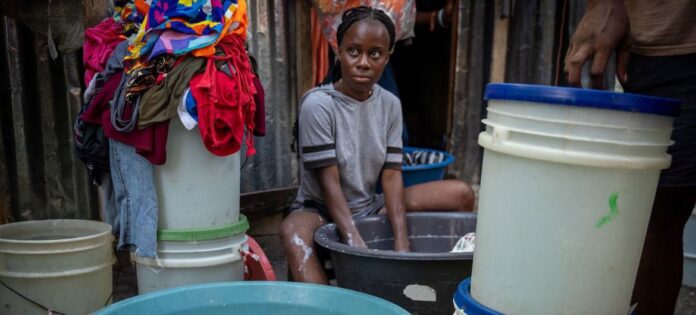
Gang violence, hunger, and instability continue to ravage Haiti as the United Nations’ emergency relief chief called for urgent global action to support families struggling to survive amid severe funding shortfalls.
“We have to do better,” said Tom Fletcher, Under-Secretary-General for Humanitarian Affairs and head of the UN Office for the Coordination of Humanitarian Affairs (OCHA), during a visit to the Caribbean nation on Wednesday. “I’m ashamed on behalf of the world that we cannot find it in ourselves to be more compassionate, to recognize what people here are going through.”
Haiti, a country of 11 million, faces a deepening humanitarian and protection crisis marked by a cholera outbreak, rising malnutrition, and widespread displacement. OCHA reports that half of all Haitians are food insecure, while over one million people — triple the number from last year — have been forced to flee their homes due to gang activity, with large-scale displacements continuing into 2025.

For over a year, gangs have seized control of large areas in and around Port-au-Prince, committing killings, rapes, and kidnappings, and targeting civilian infrastructure including schools and hospitals. “Fear permeates daily life,” OCHA said. “Up to half of all armed group members are children.”
Fletcher visited families living in makeshift shelters and heard firsthand the stories of those displaced. Cashmina Jean-Michel, who once ran a beauty salon, described losing her business and belongings during a gang attack. “At 5 a.m., there was a lot of shooting. I had no choice but to get my children and run immediately,” she said. “Today, I live in a very cramped space in misery, where I can only keep one of my children while the others must stay with friends.”
Food shortages are widespread at displacement sites. Innocent Fagneau, vice-president of one shelter, said, “The quantity of food we receive to distribute finishes by noon, but what about 3 or 4 p.m.? People should still be able to eat something.”
Amid the despair, some programs offer hope. The OCCED’H youth center provides vocational training and education to nearly 300 adolescents living in violence-affected communities and displacement sites. Students like Phanie Sagesse, learning leathercraft, see opportunities for economic independence. “If you take leathercraft seriously and put all your heart into what you are doing, it can help you achieve economic independence,” she said.
Fletcher praised these efforts, emphasizing the need for global support. “We can see that people can rebuild their communities, not just as individuals, but as a society — as Haiti,” he said. “That’s why the world must be here, helping them rebuild from despair and the ruins of their lives.”
Despite the ongoing efforts of UN agencies, Haiti’s humanitarian appeal remains critically underfunded. Of the $908 million needed to address urgent needs, only 11 percent has been received, leaving an $800 million funding gap. “This is not enough,” Fletcher said. “I can’t believe that we’re struggling so much to raise the funds necessary to support these families as they try to rebuild their lives, but we have to be there for them. We have to do better.”