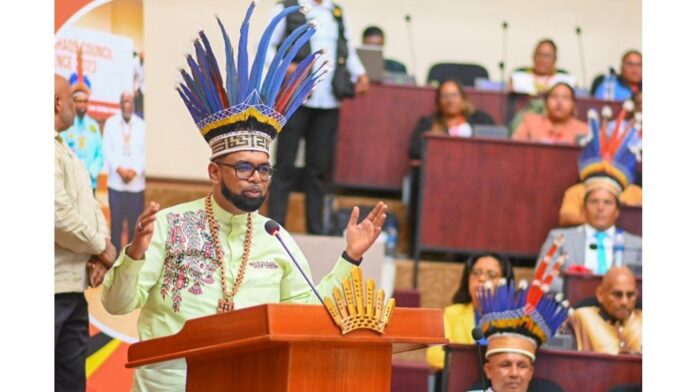
Guyana’s President Mohamed Irfaan Ali on Monday said the government will increase the amount of money paid to Guyana’s Indigenous community from the sale of carbon credits despite the decline in revenue.
“This year, the total revenue received from carbon credit sale is US$87.5 million, which is less than last year. So the 15 percent to Amerindian communities should be less,’ Ali said while speaking at the opening of the National Toshaos Council (NTC) Conference at the Arthur Chung Conference Centre (ACCC).
“Because we are a government that cares for and loves you and believes in giving more, we have taken a decision to allocate 26.5 percent of the earnings this year to Amerindian communities,” Ali said, noting that this would mean an estimated GUY$4.84 billion ($23 Million USD) directly transferred to Amerindian villages.

Guyana’s low carbon development strategy commits 15 percent of all revenues from carbon credit sales to Amerindian villages for investment in village development activities. In 2023, the country received US$150 million and 15 percent meant that US$22.5 million had been allocated to the 242 Indigenous villages.
In addition, a total of seven Indigenous villages received absolute grants and Certificate of Title, with land titling and demarcation for their villages now complete.
Additionally, the Karasaibai District in Region Nine completed its demarcation survey last month and was promised certificates of title within a short period of time.

Ali in delivering the Certificate of Title to the Toshao, said: “I want to acknowledge that these grants and so on come with a lot of work; the surveying is not an easy task. It is a very, very dreadful task in some cases.
Ali said he also asked Finance Minister Dr. Ashni Singh to examine ways that small contracts for furniture and infrastructure can be done in the Indigenous communities.
“In the new program of works, all of that will come directly to you and you will maximize on the labor from your communities,” he added.

Indigenous Peoples – or Amerindians as they are identified both collectively and in legislation – number some 78,500 in the Co-operative Republic of Guyana, or approximately 10.5% of the total population of 746,955 (2012 census). They are the fourth largest ethnic group in Guyana, after East Indians (40%), African Guyanese (29%), and people who identify as “Mixed” (20%)