Jamaica maintains its position regarding the Commonwealth Secretary General post
Key Points(5)
- “In fact, over time two member states –Kenya and Tuvalu-announced candidatures for the post… signaling the pursuit of change by two regions-Africa and the Pacific,” the statement, said noting that Kenya had withdrawn its candidate “with an expressed hope that another candidate would come forward”.
- CARICOM leaders remain divided in their support for the two candidates, including the incumbent Baroness Patricia Scotland, for the position agreeing instead to appoint a sub-committee to delve further into the matter.
- Scotland was elected to the post at the Commonwealth Heads of Government Meeting (<a href="https://thecommonwealth.org/chogm">CHOGM)</a> in Malta in 2015 and her re-election is scheduled to take place during the June 20-25 Commonwealth summit here.
- The Dominica-born Scotland is the second Secretary-General from the Caribbean and the first woman to hold the post.
- But Jamaica said it was necessary to point out that the revised Treaty of Chaguaramas that governs the regional integration movement “aspires towards coordination of foreign policy, including candidatures for positions in external forums, as far as practicable.
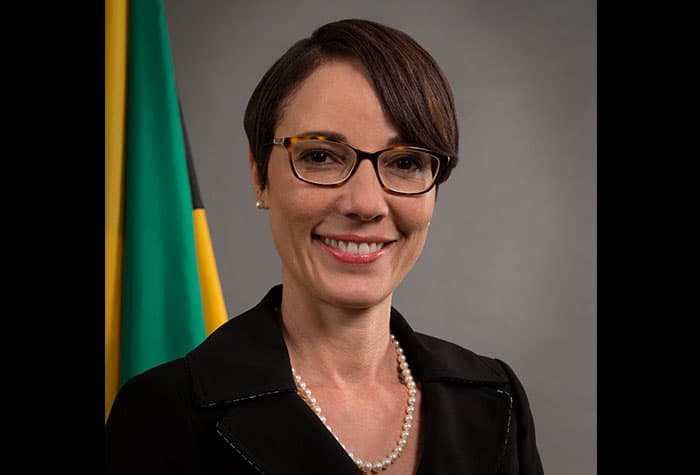
Jamaica is defending the decision to nominate its Foreign Affairs and Foreign Trade Minister, Kamina Johnson Smith for the position of Commonwealth Secretary General
In a two-page statement, the government of Prime Minister Andrew Holness said that the nomination was put forward “in a context where a change of leadership was clearly desirable by member states across regions.
“In fact, over time two member states –Kenya and Tuvalu-announced candidatures for the post… signaling the pursuit of change by two regions-Africa and the Pacific,” the statement, said noting that Kenya had withdrawn its candidate “with an expressed hope that another candidate would come forward”.
CARICOM leaders remain divided in their support for the two candidates, including the incumbent Baroness Patricia Scotland, for the position agreeing instead to appoint a sub-committee to delve further into the matter.
Scotland was elected to the post at the Commonwealth Heads of Government Meeting (CHOGM) in Malta in 2015 and her re-election is scheduled to take place during the June 20-25 Commonwealth summit here.
The Dominica-born Scotland is the second Secretary-General from the Caribbean and the first woman to hold the post.
In its statement, Kingston said “Jamaica’s final decision” to put forward the candidature of Kamina Johnson Smith was made within the context of other regions expressing a desire for change “and on the strength of the government’s confidence that she has the full range of competencies to effectively lead the Commonwealth agenda at this time”.
The statement said that Johnson Smith has in recent weeks been engaged in high-level discussions across five Commonwealth regions and that in the process of these engagements “several countries have asked about the existence of two CARICOM candidates as well as a new narrative regarding there being “no vacancy in the office”.
But Jamaica said it was necessary to point out that the revised Treaty of Chaguaramas that governs the regional integration movement “aspires towards coordination of foreign policy, including candidatures for positions in external forums, as far as practicable.
“It does not mandate harmonization and acknowledges, therefore, the sovereign decisions of member states. Jamaica’s decision was made not only within the latitude in the CARICOM treaty but more importantly, by virtue of its conviction that the leadership being offered would be in the interest of the Commonwealth”.
Jamaica said that CARICOM leaders and their foreign ministers “have had several discussions on the bid of the incumbent…to remain in office for a second term/.
“Although the most recent Communique of Heads reflected language of ”overwhelming” support for Baroness Scotland, she was the sole candidate at that time, but even then, her bid for re-appointment for a second term of four years was not collectively endorsed.