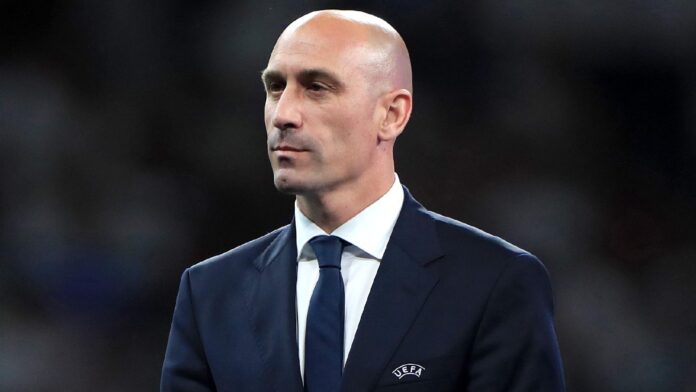
The Spanish soccer official, Luis Rubiales, who ignited a player rebellion and sparked discussions on gender boundaries by kissing an unwilling star player during the Women’s World Cup final trophy ceremony, has been banned for three years by FIFA, the global governing body of soccer.
Rubiales’ actions during the Women’s World Cup final in Australia on August 20, where he kissed player Jenni Hermoso without her consent, caused significant controversy. Despite calls for his resignation, Rubiales remained as the president of the Spanish soccer federation for three weeks following the incident.
As a result of the ban, Rubiales is prohibited from working in soccer until after the men’s 2026 World Cup. However, his ban will conclude prior to the next women’s tournament in 2027.

Spanish authorities have launched a criminal investigation against Rubiales, charging him with sexual assault and coercion for the unwanted kiss incident and his behavior during its aftermath.
FIFA initiated investigation
FIFA initiated an investigation to determine whether Rubiales violated principles of decent conduct and brought disrepute to the sport and the organization.
Another incident cited by FIFA during its investigation involved Rubiales making an inappropriate gesture by grabbing his crotch as a victory celebration while in the presence of Queen Letizia of Spain and Princess Sofía during the Women’s World Cup final.
Rubiales’ suspension brings attention to instances of sexual misconduct by male soccer officials against female players on national teams. This issue has surfaced in multiple countries, including Haiti and Zambia, during the qualification process for the Women’s World Cup hosted by Australia and New Zealand.
Before the Women’s World Cup, allegations of a sexual nature concerning Rubiales’ managerial culture had already emerged, raising concerns about his leadership at the national federation since 2018.
Marred by dissatisfaction
The preparation of the Spanish women’s team for the tournament was marred by dissatisfaction with their male coach, Jorge Vilda, who was supported by Rubiales despite objections from 15 players who requested not to be called up again due to emotional distress. Three players continued to refuse selection for the World Cup.

Rubiales ultimately resigned from his soccer positions on September 10 after three weeks of resistance, which was met with increasing pressure from the Spanish government and national-team players.
Rubiales, who also held the vice presidency of European soccer body UEFA, left that role, which paid him 250,000 euros ($265,000) annually. His resignation from these positions came as Spain was bidding to host the men’s 2030 World Cup in collaboration with Portugal and Morocco. FIFA later selected this bid as the sole candidate to host the 2030 tournament, expanding the plan to include Argentina, Paraguay, and Uruguay.
Rubiales retains the option to appeal his three-year ban, initially through FIFA and subsequently at the Court of Arbitration for Sport.
FIFA emphasized its commitment to upholding integrity and maintaining standards of decency in its statement following the ban announcement.