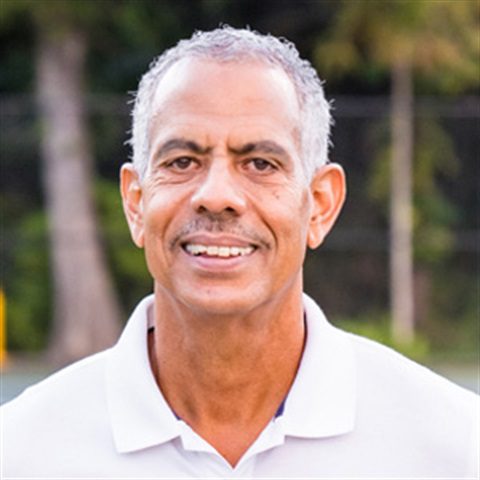
In the world of tennis, “love” literally means nothing, but for former professional Jamaican tennis player turned South Florida coach Compton Russell it’s the sport that he adores.
Russell’s foray into tennis began as a little boy growing up in Kingston, Jamaica, seeing his older cousin Richard Russell dominating the game. “I went to watch one of his important matches and decided I wanted to play also,” says Compton. Richard began teaching Compton the sport during his spare time and subsequently, the younger Russell fell in love. “I played my first tournament in 1964,” he says. “And it led to me eventually becoming the Jamaican champion and then Caribbean champion.”
With racial tensions at a high in the ’70s, Russell moved stateside to attend the University of California, Los Angeles (UCLA), in 1971. Experiencing segregation and seeing the mistreatment of black people simply based on the color of their skin then spurred a transformation in him. “I became radicalized for social change and became more racially conscious,” Russell says of the time. “When I came back from college a year later in 1972, Jamaica started to go through its social change with Michael Manley and Bob Marley. What we were having was a political and social evolution of consciousness.”

While continuing to play tennis Russell began learning and following the philosophy of Rastafarianism, which included growing locs. His choice to do so however would become a point of contention for members of society, so much so that while he was the local champion and more than eligible for the Jamaican National Tennis team, for two years, he wasn’t allowed to play on the team.
It was during this time that Russell crossed paths with Bob Marley, the iconic reggae musician and fellow Rastafarian. The two formed a friendship rooted in their shared love and commitment to the Rastafarian principles of unity and spirituality. Marley, known for his advocacy of peace and social justice, saw in Russell a kindred spirit who embodied the values of resilience and determination, and along with friend Allan “Skill” Cole dubbed him ‘Tennis Dread’.

“In the seventies, we became a Rasta community. We were the dutty Rasta’s, so it is quite an evolution that now I’m sitting in my living room and seeing so many ads that have a song by Bob Marley. When we weren’t given a chance back then. Now there is an acceptance but we can’t forget the ‘down-pression’ and push back on us simply because of our hair,” he says.
Exclusive: Bob Marley’s best friend Allan ‘Skill’ Cole talks ‘One Love’
With the help of Island Records Chris Blackwell, Russell was later given the opportunity to continue playing tennis all over the world, (United Kingdom, United States, Australia, Venezuela, China, Japan, and more) representing Jamaica with his remarkable skills and locs.
In the mid-80s, Russell retired from professional competition and seamlessly transitioned into coaching which led him to leave Jamaica’s shores in the 90s, for South Florida with his family that includes his wife Tracy, daughter Simone, and son David who is now also a tennis professional.
As Russell reminisces about the game he points out that it has grown significantly since his days of idolizing Arthur Ashe and Stan Smith. “Today’s game has evolved in technique and strategy and continues to become more exciting with the evolution of equipment. The game is at the highest peak it has ever been at,” he says.
With the Miami Open 2024 set to culminate this weekend, he is asked if he has any predictions on who will win, but like any good tennis player, he understands that the game can be unpredictable. Yet he indulges letting us know he has high hopes for Jannik Sinner and Carlos Alcaraz in the men’s division and Iga Swiatek and Coco Gauff in the women’s.
Of tennis and what it has done for him, he concludes, “I’m very happy that this sport could do all that it has for me. I’m lucky I have been able to play tennis all my life. It has been a blessing and I give thanks for that.”