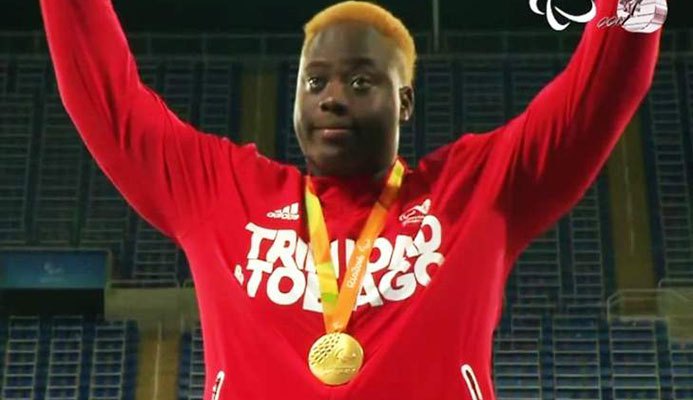
PORT OF SPAIN, Trinidad — Trinidad and Tobago’s most decorated Paralympian, Akeem Stewart, has voiced deep frustration over what he describes as years of neglect and inequitable treatment from his country’s sporting authorities.
Despite being a two-time Paralympic medalist and a global record holder, Stewart revealed that he has received no financial support from the government in recent years — a situation he says underscores the persistent marginalization of athletes with disabilities.
“After I came back from Paris, we submitted documents last year September and from then to now I haven’t received funding,” Stewart disclosed during an interview on Isports i95.5 FM on Thursday.

“I’ve never received any sort of advanced or elite funding. Back in 2020, when they had COVID-19, that was the only time I got help — and that was just temporary.”
A champion without support
At 33 years old, Stewart remains one of Trinidad and Tobago’s most accomplished athletes on the international stage. He famously captured the nation’s first-ever Paralympic gold medal in 2016, then added another historic silver at the World Para Athletics Championships in India just last month, where he placed second in the men’s F44 discus.
Yet, his accomplishments have not translated into tangible recognition or consistent backing at home. Instead, Stewart says he and his fellow Paralympians continue to be treated as “lesser athletes” despite matching — and often surpassing — the performances of their able-bodied peers.
“Paralympians are always treated like lesser individuals,” he lamented. “They look down on us because, number one, we don’t look like a normal person. People judge you based on your physical appearance and assume our competition is easy — but I can tell you, most people couldn’t come to the Paralympics and walk away with a medal that easy.”
“Thirty percent of a human being”
Adding to his discontent is the glaring disparity in government bonuses for medal-winning athletes. Stewart revealed that when he earned a silver medal at the 2024 Paralympic Games in Paris, his reward was a fraction of what his able-bodied counterparts received.
“For able-bodied athletes, a win at the Olympic Games is TT$1 million, $500,000, and either $100,000 or $200,000. I received $150,000 — and that clearly indicates that I am considered 30 percent of an average human being, and that sucks,” Stewart said bluntly.

The inequality extends beyond the Olympics. At the World Championships, athletes such as Keshorn Walcott and Jereem Richards were recently awarded TT$500,000 and TT$250,000, respectively, for their gold and silver medal performances. By contrast, Stewart said he was slated to receive just TT$75,000 for his silver at the World Para Athletics Championships.
Fighting for respect and recognition
Stewart’s frustration is not rooted merely in finances, but in respect — or the lack thereof. His comments reflect a broader struggle for equity and visibility within Trinidad and Tobago’s sporting system, where Paralympic athletes often operate with limited funding, minimal infrastructure, and little institutional support.
“They see the level of competition and think it’s easy,” he said, “but the truth is, what we do requires the same discipline, sacrifice, and excellence as any other sport. The only difference is we do it while overcoming obstacles others can’t even imagine.”
A voice for change
Akeem Stewart’s public stand comes as a rallying cry for a more inclusive and just sporting environment — one where athletes with disabilities are valued not for their limitations, but for their achievements and resilience.
His message to policymakers is unmistakable: parity in recognition and support is long overdue.
“We represent this country just like anyone else,” he reminded. “We wear the same colors, we raise the same flag — but the way we’re treated makes it seem like we’re invisible.”