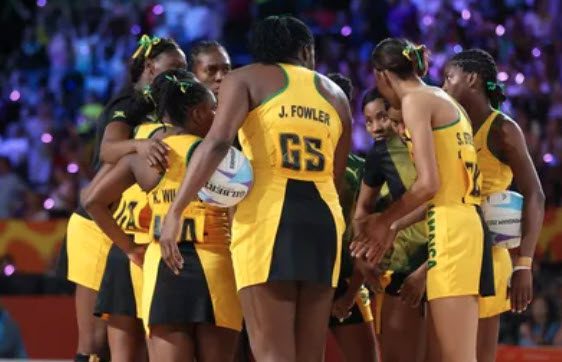
Australia left no doubt. In a display of depth, discipline, and clinical execution, the world number one Diamonds completed a comprehensive 3-0 sweep of Jamaica’s Sunshine Girls with an emphatic 80-33 victory in Melbourne, sealing a series defined by dominance.

Across the three-Test series, the Australians imposed themselves with unrelenting precision, defeating Jamaica by an average margin of 31 goals. The Sunshine Girls fell 71–42 in the opener, 73–41 in the second encounter, and then endured their heaviest defeat in the finale.
For Jamaica, it was a sobering tour, made more difficult by the absence of several elite players, and one that revealed the gulf in preparation between the two sides at this stage of the international cycle.

Early control, relentless pressure
The final Test followed a now-familiar script.
Australia seized control from the outset, suffocating Jamaica’s attacking rhythm and restricting them to just six goals in the opening quarter to establish an 18-6 lead. The Diamonds’ defensive intensity disrupted passing lanes, forced turnovers, and converted possession with ruthless efficiency.
By halftime, the margin had stretched to 35-18. Jamaica’s most competitive spell came in the second quarter, where they managed 12 goals, their most productive stretch of the contest, but even then, Australia comfortably outscored them 17-12 to maintain firm command.

Any hope of a second-half response was quickly extinguished. The Diamonds accelerated in the third quarter, widening the gap to 56-28 before delivering a crushing 21-5 final-quarter surge. The five goals represented Jamaica’s lowest-scoring quarter of the entire series, underscoring the scale of Australia’s defensive control.
Allison provides lone bright spot
Amid the lopsided scoreline, goal shooter Gezelle Allison produced one of the few encouraging individual performances for Jamaica.
Allison converted 20 of her 24 attempts, including an impressive 11-from-12 return in the second quarter, accounting for more than half of her team’s output on the day. Her efficiency, however, stood in contrast to the broader attacking struggles that plagued the Sunshine Girls throughout the series.

Turnovers, disrupted transitions, and difficulty sustaining scoring momentum remained persistent issues against Australia’s structured defensive unit.
Absences and adjustment
The squad was without several established senior figures, including captain Jhaniele Fowler, Shamera Sterling, Jodi-Ann Ward, Adean Thomas, and Shimona Nelson. In the final Test, defender Kadie-Ann Dehaney was also ruled out due to injury, further limiting options in the defensive third.
The missing experience and cohesion were evident against an Australian side operating with continuity and sharpness. Australia’s combinations looked settled, their rotations seamless, and their conditioning superior across all four quarters.
For Jamaica, the tour became as much about evaluation as competition.
Lessons ahead of the Commonwealth Games
The back-to-back series defeats to England and Australia have provided a stark assessment of where the Sunshine Girls stand as they build toward the Commonwealth Games.
The gap in match readiness, execution under pressure, and overall fitness was exposed against two of the sport’s elite programs. Australia, in particular, demonstrated the standard required, a benchmark Jamaica must now chase in the months ahead.
While the results were heavy, the experience offers clarity. Squad balance, defensive depth, attacking structure, and physical conditioning will all demand urgent attention as selectors assess the optimal combination moving forward.
The Diamonds, meanwhile, reinforced their status as the sport’s gold standard — clinical, composed, and uncompromising from first whistle to last.
For the Sunshine Girls, the path forward is clear. The rebuilding phase must now accelerate.