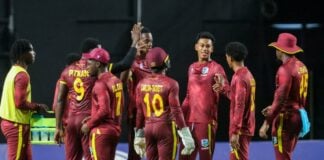
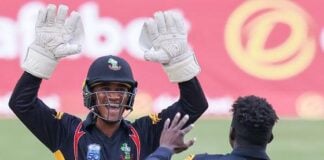
Under the fading light of Sabina Park on Monday, the West Indies suffered one of the most humiliating defeats in Test history.

Chasing 204 for victory in the first day-night Test at the venue, they were dismantled for just 27 runs, the second-lowest total ever recorded in Test cricket.
Australia’s relentless pace attack needed a mere 14.3 overs to complete the demolition, securing a resounding 176-run victory and a 3-0 sweep of the Frank Worrell Trophy.

Had it not been for a misfield by 19-year-old debutant Sam Konstas, the West Indies would have matched the all-time record low of 26, set by New Zealand against England in 1955. Instead, they narrowly avoided that unwanted piece of history.
Starc’s historic burst: Five wickets in 15 balls
Mitchell Starc led Australia’s destruction with a spell of fast bowling that bordered on the unreal. The tall left-arm quick struck with the very first ball of the innings, removing opener John Campbell with a delivery that moved late and found the edge, comfortably taken by concussion substitute wicketkeeper Josh Inglis.
From there, Starc unleashed carnage: Kevlon Anderson was trapped lbw. Brandon King was bowled for a golden duck. Mikyle Lewis followed soon after for 4. Shai Hope, the last recognized batter, was pinned lbw by a thunderbolt that swung viciously.

Within 15 deliveries, Starc claimed five wickets, the fastest five-wicket haul in Test history, en route to sensational figures of 6 for 9. It was also his 15th five-wicket haul in Tests and a fitting follow-up to claiming his 400th career wicket in his 100th Test match earlier in the series.
“It’s been a fantastic series,” Starc said with a smile. “We saw last night how tough batting can be with the hard pink ball under lights. We didn’t think it would happen this quickly today, until the sun went down a bit. It’s been very enjoyable, and I’ll go home with a smile on my face.”
Boland’s hat-trick seals the rout
While Starc was the chief destroyer, Scott Boland provided the coup de grâce with a Test hat-trick—Australia’s 10th in history.

Boland dismissed Justin Greaves, Shamar Joseph, and Jomel Warrican in successive deliveries, reducing the West Indies to rubble. He finished with scarcely believable figures of 3 wickets for 2 runs.
The collapse was so swift that by the sixth over the West Indies were 11 for 6, teetering on the brink of the lowest Test total in history. Excluding extras, the top six batters collectively managed just six runs. Only four players in the entire lineup troubled the scorers.
A misfield saves a record—barely
By the dinner break, the score limped to 22 for 6, courtesy of two dropped chances in the slips off Starc. Then came the moment of reprieve for West Indies cricket’s record books: a simple misfield from Konstas in the deep gifted a single, pushing the score to 27—one run better than the lowest Test total in history.
But it was only a temporary stay of execution. Starc returned to clean up Jayden Searles with a searing full delivery, ending the innings and the match before the lights fully took hold.
From hope to heartbreak
Earlier in the day, West Indies’ bowlers had fought valiantly. Alzarri Joseph produced a spirited effort, taking 5 for 27 as Australia were bowled out for 121 in their second innings, setting a manageable target of 204.
Australia, resuming on 99 for 6, added just 22 more runs as Cameron Green fell to the first ball of Day 3, and the lower order folded quickly.
But any hope for the West Indies evaporated within minutes of their reply. The batting lineup simply failed to withstand the pink ball’s movement under fading daylight.
Australia’s dominance and West Indies’ despair
This crushing defeat capped a series dominated by Australia’s bowlers, who won the first Test in Barbados by 159 runs, the second in Grenada by 133 runs, and the finale in Jamaica by 176 runs.
For the West Indies, the 27-run debacle is their lowest ever Test total, surpassing the infamous 47 against England at the same ground in 2004. For Australia, it was a showcase of precision, skill, and ruthless efficiency under lights.
As the Frank Worrell Trophy returns to Australian hands, the West Indies are left searching for answers to a batting crisis that continues to deepen.