Home Blog Page 93

Barbados Magistrate Oliver Thomas dies suddenly at 39

Oliver Thomas

Three weeks after being sworn in as a magistrate, former Barbados prosecutor Oliver Thomas has died suddenly at the age of 39.

Thomas, who had been appointed to the bench on January 2, passed away today, a day after presiding over multiple cases in Criminal Court No.1 at the District “A” Magistrates’ Court. Among the matters he heard yesterday were the case of Jayden Tyrell Haynes, accused in an alleged mass shooting on Hincks Street, and Dario Demario Ifill of Richard Land, Bush Hall, St Michael, who admitted to possessing cannabis.

Admitted to the Bar in 2014, Thomas joined the office of the Director of Public Prosecutions in 2015 and rose to the position of Principal State Counsel before his appointment as magistrate. He also contributed to the legal community as a tutor in the Regional Security Systems Fisheries Prosecution and Interdiction Course and served on the Disciplinary Committee of the Barbados Boxing Association.

Thomas came from a family with a notable legal and law enforcement background. He was the grandson of Marcus Thomas, the first Police Commissioner of independent St Vincent and the Grenadines, and the son of Justice Errol Thomas, a former High Court judge of the Eastern Caribbean Supreme Court.

He married in June last year.

Jakes Hotel unveils 2026 programming following reopening

Jakes Hotel

On Jamaica’s magnetic south coast, Jakes Hotel is stepping into 2026 with a renewed sense of rhythm, signaling a return to gatherings, movement, food, and storytelling following its December reopening after Hurricane Melissa.

The Treasure Beach landmark is entering the new year with expanded programming, the return of popular excursions, newly restored accommodations, and the milestone 30th anniversary of the Jakes Off-Road Triathlon—one of the Caribbean’s most distinctive endurance events. The season also doubles as a quiet celebration of founder Sally Henzell’s enduring creative vision, which continues to shape the property’s community-centered ethos.

To mark the moment, Jakes is offering 30 percent off accommodations for new bookings of two nights or more through June 30, 2026. The promotion applies to hotel rooms and bungalows, with select cottages and villas included. Bookings must be made by June 28, 2026, using the code “Travel.”

Life at Jakes has returned to its familiar rhythm, centered around swims in the sea, bike rides along back roads, and long afternoons that spill into music-filled evenings at Jack Sprat Bar & Restaurant. Fresh fish arrives straight from the boats, lobster pizza remains a staple, and the beachfront space once again serves as a gathering point for locals and visitors alike. Artists, athletes, writers, and wanderers mix easily here, reinforcing Jakes’ reputation as the social heart of the south coast.

That energy will peak on Saturday, April 25, 2026, when the global athletic community descends on Treasure Beach for the 30th staging of the Jakes Off-Road Triathlon, the longest-running off-road triathlon in the world. The event features a 300-meter ocean swim, a 25-kilometer back-country mountain bike ride, and a 7-kilometer trail run through farmland and fishing villages, including the grueling climb through Big Ground. While elite athletes compete, the event remains as much a community festival as a race, drawing spectators from around the world.

Excursions return to the South Coast

Beyond the hotel grounds, key south coast attractions are also reopening. YS Falls resumes operations on January 24, followed by the return of the iconic Pelican Bar on January 31. Experiences at Appleton Rum Estate are expected to restart later in the season, while Captain Dennis’ Beach Picnic is already welcoming guests back.

Food remains central to the Jakes experience, particularly in St. Elizabeth, widely regarded as Jamaica’s breadbasket. On January 31, the hotel launches the first in a new series of Thatch Walk dining events, spotlighting local farmers, fishermen, and seasonal ingredients. Additional culinary gatherings are planned throughout the year.

Looking ahead, four fully renovated seaside bungalows are set to debut in February, expanding the hotel’s accommodations while remaining faithful to Henzell’s sculptural, playful design language. The season also carries personal significance for the Henzell family, with celebrations planned around Sally Henzell’s 85th birthday in March.

As Jakes approaches the anniversaries of Jack Sprat on February 14 and Jakes Hotel on March 7, the property enters 2026 grounded in continuity rather than reinvention. For travelers drawn to movement, music, shared tables, and genuine community, the season offers an invitation to experience a place that continues to evolve without losing its soul.

Winter rates start at $209 per night, with summer rates beginning at $175. More information is available at jakeshotel.com.

Six Senses La Sagesse targets solo travelers with new wellness experiences

Six Senses La Sagesse

Six Senses La Sagesse is expanding its wellness-focused offerings in 2026, introducing new nature-led experiences, visiting practitioners, and restorative programs designed to deepen relaxation and personalization—particularly for solo travelers seeking meaningful, slow-paced escapes.

Set against Grenada’s lush landscapes, the resort’s latest updates build on its holistic approach to wellbeing, blending immersive rituals, limited-time expert residencies, and experiences rooted in the island’s natural and cultural rhythms.

Among the newest additions is a Floating Sound Bath, an immersive wellness ritual that combines gentle water buoyancy with vibrational sound therapy. Guided by the resort’s wellness team, the experience is designed to encourage deep relaxation, nervous system reset, and a heightened sense of presence.

Six Senses La Sagesse is also continuing its Visiting Practitioners Program, which brings internationally respected wellness experts to the resort for short-term residencies, allowing guests to further tailor their stays.

  • Virginia Miller, known for intuitive therapeutic bodywork and craniosacral techniques, is offering treatments including Gua Sha and lymphatic facials, as well as biodynamic craniosacral therapy. Her residency runs through January 21, 2026.

  • Daniel Weinberg will be in residence from January 26 to February 6, 2026, offering neurofunctional and Japanese-style acupuncture, along with cosmetic facial enhancement treatments rooted in individualized healing practices.

  • Erin Nikole, whose work focuses on grounding and inner vitality, will offer custom breathwork programs and a series of ritual-based sessions from March 1 through March 13.

The expanded programming also positions Six Senses La Sagesse as a natural fit for solo travelers. Designed to balance privacy with gentle guidance, the resort allows independent guests to move at their own pace while engaging in structured wellness rituals, movement sessions, and mindfulness practices throughout the day.

Solo guests can participate in the resort’s Digital Detox Program, as well as personalized elements of the Eat with Six Senses and Sleep with Six Senses initiatives, which focus on nourishment, rest, and overall balance. Beyond the resort, guided rainforest hikes and waterfall swims offer an accessible way for solo travelers to explore Grenada’s interior with expert support.

Together, the new wellness journeys and practitioner-led experiences underscore Six Senses La Sagesse’s ongoing commitment to thoughtful, nature-driven hospitality—encouraging guests to slow down, reconnect, and restore in one of the Caribbean’s most naturally rich settings.

Jamaica unveils ambitious tourism recovery plan post-Hurricane Melissa

Pictured: Minister of Tourism, Hon Edmund Bartlett (c-r) and Deputy Director of Tourism, Americas, Philip Rose (c) pause for a photo opportunity with top trade and consumer media at a luncheon to provide recovery updates on the sector in New York on Thursday January 15, 2026.

Jamaica is taking bold steps to rebuild and future-proof its tourism sector following the unprecedented impact of Category 5 Hurricane Melissa, which brought sustained winds of 185 mph and gusts up to 252 mph.

Speaking in New York on January 18, Minister of Tourism, Hon. Edmund Bartlett, outlined a recovery strategy that prioritizes resilience, sustainability, and innovation to ensure the industry emerges stronger than before.

“When we have mega disruptions of whatever type, whether weather-related or otherwise, the world recognizes that Jamaica is somewhere to visit, that Jamaica is a safe destination, that Jamaica is secure, and that Jamaica will give them a seamless experience,” Minister Bartlett said. He highlighted Jamaica’s competitive advantages, including world-class accommodations, vibrant ambience, and “people with hospitality in their DNA—people with a purpose.”

The recovery framework focuses on building infrastructure resilience, including reconstructing vulnerable areas and reimagining resort zones and coastal townships such as Black River with more dynamic tourist experiences. Environmental sustainability and workforce development are also central to the plan, preparing the sector to adapt to climate change and evolving traveler expectations.

“Our workers are at the core of our recovery strategy,” the Minister noted. “Through relief initiatives and training, they will get back to their livelihoods and lead in providing high-touch service to visitors in this post-hurricane period.”

Diversification into emerging markets, including Latin America and the Gulf Cooperation Council (GCC) countries, is another priority as Jamaica seeks to expand its tourism footprint globally. “This reimagining is about future-proofing Jamaica’s most vital economic sector,” Minister Bartlett emphasized. “We are rebuilding tourism to sustain our people’s livelihoods for generations to come, while preserving the natural beauty and cultural richness that make Jamaica truly special.”

Despite the hurricane’s devastation, more than 70 percent of hotels have reopened, with all airports, cruise ports, attractions, and tours fully operational. The Ministry will continue collaborating with industry stakeholders, international partners, and local communities to implement this forward-looking vision.

Miami-Dade Public Schools tops nation with 97 national Magnet Merit Awards

Miami-Dade Public Schools

Miami-Dade County Public Schools (M-DCPS) has once again cemented its reputation as a leader in innovative education, receiving 97 Magnet Merit Awards from Magnet Schools of America (MSA) for the 2025–2026 award cycle—more than any other district in the United States.

The awards recognize magnet schools and programs for excellence in academic standards, curriculum innovation, equitable access, specialized teaching staff, and parent and community engagement. M-DCPS earned 61 Magnet Schools of Excellence Merit Awards and 36 Magnet Schools of Distinction Merit Awards. In addition, 14 magnet schools are under consideration for a Top-Performing Magnet School Merit Award. Schools receiving MSA Merit Awards rank among the top 5% of magnet schools nationwide, with Excellence recipients recognized as National Exemplary Magnet School Models.

“These awards reflect our ongoing commitment to providing dynamic, high-quality educational experiences for students across Miami-Dade,” said M-DCPS officials. “Our magnet schools continue to set the standard for academic excellence and innovation, ensuring that families have access to outstanding opportunities across the district.”

Over the past 14 years, M-DCPS schools have amassed a total of 807 Magnet Merit Awards, highlighting the district’s sustained focus on creating enriching educational environments that meet the Magnet School Standards of Excellence.

Among this year’s honorees, Schools of Distinction include Dr. Henry E. Perrine Academy of the Arts, Joella C. Good Elementary, and TERRA Environmental Research Institute, while Schools of Excellence include Ben Sheppard Elementary, Air Base K-8 Center for International Education, and Coral Reef Senior High School. Top Magnet Schools of Excellence recipients include Bowman Ashe/Doolin K-8 Academy, iPreparatory Academy, and Hialeah-Miami Lakes Senior High School.

The recognition showcases M-DCPS’ dedication to cultivating exceptional academic programs, fostering equitable access, and encouraging community involvement, positioning the district as a national leader in magnet education.

Jamaica Brew Literary and Film Festival returns with expanded line-up in South Florida

Jamaica Brew Literary

All is set for the third annual Jamaica Brew Literary and Film Festival, which will unfold on Saturday, January 31, at the Broward County Southwest Regional Library in Pembroke Pines, presented by the Consulate of Jamaica in Miami.

The free, day-long event opens at 9:00 a.m. with complimentary Jamaica Blue Mountain coffee, followed by book sales and signings featuring a wide cross-section of Jamaican and Caribbean authors and poets. Special presentations and panel discussions will run throughout the day, with the festival concluding at 5:00 p.m. after a two-hour showcase of short films.

The festival is held in recognition of Jamaica Blue Mountain Coffee Day, observed on January 9, and was created to spotlight Jamaica’s creative industries. According to Consul General Oliver Mair, the event serves as a platform for Jamaican storytellers. “It’s about telling our stories to the world—our worth and who we are as a people,” he said.

New this year is a Children’s Corner, inspired by the traditional Ring-Ding games and cultural legacy of national icon Louise Bennett-Coverley (Miss Lou). The area will also feature exhibitions by emerging artists. Another highlight will be a theatrical-style presentation unveiling the acronym B-R-E-W, with each letter symbolizing what is being “brewed” at the festival, kicking off formal presentations at 10:00 a.m.

Themes of resilience will take center stage through video features and discussions reflecting on Jamaica’s recovery from Hurricane Melissa. The story of author and farmer Keith Wedderburn, drawn from his latest book Give Thanks For Life – Surviving Hurricane Melissa, will be shared. Acclaimed dub poet Malachi Smith will lead an on-stage conversation on resilience and recount experiences from the eighth Jamaica Poets Nomadic College and School Tour, which visited schools in some of the island’s hardest-hit communities last December.

As a curtain-raiser to Black History Month, the festival will also explore the legacy of Alexander Bedward and the Jamaica Native Free Baptist Church, examining its challenge to colonial authority. The Talawah Mento Band and Jamaican Folk Revue will perform selections from their upcoming musical Bedward, offering cultural context to the discussion. The short film segment will include a special tribute highlighting the life and legacy of Jimmy Cliff.

The 2026 festival will feature a diverse slate of writers and creatives, including Sharon Gordon, winner of the 2025 What’s Your Story Jamaica storytelling competition. Her audiobook Sheribaby recently made history as the first audiobook in Jamaican dialect to receive Grammy consideration. Other participants include Kacy Garvey, Richard Blackford, Simone Russell, Raul “Blaze” Davis, Kaysia Earley, Curtis Myrie, Oberlene Smith Whyte, Dr. Aza Weir-Soley, and communications specialist Gail Abrahams, who will present her debut book Heels, Hustle, HEART.

Admission is free, but registration is required via jamaicabrew2026.eventbrite.com. Organizers say the festival continues to grow as a vibrant space for literature, film, history, and cultural expression—sharing all that’s brewing in Jamaica’s creative world.

Jamaica pushes to expand US work visa programmes

Jamaica’s Ambassador to the United States, His Excellency Major General (Ret’d) Antony Anderson, Center discusses Jamaica’s overseas employment programmes with Permanent Secretary in the Ministry of Labour and Social Security Mrs. Colette Roberts Risden, who holds oversight responsibility for overseas employment programmes in the United States and Canada second left during a meeting at the Embassy of Jamaica in Washington DC. From left to right are Liaison Officer Mr. Sheldon Brown. Minister Counsellor for Trade and Economic Affairs at the Embassy of Jamaica, Ms. Aliceia Taylor. And Liaison Officer Mrs. Karlene Brown, Photo Derrick Scott.

The Government of Jamaica is moving ahead with plans to expand access to the United States’ H-2A and H-2B work visa programmes, as discussions continue on strengthening overseas employment opportunities for Jamaican workers.

Jamaica’s Ambassador to the United States, His Excellency Major General (Ret’d) Antony Anderson, recently met with Permanent Secretary in the Ministry of Labour and Social Security, Mrs. Colette Roberts Risden, at the Embassy of Jamaica in Washington, D.C. The meeting focused on the current performance and future growth of Jamaica’s overseas employment programmes, which remain intact despite broader immigration enforcement measures in the US.

Both officials underscored the importance of the H-2A and H-2B visa programmes to Jamaica’s economic stability, particularly for rural communities that rely heavily on seasonal employment abroad. Roberts Risden, who has oversight responsibility for overseas employment programmes in the United States and Canada, provided an update on emerging opportunities, including new pathways for Jamaican Commercial Driver’s Licence (CDL) holders and workers trained in heavy machinery and equipment operation. These sectors, she noted, align well with Jamaica’s English-speaking workforce.

Ambassador Anderson emphasized the long-standing bilateral labour partnership between Jamaica and the United States, describing the programmes as a critical pillar of economic resilience.

“Jamaica’s overseas employment programmes continue to be a pillar of economic resilience for our Jamaican workers and rural communities. Through our longstanding partnership with the United States, the Embassy remains committed to expanding safe, orderly, and mutually beneficial labour pathways, especially as we rebuild and create new opportunities in the aftermath of Hurricane Melissa,” Anderson said.

The discussions also reflected on the historical roots of the programme, which dates back to 1943 when Jamaican workers first travelled to the United States during World War II to help address labour shortages. Over the past eight decades, the arrangement has grown into one of the most successful bilateral labour programmes in the Western Hemisphere.

Recent figures highlight its continued strength. In the last programme year, approximately 5,000 Jamaican workers were employed seasonally in the US agricultural sector under the H-2A visa programme, while more than 12,000 Jamaicans participated in the H-2B programme, supporting industries such as hospitality and landscaping.

Beyond job placement, the United States has provided Jamaica with technical assistance in key areas of labour governance, including labour market information systems, child labour prevention, occupational safety and health standards, and initiatives to combat trafficking in persons.

The meeting took on added significance amid Jamaica’s ongoing recovery from Hurricane Melissa. Both sides agreed that overseas employment programmes are a vital tool in the recovery process, providing income opportunities that directly support families and communities affected by the disaster.

Roberts Risden was accompanied by liaison officers Sheldon Brown and Karlene Brown, who work directly with Jamaican participants in the programmes. Minister Counsellor for Trade and Economic Affairs at the Embassy, Ms. Aliecia Taylor, was also in attendance.

The Embassy of Jamaica in Washington reaffirmed its commitment to deepening labour cooperation with the United States and ensuring that Jamaican workers continue to access dignified, well-regulated employment opportunities overseas.

Haitian-American artist Mickael Marabou makes history at Audiomack Connect in New York

Mickael Marabou
Photo Credit @audiomackstudiosnyc @shotbyall @audiomackcaribbean

Manhattan briefly became a hub for Caribbean culture and sound on January 14 as Haitian-born artist Mickael Marabou hosted a landmark Audiomack Connect event, making history as the first Caribbean artist to lead the platform’s New York City gathering.

The event, held at Audiomack’s Manhattan Connect space, brought together a cross-section of industry professionals, creatives, media figures and fans for an evening that went beyond traditional networking. From the outset, the atmosphere reflected intentional community-building, with guests engaging in genuine conversations rooted in shared culture and creativity.

Often selective about public appearances, Marabou’s presence underscored the significance of the night. While she has remained active online, the event signaled a visible shift toward more in-person engagement, aligning with indications that 2025 will mark an expansion of her live performances and concert appearances.

Attendees described the gathering as an organic cultural link-up rather than a surface-level industry mixer. Artists connected directly with supporters, while creatives exchanged ideas in a space that highlighted the depth and unity of New York City’s Caribbean creative community.

A standout moment came when Marabou and Colmix Comic entered to their collaborative track Kenbèl La. The crowd immediately responded, singing along and moving in unison as the song filled the room. The reaction mirrored the track’s growing traction online, where it has been gaining momentum and positioning itself as a potential breakout hit for the summer.

By centering the event around Marabou, Audiomack reinforced its commitment to independent artists and global sounds, continuing its reputation as a platform that not only streams culture but actively supports it.

More than a host, Marabou emerged as a cultural leader, creating a moment defined by authenticity, impact and representation. The event served as a reminder of the resonance that follows when Caribbean artists are given space to lead—both within the industry and beyond it.

Plans unveiled for Bob Marley’s 81st birthday celebration

Reggae lovers across the world will have the opportunity to celebrate the life and legacy of Robert Nesta “Bob” Marley on Friday, February 6, as the Marley family hosts an all-day celebration marking what would have been the reggae icon’s 81st birthday.

The annual observance, themed “Positive Vibration,” takes its name from Rastaman Vibration, the 1976 album by Bob Marley and The Wailers that propelled reggae into the global mainstream. This year’s programme promises a full slate of activities designed to engage fans of all ages while honouring the cultural influence of the King of Reggae.

Festivities will begin with a morning ceremony, followed by student performances celebrating Marley’s message of unity and empowerment. A specially curated Kids’ Village will offer interactive activities, while live performances from both established and emerging artists will pay tribute to Marley’s timeless catalogue.

The celebration will culminate with a Bob Marley Tribute Concert at Emancipation Park, hosted by the Ministry of Culture, Gender, Entertainment, and Sport.

In keeping with Jamaica’s ongoing recovery efforts, the Bob and Rita Marley Foundations have also partnered with American Friends of Jamaica, Tuff Gong Radio, and SiriusXM to present a four-part concert series dubbed “Positive Vibrations.” The series officially kicks off on February 6 with a Positive Vibration 81 session airing on Bob Marley’s Tuff Gong Radio from the SiriusXM Miami Beach studio.

The initiative will spotlight critical areas of national recovery in the aftermath of Hurricane Melissa, focusing on housing, agriculture, health, and programmes supporting women and children.

More than four decades after his passing, Bob Marley’s impact remains unmatched. He is the only reggae artist to date to be inducted into the Rock and Roll Hall of Fame and continues to hold multiple chart records, including having the longest-charting album in Billboard history. Legend, his greatest hits compilation, has spent more than 800 weeks on the Billboard 200 and remains one of the best-selling albums of all time.

His influence is also reflected in his commercial success. In 2025, he earned an estimated US$13 million posthumously, again securing a spot on Forbes’ Highest-Earning Dead Celebrities list at number nine.

In June, Mandalay Bay in Las Vegas launched Bob Marley Hope Road, a live entertainment experience staging up to 29 shows per week. The production is expected to generate millions of dollars for the Marley estate over the coming years, alongside show investor Primary Wave, which acquired a stake in Marley’s publishing catalogue in 2018.

While the majority of Bob Marley’s master recordings remain owned by Universal Music Group, the Marley estate has built an expansive global business through licensing his name, image, and likeness. From audio equipment, coffee, fragrances, posters and cannabis products, Marley’s brand continues to resonate across generations and markets.


Sandals guests and travel partners deliver over 7,000 pounds of supplies after Hurricane Melissa

Adam Stewart, Executive Chairman for Sandals Resorts International (center) and Sandals Foundation volunteers from the Montego Bay Region (far left/right) receive packages of school supplies from Travel Agents at the Travel Leaders Network Conference at Iberostar in early December.

Travel partners, along with guests of Sandals and Beaches Resorts, are contributing to community recovery efforts in Jamaica following the passage of Hurricane Melissa in October, delivering thousands of pounds of relief supplies through coordinated charitable initiatives.

Since the reopening of Sandals resorts in Ocho Rios and Negril on December 6, guests and travel partners have provided more than 7,000 pounds of supplies through the Sandals Foundation’s partnership with the United States-based non-profit Pack for A Purpose. The donated items are supporting children, families, and vulnerable communities still recovering from the storm.

The supplies—ranging from clothes, toys, school supplies, and stationery to sanitary products—have been systematically distributed to organisations, remote communities, and families across St. Ann, St. James, Westmoreland, St. Elizabeth, and Trelawny.

“We have seen a growing number of guests respond to appeals to donate supplies through the Pack for a Purpose programme, a global initiative that enables travelers to bring up to 5 lbs of essential items for local communities in need,” said Regional Public Relations Manager in Negril, Ashley Simms.

(L-R) Mellisa Boothe-Anderson centre manager, Ashley Simms regional public relations manager (Sandals Negril), Stacey-Ann Reid counsellor and Claudia Lindsay pose with a portion of the donations made by the Sandals Foundation, Pack for a Purpose to the Savanna-La-Mar Women’s Centre of Jamaica Foundation.

Within her region, Simms said the donated items have been distributed to the Savanna-La-Mar Women’s Centre of Jamaica Foundation and the Westmoreland Municipal Corporation Poor Relief Department, both of which continue to support families nearly three months after the hurricane.

“We have collected quite a variety of products, including non-perishable food, hygiene products, school supplies, and other everyday essentials identified as priority needs by local stakeholders. The supplies are expected to assist hundreds of residents in the region who continue to face challenges related to housing repair, food security and basic necessities,” Simms said.

Mellisa Boothe-Anderson, a representative of the Savanna-La-Mar Women’s Centre of Jamaica Foundation, affirmed the long-standing partnership with the Sandals Foundation.

“When it comes to Sandals and the Women’s Centre of Jamaica foundation, we can never be strangers because the partnership over the years has been phenomenal – whether it’s a celebration, wellbeing support, or relief, the Sandals Foundation has always been there, and we are thankful,” she said.

Sandals Resorts and the Sandals Foundation have, since the passage of Hurricane Melissa on October 28, played a central role in relief and recovery efforts, including supporting hospital and school restoration, coordinating assistance from local and international partners, and addressing the livelihood and well-being needs of affected families.

In December, as part of efforts to mark the Yuletide season, more than 300 travel advisors attending the ‘Back to Jamaica’ Showcase coordinated by Sandals Resorts also brought over 250 pounds of toys, which continue to be distributed to children across various schools.

As recovery continues, local leaders and residents have emphasized that sustained, coordinated support from both domestic and international partners remains critical to long-term recovery efforts.

Deerfield Beach votes to end 35-year policing relationship with BSO

FDLE and BSO investigate deputy-involved shooting in Pompano Beach

Deerfield Beach has voted to cut ties with the Broward Sheriff’s Office (BSO), ending a 35-year relationship that deteriorated sharply over the past year amid rising costs, political tensions and competing visions for public safety.

In a 4–1 vote Tuesday night, the City Commission approved a motion to begin establishing its own police and fire rescue departments for the first time since 1990. The decision followed months of heated debate between city leaders and Broward Sheriff Gregory Tony, with both sides accusing the other of placing politics and personalities ahead of effective policing.

Mayor Todd Drosky said the move would give the city greater autonomy and long-term stability.

“The vote gives the city control of its own destiny,” Drosky said, adding that the decision was made in the best interest of Deerfield Beach’s roughly 87,000 residents.

Deerfield Beach has contracted law enforcement services from BSO since 1990 and fire rescue services since 2011. The city’s contract with the sheriff’s office expired in September, triggering a two-year window in which the city could either renegotiate or pursue independent operations. Under the expired agreement, BSO is required to continue providing police and fire services until September 2027.

In October, the city hired the Independent Center for Public Safety to conduct a feasibility study on creating its own departments. The consultant projected potential savings of more than $500 million over 20 years, while acknowledging the figure was an estimate and that actual savings could range from $250 million to $900 million.

Sheriff Tony sharply criticized the study, calling it flawed and biased. At a January 6 commission meeting, he described it as “an advocacy memorandum to support some of the agenda to move towards an independent police department and fire rescue.”

“If you are going to make that decision, it needs to be an informed decision based upon data analytics, sound reporting, qualitative and quantitative analysis, and not an emotional decision that impacts the 87,000 people and the hundreds of first responders that have been serving this community for 35 years,” Tony said.

Ahead of Tuesday’s vote, Tony offered the city a two-year contract extension that would maintain current services while a new, sheriff-funded study was conducted by a consultant chosen from what he described as top reputable firms. The commission rejected that offer.

In an op-ed published on the eve of the decision, Tony warned against what he described as a hasty move based on “unsupported assumptions” and “incomplete or inaccurate information.”

“The commission acknowledged that public safety cannot be governed by theoretical savings or untested models and that any proposed changes must be rooted in verifiable data, operational reality and a clear demonstration that it will enhance, not jeopardize, public safety,” Tony wrote.

Drosky pushed back, saying the city had fulfilled its obligation by commissioning an independent analysis and relying on professional staff.

“It’s not just that we trust our consultant,” he said. “I have confidence in our city manager and staff going forward. I know this is in the best interest of Deerfield Beach long-term.”

He also dismissed concerns about the wide range of projected savings, noting that long-term forecasts are inherently variable. “Even on the low end, a savings of $250 million is nothing to sneeze at,” the mayor said.

At the center of the dispute were escalating costs. In August, BSO sought a 9.4% increase for fire rescue services and a 10.1% increase for law enforcement, despite contractual language limiting annual increases to no more than 5%. Drosky said the BSO model left the city with limited authority over staffing, compensation and operational decisions while bearing the full financial burden.

“Under the BSO model, it is indisputable that the city has limited authority over staffing, compensation benefits, and operational decisions, yet it bears the full financial impact of cost increases,” he said.

The mayor also strongly rejected claims that public safety would suffer without BSO.

“The fallacy that lives will be lost or that there’ll be a lack of public safety with such a switch is nothing but baseless fear-mongering,” Drosky said. “To imply these men and women somehow would be less professional or less attentive to their duties, merely because they work for the city of Deerfield Beach instead of BSO is offensive to everyone who wears the uniform.”

Public comment ahead of the vote was divided, with some residents arguing that law enforcement services were not broken and did not need fixing. Since the vote, Sheriff Tony has not issued a public statement.

Trinidad school accused of discrimination over hair restrictions for female students

The Trinidad and Tobago Ministry of Education has issued a clarification on student hairstyles and grooming policies following public backlash over rules circulated by Fyzabad Secondary School that some parents, students and activists have described as discriminatory.

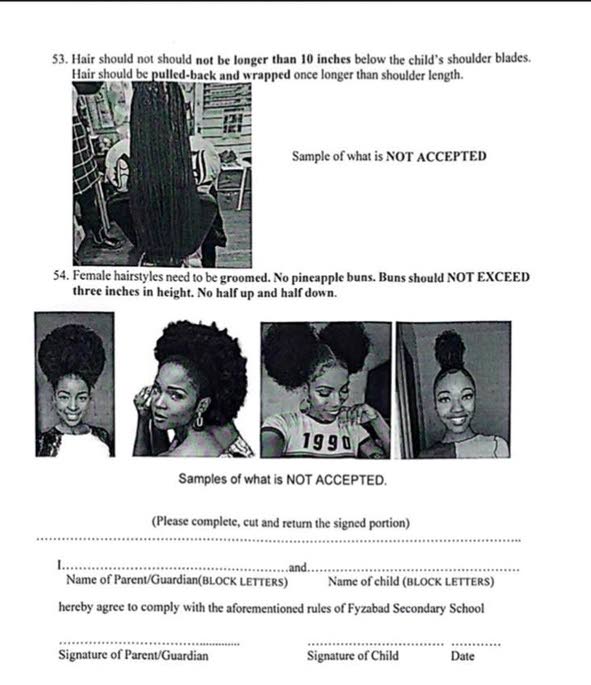
The controversy erupted after a school document outlining grooming rules for female students circulated on social media. The guidelines stated that hair should not extend more than ten inches below the shoulder blades, must be tied back once longer than shoulder length, and that buns should not exceed three inches in height. Certain styles, including “pineapple buns” and “half-up, half-down” hairstyles, were also prohibited. The rules further required that female hairstyles be properly groomed.

The document included photos of Afro-textured hairstyles labelled as “Samples of what is NOT ACCEPTED,” prompting accusations of racial and cultural bias. Some parents argued that the rules were unnecessarily punitive and said schools should focus on education rather than policing students’ appearance.

The issue intensified after a post on January 17 showed a contract sent to parents of Fyzabad Secondary School outlining items 53 and 54 of the school’s 2026 rules. The document included signature lines for both parent and child, indicating agreement to comply with the rules.

Item 53 stated, “Hair should not should not [sic] be longer than ten inches below the child’s shoulder blades. Hair should be pulled-back and wrapped once longer than shoulder length.” A photo accompanying the rule showed braids extending below a person’s buttocks as an example of what was not accepted.

Item 54 stated, “Female hairstyles need to be groomed. No pineapple buns. Buns should not exceed three inches in height. No half up and half down.” The examples shown featured Black women, including images of afros and pineapple buns.

On social media, commenters questioned why no images of Indian women were included, noting that Trinidad and Tobago is a multicultural society and that Indian girls often wear long hairstyles similar to those depicted.

Comparisons were quickly drawn to the 2023 Trinity College Maraval incident, where 23 students were barred from crossing the stage at graduation because their hairstyles were deemed inappropriate. That incident led to national discussions between the Ministry of Education and key stakeholders and ultimately resulted in the introduction of a National School Hair Code on July 6, 2023.

The code states, “Students shall maintain neat and clean hair at all times. Hair that crosses shoulder length should be tied back at all times for safety reasons. Locs, twists, plaits, afros, cornrows, shall be allowed for all students, in compliance with individual School Hair Rules. Female students shall be allowed to wear hair extensions, including weaves and braids, in compliance with individual School Hair Rules. Wigs and dyed or coloured hair for students are not allowed. In exceptional cases, as determined by the school principal, approval may be granted to students.

“Hairstyles that obstruct the normal view of others are not allowed, except for religious reasons. Eyebrow markings and eyelash extensions are not allowed. Haircut parting designs should be simple. Intricate designs are not allowed. Hair ornaments should be in compliance with individual School Hair Rules.”

Under the policy, individual schools were mandated to form committees to develop their own hair policies and submit them to the Ministry of Education by October.

In a release dated January 19, 2025, the ministry reiterated that the National School Code of Conduct does not prescribe or prohibit specific hairstyles.

“Instead, it requires that any school-level guidelines on grooming and appearance be reasonable, non-discriminatory, respectful of students’ dignity, and consistent with the best interest of the child.

“Schools are permitted to establish guidelines on uniform and grooming to support order, safety, and discipline. However, these guidelines must be applied fairly and consistently, respect cultural identity and personal expression, and avoid humiliation, exclusion, or denial of access to learning.”

Education Minister Dr Michael Dowlath said, “Our approach is clear: schools may set grooming guidelines, but they must be reasonable, respectful, and never deny a child their right to education.”

The ministry emphasised that students should not be excluded from school, instruction, or school activities solely based on hairstyle or grooming concerns and said it will continue working with schools to ensure that grooming guidelines align with the National School Code of Conduct while protecting students’ well-being and upholding values of respect, responsibility and inclusion.


Antigua and Barbuda defends recruitment of Ghanaian nurses

antigua health minister
Health Minister Molwyn Joseph

The Antigua and Barbuda Government has again defended its decision to recruit health workers from Ghana, saying the move is aimed at addressing serious staffing challenges within the country’s healthcare system.

Health Minister Sir Molwyn Joseph, speaking at a news conference flanked by senior ministry officials, said the shortage of nurses has long affected the delivery of healthcare services.

“As you can appreciate, if you have nurses who are overworked or burnt out, then this compromises patient care. We now have an opportunity to fix this issue and I want to thank the permanent secretary and the technical team for the valuable input they gave to this exercise,” Sir Molwyn said.

He noted that the country has consistently struggled to maintain an adequate number of nurses, leading to public concerns about burnout and excessive workloads among existing staff. According to the minister, the decision to recruit nurses from Ghana is intended to directly address those challenges.

The Gaston Browne administration last week announced that it had agreed to contract more than 100 nurses from Ghana, while maintaining that it has not formally ended its long-standing programme of recruiting health professionals from Cuba to work within Antigua and Barbuda’s healthcare system.

The announcement comes amid renewed pressure from the United States for Caribbean nations to end their health cooperation with Cuba. Washington has said it “stands with those affected and continues to work for an end to the Cuban regime’s exploitative labour practices”.

A statement issued following the weekly Cabinet meeting said the Government welcomes “the arrival of 120 nurses from the Republic of Ghana expected over the weekend of January 23, 2026, who will serve within the public healthcare system of Antigua and Barbuda”.

“Minister of Health, Sir Molwyn Joseph, announced that these nurses will be deployed primarily at the Sir Lester Bird Medical Centre, as well as within community health clinics and schools, thereby enhancing both hospital-based and community-level healthcare delivery,” the Cabinet statement added.

Sir Molwyn told the news conference that the recruitment initiative is intended to resolve a critical weakness in the healthcare system and expressed confidence that once the full complement of nurses is deployed, longstanding concerns will be alleviated.

The healthcare system requires an estimated 400 nurses to adequately meet demand. At present, there are 260 local nurses, 33 Cuban nurses and 120 Ghanaian nurses expected to arrive this month.

Permanent Secretary for Health Stacey Gregg-Paige, who led the delegation to Ghana, said the recruitment exercise was carried out in collaboration with the Government of Ghana and is governed by a memorandum of understanding and a service agreement.

“Both instruments were comprehensively reviewed and vetted by the Ministry of Legal Affairs, confirmed to be consistent with Antigua and Barbuda’s legal, regulatory and policy framework, and formally accepted by the Government of Ghana.

“Accordingly, this initiative is lawful, transparent and structured, and operates fully within established public service, regulatory and immigration requirements,” she said.

Gregg-Paige explained that the recruitment mission took place in Accra from September 16 to 22 last year under the Ghana Labour Exchange Programme, in collaboration with the Ministry of Special Initiatives in the Office of the President.

She said 190 applications were received, with 32 rejected due to incomplete documentation or ineligibility. A total of 158 candidates were interviewed through a structured, competency-based process, and 127 were selected for vetting by the Antigua and Barbuda Nursing Council.

Medical Director of the Sir Lester Bird Medical Centre, Dr Shivon Belle-Jarvis, said a three-week orientation programme has been planned for the incoming nurses.

“It’s important to understand that anyone going into a system has to go through an onboarding process whether you are coming from within the local system or from abroad,” she said.

Gospel singer Jermaine Edwards denies US$1 million Akon payout to Rushawn Ewears

Jermaine Edwards

Jamaican gospel singer Jermaine Edwards has forcefully dismissed claims that Rushawn Ewears, the young Jamaican whose viral classroom performance helped revive Edwards’ song Beautiful Day, received US$1 million from international star Akon, warning that the rumour is now putting the teenager’s life at risk.

In an Instagram post on Monday, Edwards said the false narrative has continued to circulate despite being debunked more than a year ago, creating dangerous expectations within Rushawn’s community. According to Edwards, people believe Rushawn is withholding money and refusing to help others, placing him under mounting pressure.

“It’s actually putting my friend’s life in danger because the community are saying that he has a million US and he needs to help the community,” Edwards said. “I have the proof that this came out a year ago, and to realise the narrative is still being shared… I’m really upset about that. Please stop doing it.”

Rushawn has also publicly rejected the claims, stating plainly that he never received such a payment. “False statements like these is putting my life in danger,” he said in a recent social media post. “Please stop making false information.”


View this post on Instagram


A post shared by Rushawn Ewears (@rushawn.ewears)

Beautiful Day, written and recorded by Edwards and released in 2014, gained global attention years later after a video resurfaced of a then 10-year-old Rushawn singing the song during lunch break at Top Hill Primary School in St. Elizabeth. The clip, filmed by classmates, showed students clapping desks and singing along, and quickly went viral in early 2023. It was later remixed by international acts including The Kiffness and TRINIX, turning Rushawn into a symbol of joy and innocence online.

The renewed popularity of the song eventually led to Akon releasing his own version, Akon’s Beautiful Day, in late 2024, with Edwards credited as a writer. However, confusion and speculation followed after Akon spoke publicly about the track, referencing an old demo and expressing interest in helping Rushawn and his former school through his foundation. Online rumours soon escalated, falsely claiming Rushawn had been paid US$1 million or flown overseas as part of the project.

Edwards has strongly rejected those claims, stressing that Beautiful Day is properly registered and protected intellectual property. “My metadata and information speak for themselves,” he said. “Everywhere you see Beautiful Day played, it is properly registered and covered.”

He also addressed Akon’s suggestion that the song was inspired by a leaked demo from years ago, saying the record clearly shows otherwise. Edwards explained that there are several authorised derivative versions of Beautiful Day under distribution agreements with Sony, and that no one can legally use the song without permission.

“Akon could not use the chorus of Beautiful Day without asking us permission,” Edwards said. “If you go on his video, you will see that I am credited there, because everyone who uses the song has to credit the writer — and I am the writer, and I have receipts to prove it.”

Edwards added that two years ago, claims about a US$1 million payment had surfaced online, prompting him to contact Akon’s team directly. He said the post was later removed, but the rumour has since resurfaced, now with real-world consequences for Rushawn.

“Guys in Rushawn’s community are now coming to him saying he took them for an idiot because they think he got money and is pretending he didn’t,” Edwards said. “Imagine living in a community where people think you get a million US dollars.”


CARICOM Chair Dr. Terrance Drew launches high-level engagements with regional leaders

Terrance Drew St. Kitts and Nevis
Prime Minister of St Kitts and Nevis, Hon. Dr. Terrance Drew.

Prime Minister of St. Kitts and Nevis and Chair of the Caribbean Community (CARICOM), Hon. Dr. Terrance Drew, has kicked off a series of high-level engagements with regional leaders as part of his six-month tenure at the helm of the organisation.

On Tuesday, January 20, Dr. Drew held constructive talks with the Prime Minister of St. Vincent and the Grenadines, Hon. Dr. Godwin Friday, in a meeting attended by CARICOM Secretary-General Dr. Carla Barnett and other senior officials. The discussions mark the first in a planned round of bilateral visits with key member states designed to deepen dialogue and build consensus ahead of significant regional meetings later this year.

The engagement reflects Chairman Drew’s interpersonal approach to leadership, aimed at cultivating greater trust, coordination and cooperation among CARICOM members amid ongoing global uncertainty and shifting regional dynamics. Leaders at the meeting underscored the importance of advancing regional integration in practical, meaningful ways that deliver tangible benefits to Caribbean citizens.

Participants highlighted collective action in critical areas such as education, security cooperation, disaster response, economic coordination and institutional collaboration as pillars of regional resilience and stability. The discussions also reaffirmed a shared commitment to addressing challenges through calm, candid and respectful dialogue, with recognition that differences may arise but must be managed in ways that preserve unity and strengthen regional institutions.

Prime Minister Drew reiterated that his chairmanship will be guided by purposeful leadership, people-centred integration, enhanced trade and a renewed focus on outcomes that directly improve lives across the Caribbean.

This first meeting in St. Vincent and the Grenadines sets the stage for a series of bilateral engagements ahead of the fiftieth CARICOM Heads of Government Meeting, scheduled to take place in St. Kitts and Nevis from February 24.

Guyana to elect Opposition leader on January 26 after weeks of stalemate

Azruddin Mohamed

The election of Guyana’s next Leader of the Opposition is set for Monday, January 26, following an announcement by Speaker of the National Assembly Manzoor Nadir during a live televised address on the National Communications Network (NCN) Tuesday night.

Nadir said he has instructed the Clerk of the National Assembly to convene a meeting of all non-government Members of Parliament at 10:00 a.m. on Monday, ahead of the presentation of the National Budget and other legislative business. The decision clears the way for the formal establishment of opposition leadership in the 13th Parliament, which has remained without a sitting since it was convened on November 3, 2025.

At that inaugural sitting, opposition MPs were sworn in, but Parliament did not reconvene thereafter. Nadir subsequently travelled overseas on official duties and only returned to Guyana a few days ago, fueling mounting criticism and political tension over the delay in naming an Opposition Leader.

Earlier on Tuesday, presumptive Opposition Leader Azruddin Mohamed, leader of We Invest in Nationhood (WIN), along with other opposition parliamentarians, visited the Parliament Office seeking an audience with the Speaker. The meeting did not materialise, and by Tuesday night, WIN supporters staged a protest outside Nadir’s residence.

WIN holds 16 of the 29 non-government seats in the National Assembly, giving the party a clear majority among opposition MPs and positioning Mohamed as the frontrunner for the post.

In his nationally televised address, Nadir defended his management of Parliament and condemned what he described as “violent, vicious and unprecedented” attacks against him by Mohamed and others. He said the harassment included protests outside his home, threats against his family, and sustained personal abuse.

“I wish I had been heard before I was maligned by Azruddin Mohamed, an international fugitive offender, and his supporters,” Nadir said, adding that in more than 45 years of public life—33 of them as an elected official—he had never experienced such attacks.

The Speaker rejected claims that Parliament has been deliberately inactive, describing those assertions as “false and absurd.” He said the Assembly has remained administratively functional, with more than 90 questions and five motions received, processed, and communicated to opposition members through the Clerk’s office.

Attorney General and Minister of Legal Affairs Anil Nandlall also weighed in Tuesday night, warning that the elevation of a sanctioned and indicted individual to the role of Opposition Leader would amount to a “grave indictment” of Guyana.

“It is an indictment on our country, an indictment on the English-speaking Caribbean, for a US-sanctioned person, a fugitive offender, a person indicted by a jury in the United States of America for international financial crimes, and whose extradition is being sought, to possibly become the Leader of the Opposition,” Nandlall said.

He warned that such an outcome would damage Guyana’s parliamentary system, Constitution, and standing within the Commonwealth, adding, “We are making history for all the wrong reasons.”

Nandlall said the People’s Progressive Party/Civic (PPP/C) has taken a firm position against Mohamed’s elevation, stressing that the party’s stance is grounded in respect for the rule of law.

“The People’s Progressive Party, the party of Cheddi Jagan, is proud to stand in opposition to such a person being elevated to that high post,” he said.

The Attorney General described the Opposition Leader as effectively an “alternative president” under Guyana’s constitutional framework and cautioned that the full implications of such an appointment are not yet known. He also pointed to signals from the United States diplomatic community suggesting there could be repercussions if Mohamed assumes the role, while noting that the government does not control the opposition’s choice.


From good to great: Strategies to elevate your mental health clinic

mental health clinic

Running a mental health clinic is more than offering therapy sessions—it’s about creating an environment where patients feel supported and staff can work efficiently. Many clinics operate well, but transforming from good to great requires intentional strategies that enhance both patient care and operational effectiveness. Here are key approaches to elevate your mental health clinic.

1. Prioritize Patient Experience

Patient satisfaction is the heart of any mental health clinic. Small changes can make a big difference, from simplifying appointment scheduling to ensuring staff are approachable and empathetic. Clear communication, a welcoming atmosphere, and consistent follow-ups help patients feel valued and supported, which in turn can improve treatment outcomes and foster long-term loyalty.

Consider implementing patient feedback surveys to identify pain points and areas for improvement. Actively responding to feedback shows patients their voices matter, building trust and reinforcing the clinic’s reputation as a caring, patient-centered environment.

2. Streamline Administrative Tasks

Administrative inefficiencies can distract clinicians from their core mission: patient care. Reducing paperwork, automating appointment reminders, and digitizing records can save hours every week. Mental health software can play a critical role in this process by centralizing patient records, scheduling, billing, and reporting. When administrative tasks are simplified, clinicians can focus more on therapy sessions and improving patient outcomes.

3. Invest in Staff Development

A clinic is only as strong as its team. Investing in staff training ensures that your therapists, counselors, and administrative staff stay current with the latest practices and technologies. Workshops on new therapy techniques, compliance updates, and communication skills enhance professionalism and patient care. Encouraging professional development also boosts staff morale and reduces turnover, which contributes to a more stable, consistent clinic experience for patients.

4. Foster a Culture of Collaboration

Collaboration between clinicians, administrative staff, and leadership can dramatically improve clinic operations. Regular team meetings, open communication channels, and cross-departmental training can help identify inefficiencies and innovative solutions. When staff feel involved in decision-making, they are more likely to be engaged and motivated, creating a positive, proactive workplace environment.

5. Optimize Your Physical Space

The design and atmosphere of your clinic can significantly affect patient comfort and staff productivity. Consider creating calm, welcoming spaces with natural light, comfortable seating, and private areas for confidential sessions. Even small improvements, such as decluttering waiting areas or adding soothing colors and artwork, can help patients feel more at ease and support a healing environment.

6. Leverage Technology

Technology can elevate your clinic in multiple ways. Telehealth platforms, online scheduling, and secure patient portals allow easier access to care while reducing administrative burdens. Using mental health software can help track patient progress, manage billing, and ensure compliance with privacy regulations. Integrating these tools thoughtfully improves efficiency and enhances patient satisfaction.

7. Focus on Measurable Outcomes

A clinic striving for excellence should track performance metrics. Key performance indicators (KPIs) might include patient retention, appointment adherence, treatment progress, and staff satisfaction. By analyzing these metrics regularly, clinic leaders can identify trends, celebrate successes, and address areas needing improvement. A data-driven approach ensures that changes produce tangible results.

8. Build Strong Community Connections

Mental health clinics thrive when they are part of the community. Partnering with schools, hospitals, local organizations, and wellness programs can increase referrals and establish the clinic as a trusted resource. Hosting workshops, awareness campaigns, or support groups also enhances visibility and demonstrates commitment to holistic mental wellness beyond the clinic walls.

In Conclusion

Elevating a mental health clinic from good to great requires a balance of compassionate care, efficient operations, and strategic planning. By prioritizing patient experience, investing in staff, leveraging technology, and tracking measurable outcomes, clinics can create an environment that benefits both patients and professionals. With these strategies, your clinic can not only provide excellent mental health services but also become a model of operational excellence and patient-centered care.


Holness says Hurricane Melissa offers chance to rebuild Jamaica ‘better and stronger’

Prime Minister Andrew Holness

Prime Minister Dr. the Most Hon. Andrew Holness says the widespread damage caused by Hurricane Melissa has opened the door for Jamaica to rebuild stronger, smarter and more resilient than before.

Speaking Friday (Jan. 16) at the Jamaica Defence Force (JDF) Forward Operating Base in Luana, St. Elizabeth, Holness said the crisis created by the hurricane must be treated as an opportunity for long-term national transformation. “Yes, it created a crisis, but every crisis presents an opportunity, and we must not waste the opportunity that this crisis has given us,” the Prime Minister said. “We will rebuild Jamaica much better than we ever thought it could be.”

The Prime Minister was addressing the handover of more than $200 million in tools and building materials donated by housing developers New Era Developments Limited and Kemtek Construction. The supplies will support the Government’s roof restoration programme in parishes impacted by the hurricane.

Holness noted that the corridor linking Westmoreland and St. Elizabeth, which suffered extensive damage during Hurricane Melissa, will require major realignment and reconfiguration. He said the road network is no longer adequate to support current traffic volumes and economic activity in the region.

Beyond roads, the Prime Minister said urban centers, hospitals, police stations and municipal buildings in affected parishes must be rebuilt with climate resilience in mind. He added that hospitals, in particular, need to be located in areas less vulnerable to extreme weather events. “It will not only be a rebuilding of infrastructure,” Holness said. “What we are planning is to build a new economy for these damaged parishes.”

He emphasized that agriculture, a major economic driver in the region, will be redesigned to withstand climate and weather shocks. According to Holness, the Government plans to introduce more technology and structured, industrial-scale farming to make the sector more sustainable and resilient.

“The future of this area and these parishes that have been damaged will be quite different, but much better than what was anticipated or hoped for before Hurricane Melissa,” the Prime Minister said.

Holness also thanked New Era Developments and Kemtek Construction for their contribution, describing it as a strong example of effective public-private partnership in disaster recovery. He further expressed gratitude to engineering troops from Ghana, Rwanda and Guyana who are working alongside the JDF in ongoing rebuilding efforts.

What to expect when relocating to the Caribbean

Relocating to the Caribbean is often imagined as a life filled with warm breezes, open skies, and a slower pace of living. While the appeal is undeniable, the reality of moving involves thoughtful preparation and a clear understanding of what daily life may bring.

This transition can feel even more meaningful, especially when relocating from Houston, Texas, where routines and expectations differ greatly from island living. Knowing what lies ahead helps reduce uncertainty and allows the move to feel purposeful rather than overwhelming. From lifestyle adjustments to cultural awareness, each aspect of relocation plays a role in shaping a smooth experience.

Preparing for the Move With the Right Foundation

Before the journey begins, careful planning sets the tone for everything that follows. This stage is about understanding logistics, timing, and personal readiness. Moving to the Caribbean from Houston involves crossing borders and adapting to new systems, which makes preparation essential.

One helpful step during this phase is to hire a local Houston long distance moving company to ensure a hassle-free experience. Doing so allows you to focus on the emotional and practical elements of relocation while professionals handle the physical movement of belongings.

Preparation also includes reviewing documentation, organizing important papers, and deciding what items truly belong in the next chapter of life. Island living often encourages simplicity, so this process can be an opportunity to reset priorities. Thinking through these details early reduces stress and helps you arrive with confidence and clarity.

Adjusting to a Different Pace of Life

One of the first changes people notice after relocating to the Caribbean is the rhythm of daily life. Time tends to feel more fluid, with less urgency attached to schedules. This shift can be refreshing, but it may also require patience and flexibility. Tasks that once felt routine may take longer, and expectations around timing can differ.

Learning to embrace this pace often leads to greater peace of mind. Rather than resisting the change, observing and adapting helps build harmony with the surrounding environment. Over time, this slower rhythm can encourage balance, mindfulness, and a deeper appreciation for everyday moments.

Understanding Local Culture and Social Norms

Culture plays a central role in shaping life in the Caribbean. Each community carries its own traditions, values, and social expectations. Respect for local customs builds trust and fosters positive relationships. Taking time to observe how people communicate, celebrate, and interact offers valuable insight into daily life.

Community connections often form through shared experiences and genuine interest. Being open and respectful creates opportunities for meaningful engagement. This cultural immersion enriches the relocation experience and helps newcomers feel less like outsiders and more like participants in their new surroundings.

Navigating Housing and Living Arrangements

Finding a comfortable place to live is a key part of settling in. Housing styles, layouts, and expectations may differ from what you are used to. Natural elements often play a larger role in design, with open spaces and airflow taking priority. Understanding these differences helps set realistic expectations and supports a smoother adjustment.

It is also important to consider maintenance routines and household systems. Adapting to these details takes time, but patience makes the process manageable. Creating a living space that feels personal while respecting local practices contributes to long-term comfort and stability.

Climate Awareness and Daily Comfort

The Caribbean climate influences daily life in noticeable ways. Warm temperatures and humidity affect how people dress, plan activities, and structure their days. Learning to work with the climate rather than against it helps maintain comfort and well-being.

Hydration, appropriate clothing, and awareness of weather patterns become part of everyday routine. Over time, these adjustments feel natural. Embracing the climate also encourages outdoor activities and a closer connection to the environment.

Managing Daily Essentials and Routines

Daily routines may look different after relocating. Access to certain goods and services can vary, which encourages thoughtful planning and adaptability. Learning when and where to complete errands helps establish a reliable rhythm.

This adjustment often leads to greater resourcefulness. Being flexible and open to change allows routines to develop organically. Over time, these new habits become second nature and contribute to a sense of belonging. Simple daily tasks begin to feel more intentional, helping create structure without pressure. As familiarity grows, everyday responsibilities feel less demanding and more integrated into the surrounding lifestyle.

Building Community and Support Systems

Creating a support network is essential when starting fresh. Community ties provide emotional grounding and practical guidance. Engaging with neighbors, attending local gatherings, and showing interest in shared spaces helps build these connections.

Trust grows through consistency and respect. Being present and approachable opens doors to friendships and support. These relationships make the transition smoother and enhance the overall quality of life.

Health and Personal Well-being

Relocating brings emotional highs and lows. Taking care of mental and physical health supports a balanced transition. Simple practices like establishing routines, spending time outdoors, and staying connected with loved ones provide stability.

Listening to your body and mind during this adjustment period is important. Allowing space for rest and reflection helps maintain resilience. Over time, well-being becomes closely linked with the natural surroundings and lifestyle of the Caribbean.

Embracing Change and Personal Growth

Moving to a new region invites personal growth. Challenges encourage adaptability, while new experiences broaden perspective. Relocating to the Caribbean often inspires a reassessment of priorities and values.

This journey is not about perfection but about progress. Each step forward builds confidence and understanding. By embracing change with openness, the relocation experience becomes deeply rewarding.

Relocating to the Caribbean is a meaningful life transition that blends excitement with responsibility. Thoughtful preparation, cultural awareness, and patience shape a positive outcome. The contrast in lifestyle can feel significant, yet this difference often becomes the most enriching part of the experience. With realistic expectations and a willingness to adapt, the Caribbean can become more than a destination. It can become a place of growth, connection, and renewed perspective.


Windies falter as Afghanistan take series lead in Dubai

West Indies

DUBAI, UAE — The West Indies Men’s cricket team stumbled in their first T20 International of the year, falling to Afghanistan by 38 runs on Monday. Playing at the Dubai International Cricket Stadium, the Caribbean side failed to chase down a target of 182, finishing on 143/9. While market watchers looking for a Kalshi promo code might have favored the Windies after early breakthroughs, the match momentum shifted decisively away from the Men in Maroon as the game progressed.

The result leaves the West Indies trailing 0-1 in the three-match series. It was a contest defined by missed opportunities for the Caribbean team and a resilient recovery by the Afghan batting lineup.

Missed Opportunities in the Field

West Indies Captain Brandon King elected to field, a decision that initially paid dividends. The bowling attack reduced Afghanistan to a precarious 19/2 early in the powerplay. It seemed the Windies would restrict their opponents to a manageable total. However, the inability to break the subsequent partnership proved costly.

Ibrahim Zadran and Darwish Rasooli staged a massive recovery. The pair put together a third-wicket partnership of 162 runs, completely dismantling the West Indies’ bowling plans. Zadran anchored the innings with an unbeaten 87 off 56 balls, while Rasooli attacked with equal vigor, scoring 84 off 59 balls. Their efforts lifted Afghanistan to a formidable 181/3. Rather than capitalizing on the early pressure, the West Indies bowlers allowed the game to drift in the middle overs.

Spin Attack Dismantles Chase

In reply, the West Indies batting lineup struggled to cope with the slow conditions and a disciplined Afghan attack. The chase never found its rhythm. Brandon King departed early for just 4 runs, and Evin Lewis followed shortly after, scoring only 4 runs before being caught.

While Johnson Charles threatened briefly with a brisk 27 runs, he was trapped LBW by Mujeeb Ur Rahman, leaving the middle order exposed. The Afghan bowlers then tightened their grip:

  • Ziaur Rahman Sharifi was the pick of the bowlers, claiming figures of 3-36 to rip through the lineup.
  • Mujeeb Ur Rahman provided excellent support with 2-29.
  • Rashid Khan (2-19) and Noor Ahmad (2-34) ensured the required run rate kept climbing.
  • Sampson top-scored for the Windies with 30 runs, and Gudakesh Motieadded a fighting 28 runs late in the innings, but the top-order collapse left them with too much to do.

Series Outlook

The defeat places immediate pressure on the West Indies heading into the remaining matches in the UAE. The inability to play spin effectively remains a recurring concern for the Caribbean side. To be sure, the management will need to reassess their strategy against the slower bowlers if they hope to level the series.

Moreover, the psychological impact of letting Afghanistan recover from 19/2 will be a talking point. In international cricket, seizing key moments is essential. The West Indies failed to drive home their advantage, and Afghanistan punished them for it. The series continues later this week, with the Windies needing a victory to keep their hopes alive.


Maintenance tips to maximize the lifespan of your handheld laser welding equipment

Weld quality can look perfect one day and drift the next. Then you lose time chasing settings, you scrap or rework parts, and you replace wear items earlier than planned. In most shops, the root causes are predictable: dust on optics, restricted airflow that raises temperatures, and small technique differences that accumulate across shifts. A simple routine that protects the beam path and cooling will usually pay for itself fast, especially if your handheld laser welder is part of your daily workflow.

Why Manufacturer Support Matters

Good guidance makes maintenance easier to follow. You want clear upkeep steps, realistic wear-item expectations, and safety instructions you can apply on the floor. Denaliweld is one example of a manufacturer that publishes practical guidance you can adapt into a checklist. As you build your workflow for your handheld laser welder, treat the manual, parts list, and service pathway as tools that reduce downtime.

Key Factors That Influence Longevity

How Laser Welding Differs from MIG/TIG

Laser welding focuses energy into a small spot, while MIG and TIG typically spread heat more broadly through an arc. That is why laser welding can help reduce distortion on thin stock, but it also means that setup and cleanliness matter more.

When optics get dirty or the nozzle area clogs, you often compensate by slowing travel speed or increasing power. That extra load heats the head, stresses the cable, and forces cooling components to work harder.

Factor Laser Welding (Handheld) MIG/TIG (Typical)
Heat footprint Localized Broad
HAZ size Often smaller Often larger
Drift triggers Optics and setup Heat input and technique

Heat Input and Distortion Basics

Lower heat input only helps when your process stays stable. If you find yourself turning the power up more often, pause and inspect first. A dirty protective lens, restricted airflow, or inconsistent standoff distance can look like a “settings problem” even when it is maintenance.

Routine Cleaning and Environmental Care

Dust Removal and Exterior Cleaning

Your goal is to keep debris away from vents, connectors, and the handpiece head. A short routine that happens every shift beats an ambitious plan that gets skipped.

Before you start, wipe exterior surfaces, check that vents are clear, and confirm the cable is not pinched or kinked. After dusty work, clean around the air inlets and outlets and keep the area around the machine tidy. Avoid blasting shop air into openings because it can drive fine dust deeper into sensitive areas.

Operating Environment and Temperature Limits

Hot ambient temperatures make cooling work harder, and abrasive dust raises contamination risk. If you cannot move welding away from grinding and sanding, use barriers and tighten your inspection rhythm. Storage matters too. A torch left on a dusty bench accumulates contamination, while one stored in a clean, protected place stays ready.

Handling Practices and Protective Measures

Handle the handpiece and cable like precision components. Prevent sharp bends, avoid dragging the cable across edges, and store the handpiece so the nozzle area stays clean.

You also protect equipment when you protect people. Handheld laser systems are high-power tools, so controlled access, proper eye and skin protection, and clear “laser on” signaling reduce rushed workarounds that lead to broken lenses, strained cables, or accidental knocks.

Planned Parts Replacement and Wear Planning

Annual Replacement Schedule

Worn items are normal. What hurts is replacing them reactively, mid-job. Use a schedule, then adjust it to match your duty cycle.

Interval What You Check or Replace Why It Matters
Each shift Lens and nozzle area Prevents weld drift
Weekly Vents, filters (if used), cable strain points Prevents overheating
Monthly Connectors, safety functions, and cooling feel Catches faults early
Annually Planned wear-item refresh per manual Reduces surprise downtime

Consumables and Inspection Rhythm

Protective lenses and nozzle-area parts take daily abuse. Replace a lens when it looks hazy, pitted, or spattered. Waiting usually increases rework and pushes you to compensate with more power or slower travel.

A practical cue is simple: if you feel tempted to “turn it up,” stop and inspect first.

Reduced Post-Processing and Less Wear

Cleaner welds can reduce grinding and polishing, lowering abrasive dust in your work area. Less dust benefits every machine nearby, including your laser equipment.

Operating Practices That Reduce Stress

Consistent Parameter Control

Consistency is a maintenance strategy. When you bounce between “close enough” settings, you create heat swings that stress components and make troubleshooting harder.

If a joint repeats, lock in a proven range for power and travel speed. Save presets if your system supports it. When something changes, change one variable at a time and document what worked.

Precision Technique and Smaller HAZ

A smaller heat-affected zone is both a quality target and a tool-protection target. Keep standoff distance steady, maintain a repeatable torch angle, and move at a consistent pace. If the weld suddenly looks different, stop and inspect before you push through.

Training and Setup Standardization

If more than one person runs the machine, standardization is what keeps results stable. You need a shared startup routine, a few common presets, and a short “stop and check” rule that tells you when to clean or replace a lens rather than compensate with settings.

Reliability Checks and Recordkeeping

Reliability Checks by Component

Catch small issues early by watching for louder fans, reduced airflow, loose connectors, or intermittent faults that appear when the cable moves. These symptoms often point to something fixable, such as a dirty intake, stressed strain relief, or an overdue lens.

Certifications and Document Tracking

Keep your manual, training notes, and service records in one place so you can find them fast.

Denaliweld states that its equipment is designed and manufactured in Chicago and that its machines are certified by CE and SGS. Whether you choose that brand or another, track the certifications that matter to your environment and keep proof of training and servicing easy to retrieve.

Maintenance Logs for Fleet Consistency

A maintenance log can be simple: date, what you cleaned or replaced, what looked unusual, and what you changed. If you run multiple machines, logs help you spot patterns, such as one unit consuming lenses faster because it sits closer to the grinding dust or is handled differently.

Conclusion

Your equipment lasts longest when you treat it like precision gear. Keep dust away from vents and optics, respect temperature and airflow limits, replace wear items on a plan, and standardize how you run jobs so you stop chasing settings. Add quick checks and a simple log, and you will reduce surprises while maintaining weld quality. Your next step is to build a one-page checklist and follow it for every job you run on your handheld laser welder. Denaliweld is a helpful example of a manufacturer that publishes guidance you can adapt into that checklist, so you spend more time welding and less time troubleshooting.




Rep. Sheila Cherfilus-McCormick’s arraignment delayed over legal representation issues

Sheila Cherfilus-McCormick the first Haitian American Democrat elected to Congress.
Sheila Cherfilus-McCormick

Haitian-American U.S. Congresswoman Sheila Cherfilus-McCormick returned to a Miami federal courtroom Tuesday for what was scheduled to be her arraignment on charges related to the alleged theft of $5 million in government relief funds.

However, the arraignment was postponed again after the law firm temporarily representing Cherfilus-McCormick requested more time. Miami attorney David Markus of Markus Moss PLLC told U.S. Magistrate Enjolique Lett that there are still financial and “other complications” that need to be resolved before the firm can be permanently retained.

“At some point we’re going to have to decide what’s going on,” Lett said during a hearing that lasted just four minutes.

“You’re absolutely right, your honor,” Markus replied. “I think we can work this out.”

The magistrate agreed to defer the arraignment until Feb. 3, after Markus pledged that the retention issue would be resolved by then — either with the hiring of his firm or another attorney. The delay effectively pushes back a Jan. 26 trial date previously set by U.S. District Judge Darrin Gayles, who is overseeing the case. Cherfilus-McCormick is scheduled to appear Wednesday morning before Gayles for a separate scheduling conference.

Markus told Judge Lett that he would update Gayles on the situation when he appears in court with the congresswoman. After Tuesday’s hearing, both Markus and Cherfilus-McCormick left the C. Clyde Atkins U.S. Courthouse in downtown Miami without commenting to reporters.

Cherfilus-McCormick, 46, a Democrat, was indicted in late November on multiple counts, including theft of $5 million from the Federal Emergency Management Administration, conspiracy to commit theft, money laundering, conspiracy to make and receive straw donor contributions, and conspiracy to make a false and fraudulent statement on a tax return.

The congresswoman first appeared in court on Dec. 29 before U.S. Magistrate Judge Lisette Reid, but that arraignment was postponed after it was determined her permanent legal representation had not been finalized.

As a result, Cherfilus-McCormick has not yet entered a plea. She has repeatedly declared her innocence in public statements. In December, she said, “In no way did I steal any kind of funds. I am committed to the people of Florida in my district. We are going to continue fighting and making sure everyone gets the representation they need.”

“We look forward to our day in court so we can prove our innocence,” she added. “A lot has been said about what was done, but it was never done. There’s no place ever in my life I have ever been accused of anything.”

In November, Cherfilus-McCormick described the indictment as “baseless.” The case is expected to continue drawing national attention as the legal process unfolds.


Florida moves to restrict benefits, licenses for undocumented residents

Blaise Ingoglia

Florida Chief Financial Officer Blaise Ingoglia has filed legislation aimed at cracking down on illegal immigration in the state. The measures, introduced as Senate Bill 1380 and House Bill 1307, would impose stricter rules on employment, licensing, and state benefits for undocumented residents.

Ingoglia said the legislation, filed on January 13, is intended to build on Florida’s existing measures against illegal immigration and to increase deterrents for individuals attempting to enter the state unlawfully.

The bills include provisions that would:

  • Limit commercial driving license instruction, testing, and licensing to English only.

  • Exclude illegal immigrants from coverage under the state Workers’ Compensation statute.

  • Require employers who hire illegal immigrants to pay out-of-pocket for work-related injuries.

  • Mandate use of E-Verify for Workers’ Compensation claims.

  • Prohibit illegal immigrants from obtaining licenses from the Department of Financial Services.

  • Block the use of illegal immigrant identification to open accounts or obtain cashier’s checks from state-chartered banks.

  • Prevent illegal immigrants from accessing Down Payment Assistance programs and silent second home mortgage programs.

  • Require insurance companies to accept fault if an illegal immigrant is involved in a car accident in Florida.

During a news conference in Winter Haven, Ingoglia also recognized several law enforcement offices for supporting federal immigration enforcement. “We have a network that flows through local and state governments in partnership with the federal government,” he said. “We will arrest and deport individuals in violation of the law because the first rule of government is to keep the people safe.”

Grenada decriminalises cannabis, sets age of 21 for legal possession

Bahamas Rastafarians seek legal help over cannabis concerns

Grenada’s Parliament has passed legislation amending the country’s marijuana laws, decriminalising cannabis for adults and laying the groundwork for a regulated medicinal and therapeutic cannabis industry.

Prime Minister Dickon Mitchell said he had preferred the legal age for cannabis possession to be 18, the age of civil responsibility, but ultimately settled on 21 following “passionate debate” and expert advice.

“There was passionate debate, we went back and forth…if you are an adult you are an adult, 18 is 18, we recognise 18, you can drive, you can vote, you can get married, so from my perspective you should be allowed at 18 if you do so wish to choose but I was in the minority,” Mitchell said during the debate on the Drug Abuse (Prevention and Control) (Amendment) Bill, 2026.

“And so I cede graciously to the medical experts, to the mental health experts who recognise that at 18 a brain is still developing,” he added.

The government described the measure as a transformative milestone toward cannabis reform. Minister for Agriculture, Lands and Forestry, Economic Development and Planning Lennox Andrews said it prioritises “the health of individuals and safety of our youth, while finally unlocking therapeutic and economic power for all Grenadians.”

The legislation provides amnesty and automatic expungement of criminal records for minor cannabis offences and discontinues pending proceedings for specified small amounts. It also affirms the constitutional rights of the Rastafari community to use cannabis as a sacrament within registered places of worship and at special events, with allowances for cultivation.

Under the law, adults aged 21 and over may possess up to 56 grams of cannabis and 15 grams of cannabis resin, and register to cultivate up to four plants per household for private use. Public consumption remains prohibited and subject to penalties, and strict safeguards protect minors, including criminal penalties for supplying youth and rehabilitative approaches for those found in possession.

Prime Minister Mitchell noted the policy balances benefits and risks. “Yes, there is always the bright side and the dark side…We also recognise that there are serious medical risks and serious societal challenges that exist whether or not the policy continues to criminalise the use or possession,” he said.

Leader of Government Business and Minister of Health Phillip Telesford emphasized that recreational use remains prohibited. “Our policy of decriminalisation will be paired with strict regulations to protect the youths and accompanied by a robust public education campaign and strong enforcement against intoxication while driving. Medical use remains controlled and recreational use as per this Bill is not permitted. The Government prioritises health and safety over short-term economic gains,” he told Parliament.

Attorney General Senator Claudette Joseph highlighted the bill’s timeliness. “Grenada is one of the last jurisdictions to now move in the direction of the decriminalisation of cannabis and ultimately the establishment of a medical cannabis industry,” she said. Joseph stressed that decriminalisation does not mean unrestricted use; cannabis will remain controlled, with clear limits, defined offences, and enforcement mechanisms.

The government said it plans to develop a comprehensive national cannabis policy framework within three to six months, covering cultivation, processing, research, and medicinal use.

DHS cuts wait times for religious workers returning to US

The U.S. Department of Homeland Security has issued an interim final rule allowing thousands of religious workers—including priests, nuns, rabbis, and other faith-based staff—who previously were required to remain outside the United States before returning, to resume their essential services without the one-year foreign residency requirement.

The change significantly reduces wait times, providing stability for faith-based organizations and minimizing disruptions to the communities they serve. Religious workers perform duties for churches, synagogues, temples, and other faith-based organizations, including clergy, missionaries, and support staff, often requiring specific visas, such as the U.S. R-1 visa, for temporary work.

“Under the leadership of Secretary Noem, DHS is committed to protecting and preserving freedom and expression of religion. We are taking the necessary steps to ensure religious organizations can continue delivering the services that Americans depend on,” a DHS spokesperson said. “Pastors, priests, nuns, and rabbis are essential to the social and moral fabric of this country. We remain committed to finding ways to support and empower these organizations in their critical work.”

The rule aligns with the U.S. government’s Executive Order 14205, Establishment of the White House Faith Office, and removes the requirement for R-1 religious workers to reside outside the United States for one year when they reach the statutory five-year maximum period of stay. While R-1 workers are still required to depart the U.S., they no longer must remain abroad for a minimum period before seeking readmission in R-1 status.

The rule comes amid longstanding challenges in the EB-4 visa category. Demand for these visas has historically exceeded supply, and changes implemented by the Department of State in 2023 further increased wait times for immigrant visas for certain countries, including those for religious workers. These delays left many religious workers unable to extend their R-1 status, exhausting their maximum period of stay. By eliminating the one-year foreign residency requirement, USCIS is reducing the time religious organizations are left without trusted clergy and non-ministerial religious workers.

The interim final rule is effective immediately. USCIS invites written comments and related materials to be submitted within 60 days of the rule’s publication in the Federal Register.