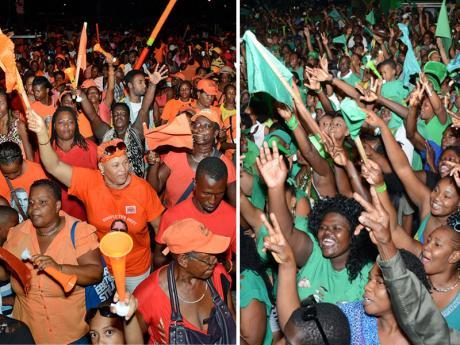
In just one week, on September 3, Jamaicans will vote to either give the ruling Jamaica Labour Party (JLP) a historic third term or elect the opposition People’s National Party (PNP) to take over the government under a new prime minister, Mark Golding. The latest polls indicate a close election, but both JLP and PNP supporters seem convinced their party will secure a massive landslide victory.
Analysis by this newspaper also suggests the results could be very close. The PNP appears to have gained momentum over the last few weeks, but it’s unclear if this is enough to break the JLP’s hold on government. What’s evident is that more of the Jamaican middle class supports the JLP, while more working-class voters—especially those in rural areas and inner cities—support the PNP. With the outcome looking potentially very close, victory for either party will depend on which can better turn out its supporters on election day.
Since the 2016 general elections, voter turnout has been a growing concern in Jamaica. That year, turnout dropped sharply to 48%—the lowest since the 1983 elections, which the PNP did not contest. This decline was linked to demographic shifts, elimination of election irregularities, generational apathy, and a sense of political disconnection. In 2020, these entrenched issues were compounded by the COVID-19 pandemic, which brought health concerns, logistical challenges, and widespread anxiety. The result was a historically low turnout of roughly 37%, the lowest since Jamaicans began voting in 1944.

Analysts attributed the lower voter turnout in 2016 to several factors:
1.Cleaner, more accurate electoral process: In past decades, high turnout figures were often inflated by irregularities, including fraudulent votes. Eliminating these practices produced more honest, but lower, turnout numbers.
2.Youth disengagement and disillusionment: Younger generations showed less interest in politics, often feeling their votes didn’t matter or that the JLP and PNP were indistinguishable.
3.Declining political enthusiasm: The emotional drive to vote, rooted in past struggles for democratic rights and social equality, seemed to have waned, particularly among younger voters who felt one vote made no difference.
4.Shift in party approach: Some analysts argued that during elections, both parties focused more on winning at any cost rather than presenting compelling ideologies or policies. This reduced motivation for many to vote.
The steep decline in turnout between 2016 and 2020 was also largely attributed to concerns about COVID-19. Many voters felt unsafe standing in lines, despite protocols such as masks and sanitizers. Anxiety was heightened when public figures tested positive just before election day.
Additionally, the 2020 elections were called six months early, leaving voters and the electoral office with less preparation time and greater uncertainty. Beyond the pandemic, however, apathy deepened. A post-election poll found that many voters felt disconnected from politicians and the political process. The main reasons cited for not voting were lack of community development (37%), unfulfilled promises (11%), and lack of interest (8%), together accounting for 65% of non-voters.
Youth participation was also strikingly low. Only about 32% of 18–24-year-olds had ever voted, compared to over 90% of those over 55.
Several polls since 2020 suggest turnout could again be low on September 3, but likely higher than in 2016 and 2020. A poll conducted a few weeks ago showed 50.4% of voters plan to cast a ballot. Of the remaining 49.6%, 29.1% said they had no intention of voting and 20.5% were unsure.
It would be unrealistic to expect turnout much higher than 50%. To be assured of victory, both parties must focus on mobilization. With apathy strongest among the youth, efforts must be made to get younger voters to the polls.
The PNP has been actively campaigning for the past two years, and while it made a strong showing in the 2024 local government elections, the fact that nearly half of Jamaican voters either won’t vote or remain uncertain does not suggest a decisive shift toward the party. Opposition parties are typically more likely to unseat incumbents when voter turnout is high, but that is not clearly the case here.
Both the JLP and PNP are pressing hard with political meetings, motorcades, debates, social media campaigns, and advertising. Ultimately, it will be the party that turns out more of its base that will win on September 3.