Venezuela holds election in Essequibo region, escalating tensions with Guyana
Key Points(5)
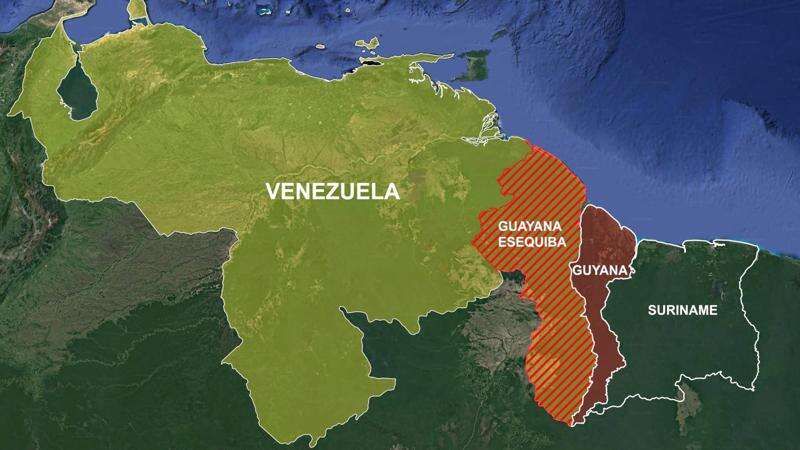
- Venezuelans on Sunday voted to elect a governor and other lawmakers for Essequibo, an oil-rich region internationally recognized as part of Guyana but long claimed by Caracas.
- The vote marked the first time Venezuelans have elected officials for the territory, despite the absence of participation from Essequibo’s 125,000 residents.
- The election, <a href="https://www.caribbeannationalweekly.com/news/guyana-president-ali-warns-venezuela-do-not-cross-the-fence/">described by Guyanese President Irfaan Ali</a> as “scandalous, false, propagandistic (and) opportunistic,” has sharply escalated an already tense border dispute.
- The vote installed a new governor, six deputies to Venezuela’s National Assembly, and seven members to a regional legislative assembly—all for a region over which Venezuela has no administrative control.
- It is unclear how the officials, once elected, plan on running the territory, which Guyana governs.
Venezuelans on Sunday voted to elect a governor and other lawmakers for Essequibo, an oil-rich region internationally recognized as part of Guyana but long claimed by Caracas.
The vote marked the first time Venezuelans have elected officials for the territory, despite the absence of participation from Essequibo’s 125,000 residents.
The election, described by Guyanese President Irfaan Ali as “scandalous, false, propagandistic (and) opportunistic,” has sharply escalated an already tense border dispute. The vote installed a new governor, six deputies to Venezuela’s National Assembly, and seven members to a regional legislative assembly—all for a region over which Venezuela has no administrative control.
It is unclear how the officials, once elected, plan on running the territory, which Guyana governs. Only 42.63% of eligible voters showed up. Many polling stations across the country were nearly empty, especially in urban centers. The ruling party, PSUV, led by Maduro, still secured a sweeping victory, winning 23 out of 24 governor races.
Among the winners was Neil Jesús Villamizar Sánchez, named the first “governor” of Guayana Essequiba—even though Guyana continues to govern the area. The Venezuelan opposition, led by María Corina Machado, boycotted the elections, calling the process dishonest.
The move is the latest flashpoint in a territorial saga that dates back more than a century. It comes over a year after Venezuelan President Nicolás Maduro declared the creation of a 24th state called “Guayana Esequiba” within the disputed territory, following a national referendum supporting the annexation bid.
“This election is part of the broader elections for governors and lawmakers across Venezuela,” Maduro stated on Telegram, calling on citizens to “elect the best for the governorships of the 24 states,” explicitly including Essequibo in the count.
Guyana, which has administered the region since gaining independence in 1966, remains on high alert. The country, with a military force of fewer than 5,000 troops, has ramped up defense ties with the United States in response to Venezuela’s aggressive posture. On Sunday, the U.S. State Department denounced the vote as a “sham,” with the Bureau of Western Hemisphere Affairs writing on X: “The United States rejects all attempts by Nicolas Maduro and his illegitimate regime to undermine Guyana’s territorial integrity, including this latest sham election in the Essequibo region.”
Venezuelan Defense Minister Vladimir Padrino López pushed back, insisting, “We are supported by historical, legal, and moral grounds regarding that territory.”
Venezuela's claim hinges on the argument that Essequibo was part of its borders during Spanish colonial times, and it has long rejected the 1899 arbitration ruling that delineated the boundary when Guyana was still a British colony. That ruling is currently under review by the International Court of Justice (ICJ), following a 2018 application from Guyana seeking its validation. Earlier this month, the ICJ ordered Venezuela not to proceed with the election, but Caracas has refused to recognize the court’s jurisdiction.
The stakes in the dispute have intensified since the discovery of large offshore oil reserves in Guyana’s waters, making the country one of the world’s fastest-growing oil producers and a future leader in per capita oil output.
Just hours before Sunday’s election and ahead of Guyana’s Independence Day, Guyanese officials hosted a National Patriotic Concert in Essequibo to reaffirm their sovereignty. Thousands attended, waving flags and wearing shirts emblazoned with the phrase: “Essequibo is Guyana’s.”
“Essequibo belongs to Guyana and we are going to do everything to ensure that Essequibo will forever be part of our 83,000 square miles,” President Ali told the cheering crowd.
As the territorial dispute heads back to the international legal stage and the political rhetoric on both sides intensifies, the future of Essequibo remains at the center of a high-stakes geopolitical standoff.