Suriname elections declared valid, paving way for new government formation
Key Points(5)
- The Independent Electoral Bureau (OKB) has officially declared Suriname’s May 25 parliamentary elections valid, clearing the way for a new government to be installed.
- The announcement comes after the Central Main Electoral Office (CHS) publicly revealed the election results, confirming the 51 successful candidates who will form the country’s National Assembly.
- However, under Surinamese law, the OKB must formally certify the elections and determine whether they are binding or not—a process that concluded over the weekend.
- OKB chairman Sheik Samseerali-Alibaks acknowledged that “numerous irregularities and administrative errors” occurred during the election process, but emphasized that they were not significant enough to alter the overall outcome.
- “All protest letters and objections from various political parties, individuals, and organizations had been investigated and addressed,” he said.
The Independent Electoral Bureau (OKB) has officially declared Suriname’s May 25 parliamentary elections valid, clearing the way for a new government to be installed.
The announcement comes after the Central Main Electoral Office (CHS) publicly revealed the election results, confirming the 51 successful candidates who will form the country’s National Assembly. However, under Surinamese law, the OKB must formally certify the elections and determine whether they are binding or not—a process that concluded over the weekend.
OKB chairman Sheik Samseerali-Alibaks acknowledged that “numerous irregularities and administrative errors” occurred during the election process, but emphasized that they were not significant enough to alter the overall outcome. “All protest letters and objections from various political parties, individuals, and organizations had been investigated and addressed,” he said. The OKB itself had also raised concerns during the electoral process, which were communicated to the CHS.
Despite the objections and irregularities, the OKB concluded, based on its investigations, that the elections should be declared binding. All OKB members signed the official report, indicating the results must be respected by all stakeholders.
This marks the first time Suriname has held parliamentary elections under a system of proportional representation, making coalition-building essential. No single party secured the two-thirds majority (34 out of 51 seats) required to elect the country’s next president, setting the stage for prolonged negotiations and potential policy gridlock.
Following the preliminary results, six of the seven parties that won seats agreed to form a coalition led by the National Democratic Party (NDP), which captured 18 seats. The coalition includes five minority parties: the Alternative 2020 Party (A20), the Brotherhood and Unity in Politics (BEP), the General Liberation and Development Party (ABOP) led by former Vice President Ronnie Brunswijk, the National Party of Suriname (NPS), and the Pertjajah Luhur Party (PL). Notably, ABOP, NPS, and PL were until recently members of the Santokhi-led administration, but they have since withdrawn their support, citing exclusion from policymaking.
Meanwhile, the Progressive Reform Party (VHP), headed by President Chandrikapersad Santokhi, secured 17 seats and will now become the sole opposition party. Santokhi, a former police officer, assumed office in 2020 as Suriname’s ninth president.
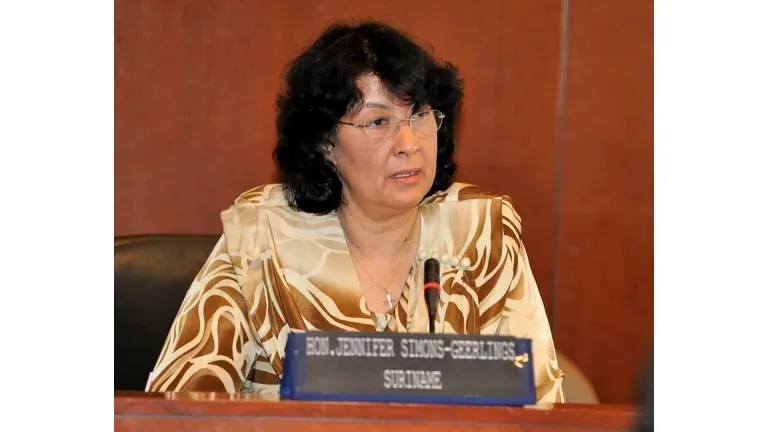
The newly formed coalition has nominated NDP chair Jennifer Geerlings-Simons as its presidential candidate, with Gregory Rusland of the NPS tapped for vice president. However, a number of constitutional steps remain before a new administration can take office.
The National Assembly is scheduled to convene on June 30 to elect a new parliamentary chairperson. Following this, the assembly must vote to elect a president and vice president, requiring a two-thirds majority. If, after two voting rounds, no candidate secures the necessary votes, the election will move to the United People’s Assembly, a larger joint body comprising members of parliament, regional councils, and district councils. This body, with over 900 members, elects the president by a simple majority.
The VHP has stated it intends to “explore the legal options” to nominate its own candidates for the positions of president, vice president, and speaker of the National Assembly. According to the law, a presidential candidate may be nominated by any group of seven parliamentarians. Now that the OKB has declared the elections binding, the VHP says it accepts the outcome as final and is considering putting forward its own nominations.
The new parliament is expected to hold a session on July 8 to elect Suriname’s next government leader.