


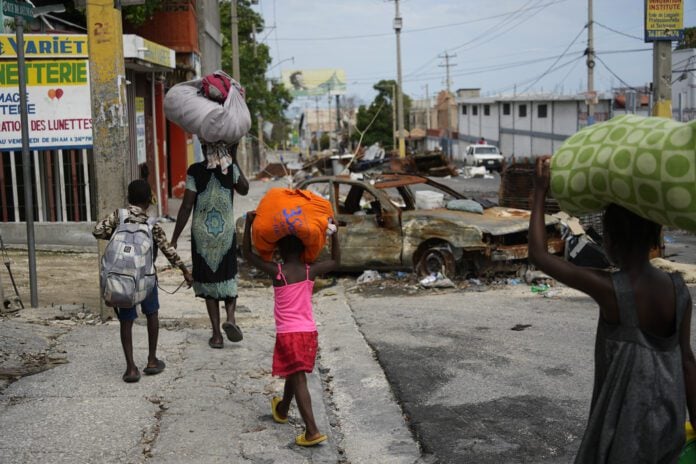
The United Nations (UN) has reported that more than 20,000 people have fled their homes across Haiti’s capital, Port-au-Prince, within just four days, as gang violence intensifies.
According to the UN, over 17,000 of these individuals are seeking shelter in 15 displacement sites while critical supply chains have collapsed.
“This is the largest wave of displacement we’ve seen since August 2023,” the UN said, linking the crisis to the continued instability that has plagued Haiti since the 2021 assassination of President Jovenel Moïse. Armed gangs have reportedly united, strengthening their grip on the capital and leaving the national police force overwhelmed and under-resourced.

The UN’s International Organization for Migration (IOM) warned of near-total paralysis in Port-au-Prince following last week’s attack on commercial air travel. A Spirit Airlines jet, inbound from the United States, was struck by gunfire as it landed at the national airport, injuring a flight attendant. In response, the US Federal Aviation Administration (FAA) has halted flights to Haiti for at least 30 days.
“International flights remain grounded, compounding the beleaguered nation’s sense of isolation. With the main seaport access restricted and roads controlled by gangs, essential supplies cannot reach the vulnerable population,” the IOM stated.
Grégoire Goodstein, IOM’s Chief in Haiti, described the humanitarian crisis as “dire.”
“With only 20 percent of Port-au-Prince accessible, humanitarian workers face immense challenges in reaching affected populations,” he said, noting that criminal groups are expanding their control, isolating entire neighborhoods.
The UN’s human rights office (UNHCR) revealed that nearly 4,000 gang-related deaths have occurred in 2024 alone. Gender-based violence, including the use of sexual violence as a weapon of terror, has also surged to “alarming levels,” with women and children disproportionately affected. The UN reported that 94 percent of displaced women and girls are at heightened risk of violence.
Despite access constraints, the IOM continues to deliver assistance, including mobile medical clinics, psychological support, water delivery, and support for displaced families at border crossings. However, the UN stressed that these efforts are under severe strain, with its $674 million humanitarian response plan funded at just 42 per cent.
“Without immediate international support, the suffering will worsen exponentially,” Goodstein emphasized.

The IOM called on all parties to respect humanitarian principles and ensure unimpeded access for aid workers, urging the global community to step up funding to address the escalating crisis.









 has reported that more than 20,000 people have fled their homes across Haiti’s capital, Port-au-Prince, in four days.)