The United States has given a mixed review of human rights practices and policies in the Caribbean, ranging from “significant human rights issues” to some Caribbean Community (CARICOM) governments rarely taking steps to prosecute government and law enforcement officials accused of committing abuses and corruption.
The US State Department has released its annual Country Reports on Human Rights Practices covering internationally recognized individual, civil, political, and worker rights, as set forth in the Universal Declaration of Human Rights and other international agreements.
In its 2021 report, Washington noted that while all the CARICOM countries were multiparty parliamentary democracies, the situation in Haiti, where President Jovenel Moïse was assassinated on July 7 last year, is worrisome.

It said while the November 2016 general national legislative elections were considered free and fair by international observers, in January 2020 the terms of the majority of parliamentarians expired due to a failure of the country to conduct elections in 2019.
“Only ten elected members of 30 remained in the upper house, while the lower house had none. As a result, parliament was unable to reach a quorum and ceased to function. Nearly 400 unelected mayors served at the pleasure of the executive.”
It said controversy arose regarding the length of Moïse’s mandate and whether it expired in February 2021 or 2022, due to ambiguities in the constitution.

“Despite opposition from most political actors and civil society, President Moïse remained in power until his assassination on July 7. Three days before his death, Moïse had named, but not yet sworn in, Ariel Henry to replace Joseph Jouthe as prime minister.”
The report noted that while Henry was later sworn in as head of the government and signed a political accord with a large number of opposition parties and civil society organizations, the planned 2021 presidential and legislative elections had already suffered logistical difficulties and delays.
“Moïse’s assassination and an ensuing lengthy process to negotiate a political accord resulted in an agreement to delay elections until 2022 or later.”

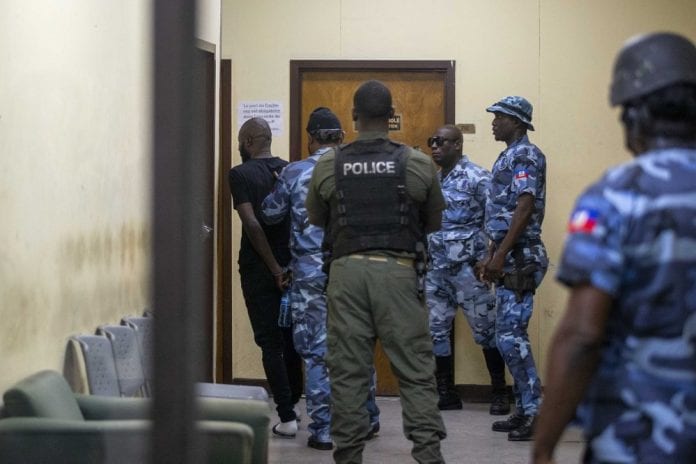
Washington also noted that while the Haitian National Police, an autonomous civilian institution led by a director general under the authority of the minister of justice, is responsible for maintaining public security, there were “credible reports” that members of the security forces committed human rights abuses.
The Human Rights report noted that gang violence escalated throughout the country, particularly in metropolitan areas, and the gangs allegedly received support from political and economic elites. “Kidnappings for ransom by armed gangs increased and affected all sections of society. Armed gangs were also responsible for armed conflicts resulting in approximately 20,000 displaced persons, for capturing up to ten police stations and substations, and for blocking fuel supplies in October and November, bringing economic life and freedom of movement to a virtual standstill.”
The report notes that in most, if not all of the Caribbean countries, significant human rights issues included credible reports of serious acts of official corruption, credible reports of degrading treatment of prisoners by prison officers and the existence of a criminal libel law, the criminalization of consensual same-sex sexual conduct between adults. trafficking in persons; and the worst forms of child labor.
There were also “significant human rights” issues such unlawful or arbitrary killings by police in at least three Caribbean countries.
The report noted that in Guyana, there have been “reliable reports that members of the security forces committed abuses.
In Jamaica, the report noted that significant human rights issues included credible reports of unlawful and arbitrary killings by government security forces, harsh and life-threatening conditions in prisons and detention facilities, arbitrary arrest, and detention.
It said there was also significant government corruption; a lack of investigation of and accountability for gender-based violence; and the existence of a law criminalizing consensual same-sex sexual conduct between adults, although the government did not enforce the law during the year.
In Suriname, where the security forces were also linked to human rights abuses, “significant human rights issues included credible reports of cruel and degrading treatment of individuals by police, serious and widespread acts of corruption and the existence of some of the worst forms of child labor.
“The government took steps to investigate, prosecute, and punish officials who committed human rights abuses, whether in the security forces or elsewhere in the government. Corruption cases were investigated, and the government implemented the laws on corruption effectively at times.”
Washington also reported that in Trinidad and Tobago “there were credible reports that members of the security forces committed some abuses.”
It said “significant human rights issues included credible reports of unlawful or arbitrary killings by police, refoulement of asylum seekers, serious acts of corruption, and human trafficking.
CMC/