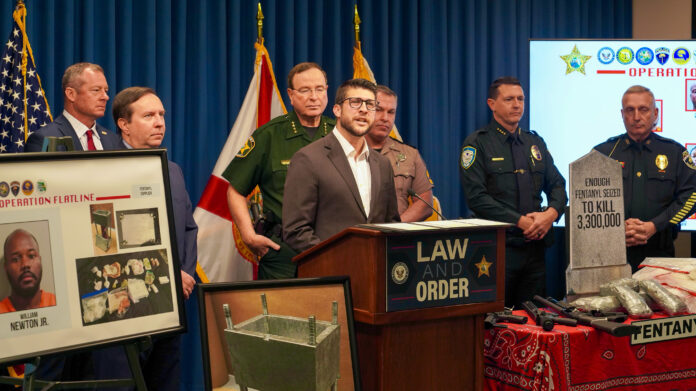
A sweeping multi-circuit drug trafficking investigation in Central Florida has led to dozens of arrests and the seizure of large quantities of narcotics tied to a gang-linked distribution network, state officials announced.

Attorney General James Uthmeier said the operation targeted affiliates of the Valentine Bloods gang and resulted in 51 arrests, along with the seizure of more than 70 pounds of methamphetamine and 10 pounds of fentanyl.
“This was a highly organized, fentanyl-pushing enterprise operating in Central Florida that had ties all the way to California,” Uthmeier said, adding that authorities will continue dismantling such organizations and prosecuting traffickers to the fullest extent of the law.

The joint investigation, launched in August 2025, involved the Polk County Sheriff’s Office, the Office of Statewide Prosecution and the Florida Department of Law Enforcement. Authorities said the probe uncovered a coordinated trafficking network spanning Polk, Hillsborough, Pasco and Orange counties, with additional links to California.
Law enforcement conducted surveillance from October 2025 through January 2026, intercepting communications related to drug transactions and distribution planning. Investigators determined that 14 of the defendants were connected to the Valentine Bloods gang.
According to officials, 35 defendants were charged in connection with the case, either for direct trafficking through hand-to-hand sales to undercover officers or for conspiracy to traffic based on recorded communications. Charges include trafficking in methamphetamine and fentanyl, conspiracy to traffic, racketeering and conspiracy to commit racketeering.
Grady Judd said the operation targeted traffickers responsible for devastating communities. “Traffickers of methamphetamine and fentanyl are literally murdering people and tearing apart families,” Judd said, praising officers who risk their lives to combat drug distribution networks.
Mark Brutnell, special agent in charge with the Florida Department of Law Enforcement, described the case as a model for dismantling organized drug operations, noting that coordination among investigators, prosecutors and state programs helped disrupt the network.
Authorities said 31 of the 35 defendants are currently in custody. One suspect was located in Kansas and is being extradited to Florida, while four others remain at large with active arrest warrants.