Haiti 'running out of time': UN Security Council warns
Key Points(5)
- “The situation is rapidly deteriorating,” Salvador said, noting that in just two months, over 1,000 Haitians were killed and more than 60,000 displaced, adding to the 1 million already uprooted by violence as of late 2024.
- She emphasized that the Haitian Government cannot stem the violence alone and called for urgent international support, particularly for the under-resourced Kenya-led Multinational Security Support mission.
- That mission currently has 1,000 personnel on the ground—less than 40% of its planned 2,500—according to Monica Juma, Kenya’s National Security Adviser.
- She stressed that despite limited resources, anti-gang operations are underway, and a rapid scale-up of personnel and equipment is essential to halt the spread of gang control.
- With 85% of Port-au-Prince now under the grip of armed gangs, the possibility of the capital falling “cannot be dismissed and cannot be allowed,” Denmark’s delegate warned.
The crisis in Haiti has reached an alarming turning point, with top international officials warning the UN Security Council that the country is teetering on the brink of collapse as armed gangs threaten to overrun the capital, Port-au-Prince.
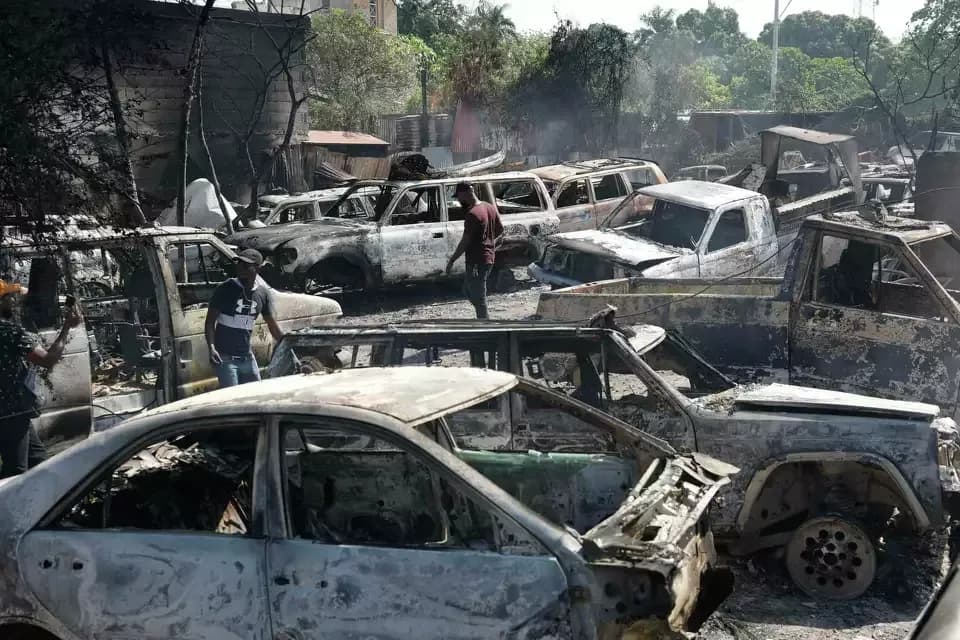
During a sobering Security Council meeting on Monday, María Isabel Salvador, the UN Special Representative for Haiti, declared that the country is approaching “a point of no return.” Criminal groups have intensified coordinated attacks since January, including the recent seizure of Mirebalais and the orchestrated prison break that freed over 500 inmates—the fifth such incident in less than a year.
“The situation is rapidly deteriorating,” Salvador said, noting that in just two months, over 1,000 Haitians were killed and more than 60,000 displaced, adding to the 1 million already uprooted by violence as of late 2024. She emphasized that the Haitian Government cannot stem the violence alone and called for urgent international support, particularly for the under-resourced Kenya-led Multinational Security Support mission.
That mission currently has 1,000 personnel on the ground—less than 40% of its planned 2,500—according to Monica Juma, Kenya’s National Security Adviser. She stressed that despite limited resources, anti-gang operations are underway, and a rapid scale-up of personnel and equipment is essential to halt the spread of gang control.
With 85% of Port-au-Prince now under the grip of armed gangs, the possibility of the capital falling “cannot be dismissed and cannot be allowed,” Denmark’s delegate warned. The Security Council was urged to increase pressure through sanctions, enforce the arms embargo, and bolster the Haitian National Police and judicial institutions.
But security is only part of the equation. Pascale Solages, a Haitian civil society leader and co-founder of the women’s group NÈGÈS MAWON, delivered an emotional appeal, highlighting the rampant sexual violence faced by women and girls and calling for a feminist approach to peacebuilding. “We refuse to be simply overlooked,” she said, demanding greater representation of women in decision-making and stronger protection mechanisms against gender-based violence.
International delegates were united in their condemnation of the escalating violence and its toll on Haiti’s civilians. Guyana, speaking on behalf of Algeria, Sierra Leone and Somalia, stressed that “the Security Council cannot resign itself to accepting the status quo.” Slovenia echoed this, urging full humanitarian access and implementation of the arms embargo.
The United States, while reaffirming its commitment, cautioned that it cannot carry the financial burden of Haiti alone and called on other nations to contribute. “An environment permissive to such maligned activities will only continue to fuel the gang violence,” the U.S. representative warned.
The conversation also turned geopolitical. China’s delegate sharply criticized the U.S., accusing it of failing to stop the flow of illegal arms from Florida and of “economic bullying.” Russia also questioned the effectiveness of the arms embargo, while calling for a Haitian-led solution to the crisis.
Despite the grim tone, Haiti’s Foreign Minister Jean-Victor Harvel Jean-Baptiste pointed to recent investments in national security—31 billion gourdes for police, 7 billion for equipment, and over 4 billion for modernizing the armed forces—as signs of progress. However, he admitted that the results have not matched expectations and urged continued international dialogue and cooperation.
Dominican Republic Foreign Minister Roberto Álvarez Gil closed the debate with a stark reminder: “We cannot stand idly by.” Haiti’s suffering, he said, is among the world’s top 10 conflicts to monitor in 2025—and requires decisive, united action now.
As the situation grows more dire by the day, the international community faces a critical test: Will it act boldly to prevent Haiti from descending into further chaos—or risk watching another nation fall into the hands of armed violence?