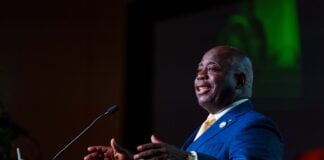
Guyana’s President, Dr Irfaan Ali, on Monday said that differences of opinion within the 15-member regional integration grouping, Caricom, should not be viewed as “divisive,” as he sought to soften the impact of recent tensions within the regional movement.

“While we must strive earnestly for consensus, a plurality of views, and at times divergence in perspectives are essential to the vitality of our deliberations,” Ali said while addressing a joint session of the Belize Parliament.
Ali, who is on a three-day state visit to the Caricom country, said that differing positions among member states can strengthen the regional bloc rather than weaken it.

“Such diversity sharpens analysis, strengthens decision-making, and ensures that outcomes are more inclusive and reflective of our lived realities. Respectful disagreements are not a source of fragmentation,” he said.
The Guyanese leader noted that Caricom has remained resilient and relevant for more than 50 years, despite a rapidly changing global environment, but acknowledged that reforms are necessary to ensure its continued effectiveness.
“It is now incumbent upon us to make the community stronger, more responsive, and better equipped to serve both the collective and national interests of our peoples. This requires renewal, commitment, and a shared sense of purpose,” Ali said.

Caricom leaders are scheduled to meet in St Kitts and Nevis from February 24–27. In recent months, however, the integration movement has faced renewed scrutiny, particularly from Trinidad and Tobago Prime Minister Kamla Persad-Bissessar, who has been critical of the bloc following her country’s support for the United States’ war on drugs in the Caribbean.
Last December, Persad-Bissessar said the regional organisation was “not a reliable partner at this time,” arguing that every sovereign state must be prepared to accept the consequences of its foreign and domestic policy choices. Her comments came as she defended the United States’ announcement of partial entry restrictions on nationals of Antigua and Barbuda and Dominica.
“Caricom cannot continue to operate in this dysfunctional and self-destructive manner,” Persad-Bissessar said, citing what she described as poor management, lax accountability, factional divisions, destabilising policies, and inappropriate meddling in domestic politics by some member states.

She also said that the organisation’s support for the then Nicolas Maduro regime in Venezuela — which has been accused of human rights violations and threatening Caricom members — further undermines its credibility. Persad-Bissessar insisted that the Caribbean cannot be described as a zone of peace, pointing to the region’s violent and deadly crime levels.