

Dominica’s President warns against war in the Caribbean amid U.S.–Venezuela tensions
Key Points(5)
- naval forces build up off the coast of Venezuela, Dominica’s President Sylvanie Burton has issued a firm call for restraint, declaring that the Caribbean must remain a “zone of peace” and urging Washington and Caracas to settle their differences diplomatically.
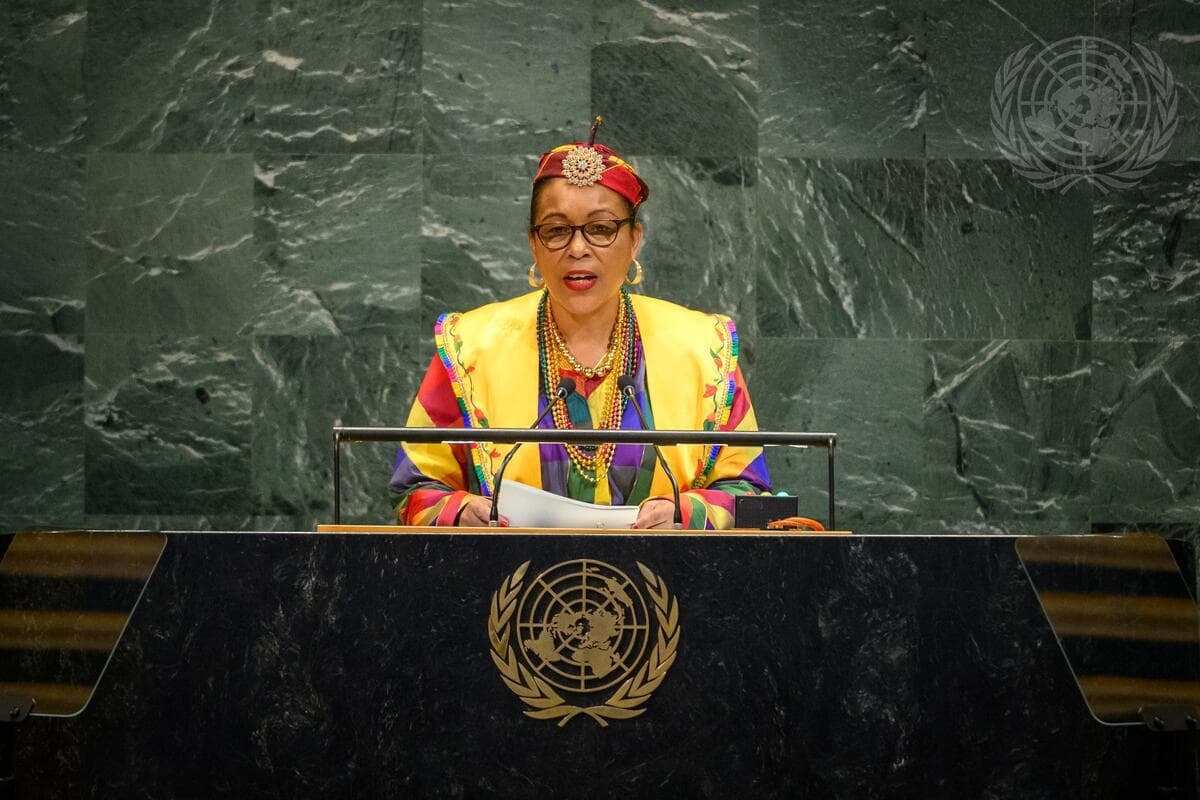
- “I want to emphasise here today that there is no place in the Caribbean for war,” Burton told world leaders during the general debate of the <a href="https://gadebate.un.org/en/80/dominica">80th United Nations General Assembly</a> on Thursday.
- “Any military conflict in the Caribbean will have significant negative impacts on the Caribbean and Latin America.
- There is a better way to resolve differences, we urge the powers that be to find another way.” Her appeal comes as the United States ramps up naval deployments near Venezuelan waters, officially to combat drug trafficking.
- The moves—combined with recent U.S.
As U.S. naval forces build up off the coast of Venezuela, Dominica’s President Sylvanie Burton has issued a firm call for restraint, declaring that the Caribbean must remain a “zone of peace” and urging Washington and Caracas to settle their differences diplomatically.
“I want to emphasise here today that there is no place in the Caribbean for war,” Burton told world leaders during the general debate of the 80th United Nations General Assembly on Thursday. “Any military conflict in the Caribbean will have significant negative impacts on the Caribbean and Latin America. There is a better way to resolve differences, we urge the powers that be to find another way.”
Her appeal comes as the United States ramps up naval deployments near Venezuelan waters, officially to combat drug trafficking. The moves—combined with recent U.S. strikes on boats allegedly carrying narcotics—have sparked fears of a broader confrontation. Venezuela has accused Washington of waging an undeclared war and has called for a U.N. investigation into strikes that killed more than a dozen alleged traffickers in recent weeks.
In her address, Burton condemned the use of force and called for strict adherence to international law, stressing that sanctions on Venezuela must end and that the country’s internal issues should be resolved without foreign interference. She also pressed for the lifting of the long-standing U.S. embargo on Cuba, describing the trade restrictions as “unjustified” and “belonging to a bygone era.”
Broadening her remarks, Burton warned that small island nations like Dominica bear the brunt when global powers engage in political, economic, or military confrontations. She highlighted climate change, poverty, and inequality as urgent issues that require united action, and renewed calls for U.N. reform to give small and developing states a stronger voice in global decision-making.
“The truth is simple yet profound: we are always stronger, wiser and better together,” Burton said, adding that she looks forward to the day a woman serves as U.N. Secretary-General as a true symbol of equality.
Her address underscored the Caribbean Community’s (CARICOM) longstanding stance that the region must remain free of conflict, even as geopolitical tensions rise just beyond its shores.



.jpg&w=3840&q=75)