The United States (US) State Department has confirmed that President Donald Trump is considering a travel ban targeting 36 countries, including four in the Caribbean.

State Department spokesperson Tammy Bruce said that while she could “speak a little bit about it, not into the detail of what,” the US remains committed to protecting its citizens by “upholding the highest standards of national security and public safety through our visa process in particular.”
“As laid out in President Trump’s Executive Order 14161, ‘Protecting the United States from Foreign Terrorists and Other National Security and Public Safety Threats,’ the visa adjudication process has got to ensure that U.S.-bound foreign travelers do not pose a threat to the national security and public safety of the United States. That is I think a very low bar and is a bar that every nation should be able to adopt,” Bruce told reporters at a press briefing on Tuesday.

Over the weekend, the Washington Post reported that Antigua and Barbuda, Dominica, St Kitts-Nevis, and St Lucia were named in a leaked State Department memo signed by Secretary of State Marco Rubio and circulated to US diplomatic missions — regarding potential travel restrictions. The memo reportedly cites concerns tied to these countries’ citizenship-by-investment programmes.
Under the CBI programme, foreign investors are granted citizenship in exchange for substantial contributions to national development. These four Caribbean countries have previously defended their CBI programmes as legitimate economic tools, citing strong due diligence measures.
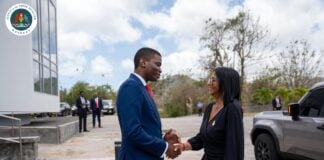
All four nations have stated they have not received official communication from Washington regarding the proposed travel ban. Antigua and Barbuda’s Foreign Affairs Minister E.P. Chet Greene responded to the reports, saying, “We will not be bullied. Our foreign policy is one of principle.”

Bruce explained that the US government evaluates countries based on security capabilities, information sharing, identity management practices, visa system abuses such as high overstay rates, and failure to repatriate removable nationals.
“So noting where a country perhaps, as you did, is located, the geoposition – the actual location – of a country is not a factor, or what continent that country is on. These are about very specific aspects about whether or not the United States feels it can trust the information we rely on those countries for to determine whether or not they’ll get a visa. We don’t – we rely on the vetting and the presentation of information from other nations in order to say yes, you can or you can’t come.”
In this case, she said, “I think that it’s clear as we’re looking at providing a period of time, countries being told if they don’t – they don’t get to that point where we can trust them, then they’ve got to change the system, update it, do whatever they need to do to convince us that we can trust the process and the information they have.”

“So that is the goal of this. The Secretary will have the discretion to determine whether or not someone is on that list as we then also continuously vet the nature of what’s happening within these conversations, and the goal is so that we can all move forward, so that people can come to the country, and that’s our goal,” Bruce added.
One major concern is the sale of citizenship without a residency requirement. The memo also cites alleged incidents of “anti-American activity” in the US by nationals of the listed countries.
However, it notes that countries agreeing to accept third-country nationals deported from the US, or those willing to sign a “safe third country” agreement, may alleviate some concerns.
In addition to the Caribbean countries, the list includes 25 African nations, along with several from Central Asia and the Pacific.
According to the Washington Post, the memo gives affected governments 60 days to meet new benchmarks. Countries were given a deadline of 8:00 am on Wednesday to submit an initial action plan outlining how they intend to comply.
When asked about the Wednesday deadline and whether countries had submitted any action plans, Bruce said: “I can just tell you that that’s not correct. The fact is, is that they will have a considerable amount of time to rectify whatever the situation is that the State Department is determined is affecting the nature of our trust in how we issue a visa.”