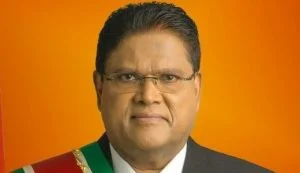
Suriname’s President Chandrikapersad Santokhi says the presence of military troops from overseas is not intended to keep his administration in office as well as to help the government deal with a spate of protests in recent months.
“The social media machine in Suriname is running perfectly, I can say that. One of the reports was that the government had called in the assistance of the Dutch army to ensure that no demonstrations would take place. Assistance for maintaining order,” President Chandrikapersad Santaokhi said as more than 200 Dutch and American soldiers arrived here to participate in the jungle training in the Ayoko Barracks in the Para district.
“Even crazier was the second message. It came as a concern that the Dutch army was here to arrest certain persons in certain mega crimes. My people, nothing could be further from the truth,” he added.

“The army of the Netherlands is here to train with the Surinamese army, to practice, to support each other, to create trust. Wars are not fought by one army but a collective. There must be a good understanding, high morale. Skills are learned, a foundation of trust is created if we wish to fight collectively against cross-border issues,” President Santokhi told the opening ceremony.
Last Thursday, the government and the business community said they would not accept a repeat of ‘February 17’ when protesters stormed the National Assembly and looted several businesses.
Minister of Justice and Police, Kenneth Amoksi, told a news conference ahead of a planned demonstration that although a number of people had been detained in connection with regards to the incident, some are yet to face the courts.

So far, 112 persons suspected of gross and violent looting, theft, vandalism and sedition have been identified and taken into custody.
“The people will all be brought to justice,” said Amoksi, adding “there are agreements with the judiciary to get all these people tried through a fast-track procedure”.
Last Friday, armed police and members of the army ringed the National Assembly building as a four-member delegation handed a proposal for a draft electoral law to the leadership of the National Assembly (DNA).

The training program will last until the end of May and Santokhi said armies are no longer solely responsible for “the classic threats.
Armies are also there to support the international legal order, to defend the rule of law together with civil authorities, to deal with cross-border issues,” he added.
CMC/