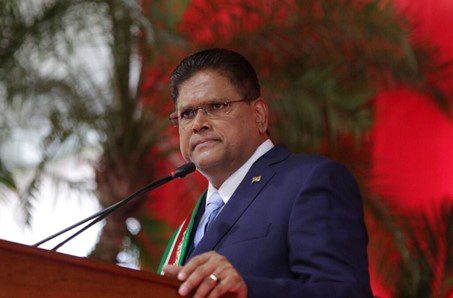
While CARICOM has not yet reached an agreement on whether bloc leaders will attend the upcoming Summit of the Americas, the government of Suriname has served notice that it does not support a proposed boycott.

According to Minister of Foreign Affairs, International Business, and International Cooperation Albert Ramdin, while President Chandrikapersad Santokhi agrees with CARICOM that the leaders of Cuba, Nicaragua and Venezuela should be invited to the event, he believes the regional bloc should avoid making an emotional decision on the matter.
“The president favors a realistic and pragmatic approach,” Ramdin said.

According to Suriname’s President, the advantages of participating in the June 6-10 summit in Los Angeles at the highest political level should be weighed against the disadvantages of not attending.
According to Minister Ramdin, if the US does not give in to demands that Cuba, Nicaragua, and Venezuela be allowed at the summit, CARICOM leaders have options other than boycotting the event to show their disapproval, including attending under protest, and sending representatives at a lower political level.
The US has argued that the governments of Cuba, Venezuela, and Nicaragua have shown that they do not respect democracy and therefore will not receive invitations to the summit.

But CARICOM leaders are adamant that as part of the Americas, those countries should not be excluded. South American and Central American countries are also in agreement. On Tuesday, Mexico announced that if the three did not receive an invitation from US President Joe Biden, President Andrés Manuel López Obrado will not participate in the conference.
In a leaked discussion paper, CARICOM advisers reportedly recommended that the leaders attend the summit, which has on its agenda, security, the climate crisis, economic development, and the consequences of the Russian military invasion of Ukraine. Suriname agrees.
Minister Ramdin said if the region wants to influence decisions made during summits, the leaders must be there to present their positions and views.

“The Cuba-US issue is not new, and we also need to consider bilateral relations with other countries. Self-interest should not be forgotten,” he suggested. “We remain in solidarity, but you can’t really afford not to go.”
CARICOM leaders are expected to discuss the issue a third time on Sunday.
CMC/