



When the Cornwall Regional Hospital (CRH) was opened in 1974, two years after its construction, it was the only type A health institution providing specialist services outside Kingston, Jamaica. Rising ten stories tall with 450 beds, it was also the first hospital built after the University Hospital was opened, 21 years before.

Constructed to meet the needs of Western Jamaica, it serves as the major hospital in the area and complimented the Noel Holmes in Hanover, Falmouth Public General in Trelawny, and the Savanna-La-Mar hospital in Westmoreland.
The hospital provides the four core services of general surgery, obstetrics and gynecology, pediatrics, and internal medicine. Additionally, it offers a comprehensive list of health specialties, making it a crucial multidisciplinary healthcare provider in Jamaica.

Cornwall Regional Hospital very important to Jamaica
In its heyday, the facility discharged an average of 18,000 patients and recorded 73,000 visits per year. Service delivery at the hospital was so good that the institution won the prestigious Prime Minister’s Trophy for the ‘Best Customer Service Entity’ in 2013.
CRH’s importance to the region is further underscored by the location of Jamaica’s tourism engine – Montego Bay. In 2017 Jamaica’s Ministry of Health stated in its annual report that CRH’s “position in the tourism mecca of the country makes any decrease in services a threat to the economic well-being of the country.”
Approximately 70 percent of Jamaica’s tourists enter through Montego Bay’s Airport each year. In 2019 that figure was close to 5 million.
To say that Cornwall Regional Hospital is important to Jamaica is an understatement. So when operations halted in 2017, it was a scary experience for users, workers, and the government.
Air quality problems
Between 2007 and 2017, a health ministry report indicated “intermittent air quality issues” at the facility. The problem escalated in late 2016, which resulted in service disruption.
After environmental testing was done to find the cause of the problem, it was revealed that the “presence of high levels of humidity and mold growth” was the primary culprit. The report stated that the problem was present throughout the hospital but more so in enclosed areas. It was also revealed that “fiberglass particles” existed in some areas. When inhaled the substance can irritate your eyes, skin, and respiratory tract. High levels of inhalation can also cause bronchitis-like conditions, and asthma sufferers may feel worse.

Problems anticipated 49 years ago
The problems that initiated the lockdown was anticipated 49 years before, however. In fact, before a block was laid, there were discussions about the drawings and the pending construction that were oblivious to Jamaica’s climate conditions, according to the former mayor of Montego Bay, Shalman Scott.
In a report carried by the Jamaica Observer in 2021, Mr. Scott said: “It’s a long-standing problem. When the official opening was done in 1968 to start the building of Cornwall Regional Hospital, there was a controversy about the building plan which was not drawn in Jamaica. It came from one of the states in the United States that have very heavy winter.”
Scott told the Observer, “The signs have been there all along. In a tropical climate, having that framework was going to create problems, which is what we are experiencing now.”
Relocation of services
To solve the problem, managers took several steps to relocate services and repurpose facilities, and the Jamaican government budgeted $4 billion to undertake rehabilitation work. The work was scheduled to be completed in 2019.
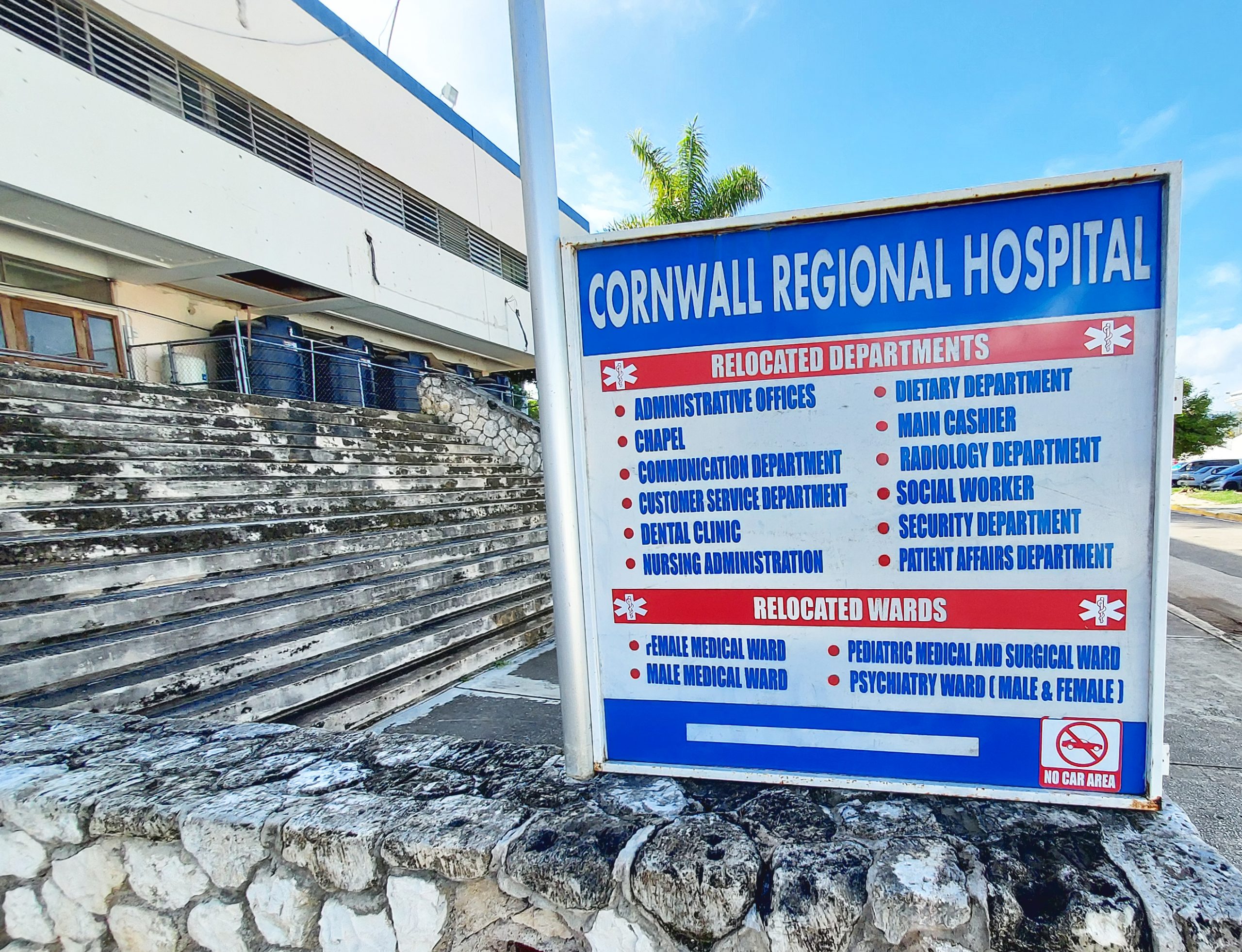
Relocations included:
- The clinics and Physiotherapy Department to the Western Jamaica Conference Center (located next door)
- Obstetrics and Gynecology clinic to the Barnett Clinic (located within five minutes)
- Intensive Care Unit and surgical services to Falmouth (located 36 minutes, around 22 miles away)
- Accident & Emergency Department to the Mount Salem Health Centre
- Lab services to containers on the property.
- Pharmacy services to on and off-campus locations
The nurse residencies and four buildings at the back of the hospital were converted into wards. The building still offers services in radiotherapy, morgue services, and cancer care.

As a result of the relocation and repurposing, the number of available beds at the hospital was reduced to around 280. There was a significant disruption in services, and the public became outraged.
Service delivery went from bad to worse in 2020 when the COVID pandemic hit Jamaica. Senior Medical Officer (SMO) Dr. Derek Harvey, who oversees the facility’s medical affairs, told CNW that providing services from extended service locations in 2017 was difficult initially, but it got easier with time. “We were still able to deliver services; however, in 2020, the covid pandemic created further difficulties,” he said.

The issue with the pandemic, according to Dr. Harvey, was that they now have repurposed areas that needed to be converted. He pointed out that from the covid experience, the hospital converted four containers into dependency units, which now function as a critical care unit.
Regarding the significant overcrowding of the critical care facility, Dr. Harvey said that it is due to many problems. These include persons coming to the clinic who are non-compliant with their medications, the need for careful investigation of patients’ health issues, and the government’s program to offset patients’ expenses which created a demand oversupply situation. He also pointed out that the hospital suffers from high attrition of medical practitioners, especially nurses. “Nurses that are double trained are the most sought after by the UK, Canada, and the USA,” he suggested.
Frustration and understanding from staff
He admitted that some medical staff displays an understandable frustration with the new operation, due mainly to logistic issues. Currently, the lab area and the wards are at opposite ends of the hospital. As a result, medical practitioners require transportation to take patients to that point of care which may not be available consistently. It means adhering to time constraints and schedules going to and coming from the point of care. Then there is the issue of staff not being able to do all the tests that are required for a patient.
CNW spoke with one male medical staff who expressed his frustration with the logistic issues. “It is really challenging to deliver services in such an environment. We want to do the best for our patients but it is an uphill task, especially for those patients that cannot be transported,” he said. In spite of the challenges, he maintained that he was there to do his best work and will do everything to achieve that goal.
Dr. Harvey said others see the situation for what it is and have decided to make it work. This he said is because “we live here, our families live here, and we tell ourselves to do what is necessary to make it happen.”
With these issues, adequate communication is essential, he insisted. “Whereas previously most medical practitioners were from the University of the West Indies and some from Cuba, now the country or region of origin and training has become more diversified. Today we have people from as far as China. Previously with most persons coming from the Caribbean and more so the UWI, we speak one language and do things a certain way; now we have to understand how everyone was trained and how that training can be integrated into our systems and operations.” Currently, nearly 250 medical personnel are working to deliver services at CRH.
Negative public sentiments of Cornwall Regional Hospital
The SMO is aware of the negative sentiments from the public. “For the group of persons who see things negatively, we understand because health is very important. But remember that most of the persons who deliver your medical services live here and have relatives who do as well. They are trying to deliver the services and within the barriers of ethical standards. One understands the frustration regarding service delivery, but where you can find a way to encourage, please do so because we all want to deliver the best of services to our community.”
He said he is happy his team can still deliver services, despite the challenges. “At the end of the process, I hope people will see the building as belonging to them and care about it because a big effort was made to fix the problems. It does not belong to the government.”
The rehabilitation work at CRH is now projected to be completed by 2024, six years after it started and four years past the original deadline.
The government recently hired a “US-based commissioning agent firm” to help strengthen the quality assurance functions of the project.
In another two years, beds at the hospitals are also expected to increase by about 800 with the completion of the Western Children and Adolescents Hospital, located just behind Cornwall Regional.

While the public in Western Jamaica waits another two years to get back services at the once top-notch health facility, many are hoping that the region doesn’t experience any significant disasters that would require the kind of service delivery expected from Cornwall Regional.












 continues to deliver services despite of challenges.)