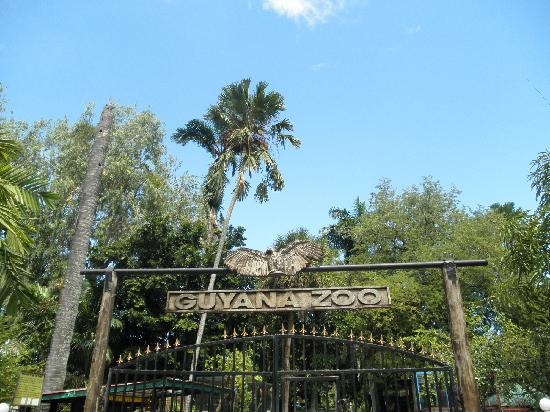
The Guyana government has expressed its intention to attract private investors to develop a safari-style zoo that focuses on wildlife conservation. During a public consultation on the restoration of the Zoo and Botanical Gardens, Vice President Bharrat Jagdeo emphasized that the project will prioritize wildlife conservation and aim to create interactive spaces to educate visitors about the country’s rich biodiversity. Jagdeo noted that the government recognizes the tourism potential and exciting experiences that a safari-style zoo could offer to Guyana.
Generally, this model is one where visitors can drive through large enclosures to view animals in more natural settings, similar to a real safari. It often features a drive-through experience, allowing visitors to observe animals from their vehicles.
“We believe that you can have a safari-type zoo in the country, where animals are just out in the open. And we want to issue a prospectus where we will give support to any private investor who wants to do this arrangement,” he said.

Jagdeo told the consultation many people in the region may have never seen or experienced this kind of model, or had the opportunity to interact with the many exotic animals Guyanese are familiar with.
“We believe that in the Caribbean, this would be a huge draw to Guyana,” he said, adding that the restoration of the National Zoological Park and the Botanical Gardens is not primarily focused on providing sensational wildlife exhibitions.
“This is not the only opportunity,” he said, noting that many of the other revenue-generating measures and wildlife experiences would be better suited to a safari-style zoo.
“There is a private zoo being developed on the East Bank too, so people can go to different places. This [national zoo] has a slightly different purpose, so it is not one where we have a large number of animals, and keep them in cages and things like that. It is a different concept.”
Jagdeo said rather, the upgrades to these areas are aimed at exposing visitors to Guyana’s diverse landscapes, while bringing greater awareness to the climate challenges faced by the country and the various ways these are being tackled.
The upgrades to these areas are aligned with the expanded Low Carbon Development Strategy (LCDS 2030), which emphasises biodiversity protection, water management, the maritime economy, climate adaptation and the energy transition.

Similarly, the government in partnership with the Guyana Forestry Commission (GFC) has a wider plan in place to transform and beautify Guyana’s urban landscape.
Through this partnership, an estimated 50,000 flowering trees will be planted along the urban area, including on the East Bank Demerara, the Soesdyke-Linden Highway and in Georgetown.