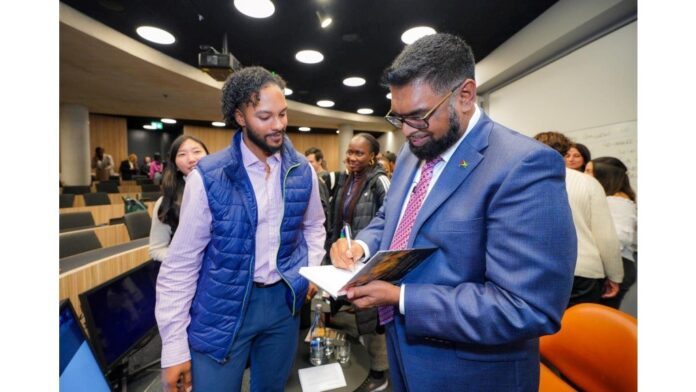
Guyana’s President Dr. Irfaan Ali has unveiled a new publication that offers a comprehensive overview of the causes and challenges of food security in the Caribbean and the global community. Titled “Achieving Global Food Security: The Caribbean Experience and Beyond,” the book was launched at the Blavatnik School of Government at the University of Oxford on Saturday.

In this publication, President Ali, who is leading the Caribbean Community’s (CARICOM) ambitious 25 by 25 plan to reduce food imports by 25% by 2025, explores strategic policy recommendations aimed at addressing food security challenges. The region is currently grappling with soaring food and fertilizer prices and labor displacement, exacerbated by the ongoing impacts of the Covid-19 pandemic and other global disruptions, including supply chain issues and increasing climate-related events.
The book begins by examining the global food security crisis and the repercussions of these shocks. It provides a macro-level overview of the Caribbean, highlighting the region’s investment capabilities in agriculture. The findings reveal only a slight increase in private sector investment in agriculture amid rising inflation, which has heightened vulnerabilities in food security—deteriorating significantly in 2020 and reversing nearly a decade of progress against climate change.

The publication pays close attention to food vulnerabilities across 14 Caribbean countries. In the concluding chapter, it outlines a series of policy measures designed to enhance the region’s food security, emphasizing innovation and leveraging the Caribbean’s comparative advantages.
The book outlines an innovative pathway to achieving freedom from hunger by leveraging the Caribbean’s comparative advantages and potential for agricultural investment. Published in collaboration with World Scientific Publishing, it serves as an essential research resource for scholars and professionals seeking insights and solutions related to food security, international development, and Caribbean studies.
Additionally, the publication features a chapter that highlights ongoing and future initiatives in Guyana. Renowned professor and UNESCO chair Amitav Acharya has praised the book as a timely and crucial contribution to addressing one of the most pressing global challenges.