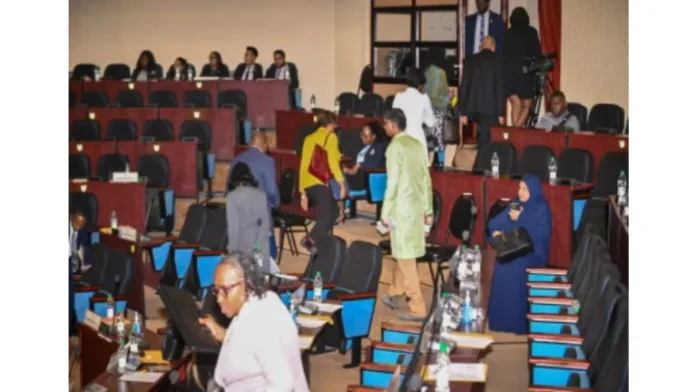
Opposition members of Guyana’s Parliament staged a walkout on Friday, accusing the Irfaan Ali administration of excluding them from crafting a motion denouncing Venezuela’s renewed claim to the oil-rich Essequibo region.

The peaceful exit from the National Assembly came moments after Foreign Affairs Minister Hugh Todd introduced the motion, which reaffirmed Guyana’s sovereignty and condemned Venezuela’s defiance of international rulings. As opposition lawmakers made their exit, members of the government benches shouted “shame” in response.
The motion, introduced by Todd, called on the Parliament to “unequivocally reaffirm the sovereignty, territorial integrity, independence, and indissolubility of the Cooperative Republic of Guyana.” It also reiterated Guyana’s recognition of the 1899 Arbitral Award and the 1966 Geneva Agreement, and denounced Venezuela’s defiance of a May 1, 2025, order from the International Court of Justice (ICJ), describing Caracas’ actions as threats to peace and violations of international law.

“It is important for Venezuela to understand that Guyana will not be bullied, threatened, or intimidated to surrender any portion of our patrimony,” Todd told the Assembly, adding that the motion was a reaffirmation of Guyana’s decades-long commitment to diplomacy and international law.
But Opposition Leader Aubrey Norton slammed the government’s appeal for bipartisan support as “selective,” and urged that the motion be withdrawn and rewritten with input from the opposition.
“You need to instill hope in the people of Guyana. Nothing that has been said today instills hope. You come over as a hopeless bunch depending on the ICJ,” Norton said. “We support the move to the ICJ, but we are well aware that Venezuela doesn’t honor agreements.”
Norton criticized the government’s failure to outline contingency measures should Venezuela act against the ICJ’s order, and accused the administration of disregarding Opposition proposals.
“We obviously have ideas probably more than the government but you choose to exclude us to your own peril,” he told Parliament. “On this issue, unilateralism will not succeed. Venezuela is an adversary whom we must confront together.”
Norton also denounced the government’s lack of a defined foreign policy to build international backing for Guyana’s claim to Essequibo, a region that comprises roughly two-thirds of the country and is home to around 125,000 people.

His remarks followed Venezuela’s recent announcement of elections for the Essequibo region, despite the ICJ unanimously reaffirming provisional measures barring such actions.
Prime Minister Mark Phillips called the move “unlawful,” stating, “To elect a governor for Guayana Esequiba is unlawful because the state, Guayana Esequiba, does not exist. There is no such state in Guyana.”
He added that only Guyana’s elected Regional Democratic Councils have legal authority over the territory.
Norton argued that the government had also failed to launch a sustained public education campaign and again called for the establishment of a commission on the territorial dispute — a proposal the government has previously rejected in favor of a largely inactive parliamentary committee.
“They adverted to the view that the parliamentary committee on foreign affairs can serve the same purpose, and we stated at the time that the committee was not meeting,” Norton said. “It met once, and never again.”
He warned that the government’s approach to diplomacy was inadequate and pointed to several ignored Opposition suggestions, including deploying special envoys, publishing full-page Spanish-language ads in regional newspapers, and launching a robust social media campaign.
“You believe in parachute diplomacy — touch them at the conference, get support. You need to do more than that,” Norton said.
Recalling bipartisan collaboration on a similar motion in 2023, Norton said the government’s decision to proceed without consulting the Opposition this time had broken trust.
“We are therefore not obligated to support this motion since it is you, the government, that has breached our trust and operated arbitrarily,” he said, adding, “We urge you to come back to the table and let us work on a motion that all Guyanese will be happy with.”
The opposition walkout leaves the government’s motion intact but politically contentious, as the border controversy with Venezuela continues to escalate.